Get Full Government Meeting Transcripts, Videos, & Alerts Forever!
Get email alerts on the Cattle Checkoff Study topic
No spam. Unsubscribe anytime.
Committee concurs to study Montana Cattle Committee and possible state cattle checkoff (HJ 52)
Summary
The Agriculture, Livestock and Irrigation Committee voted to concur with House Joint Resolution 52, approving a stakeholder-driven study of a Montana Cattle Committee and the feasibility of a state cattle checkoff after proponents from industry groups testified and members discussed legal and structural questions.
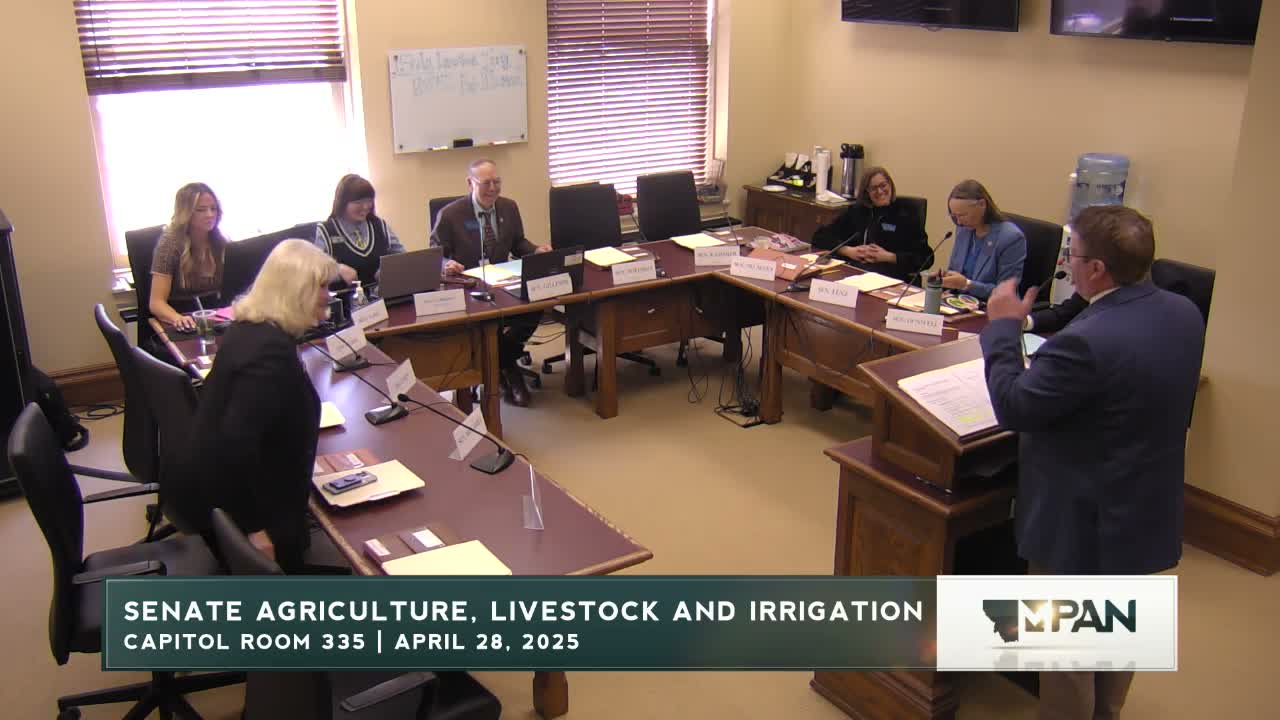
The Agriculture, Livestock and Irrigation Committee voted to concur with House Joint Resolution 52 on a voice vote, approving a stakeholder-driven study to examine creating a Montana Cattle Committee and the feasibility of a state cattle checkoff.
Representative Eric Tillman, sponsor of HJ 52, told the committee the resolution would launch a stakeholder study "to explore how Montana can strengthen its cattle industry through potential state level assessment and creation of the Montana Cattle Committee, ensuring long term sustainability, profitability, and market competitiveness." He described the measure as a study-version of prior legislation intended to resolve outstanding details before any broader action.
Proponents told the committee they support the study as a way to work through implementation questions. Karli Johnson of the Montana Farm Bureau Federation said the federation "consistently had broad support" for the concept and that a study would "flush out some of the mechanics" so producers could consider options. Rachel Prevost of the Montana Farmers Union said her organization supports an additional checkoff in concept and asked to participate in stakeholder discussions to identify the best approach.
Jim Steinbeisser, a member of the working group that has developed the idea, told members the topic is complex and has required many meetings. He said models vary across states and flagged a legal question: the group debated whether to use an existing beef council for a state checkoff or create a separate entity, noting "a question of constitutionality" that the study should examine. He also pointed to examples in other states and described a wide range of approaches from formal checkoffs to large appropriations.
Senator McCamey asked witnesses to summarize other states' approaches; witnesses cited Texas and North Dakota among others and recommended the study evaluate existing models and "piggyback" successful elements for Montana. Committee members expressed support for further discussion and additional stakeholder input during the study.
After discussion, the committee proceeded to executive action. The committee moved to concur with HJ 52 and the chair called for a voice vote. Members in the room voted aye and the chair declared the motion carried. Committee members later noted that proxies from absent members were assumed as affirmative votes; specific roll-call tallies were not recorded in the hearing transcript.
The hearing concluded and the committee adjourned.
Next steps: the committee has concurred with House Joint Resolution 52; the resolution will advance according to legislative procedure for study resolutions and stakeholders indicated they expect the study to examine constitutional questions, governance options and models from other states.