Get Full Government Meeting Transcripts, Videos, & Alerts Forever!
Get email alerts on the Taxation topic
No spam. Unsubscribe anytime.
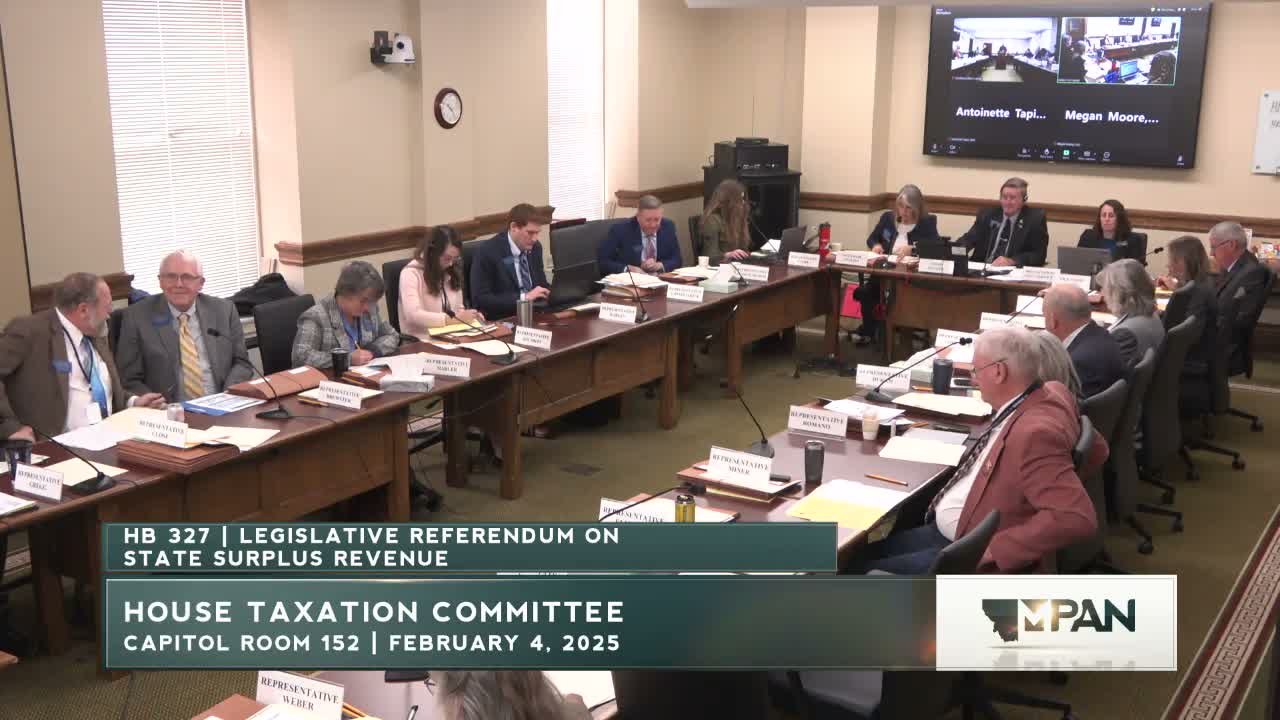
Committee hears bill asking voters whether excess income-tax revenue should be returned to taxpayers
Summary
Representative Caleb Hinkle asked the committee to approve HB 327, a legislative referendum request that would ask voters whether the legislature should create an automatic system to return excess income-tax revenue. Budget and social-service groups warned that an automatic refund mechanism could impair future legislatures' flexibility to respond to economic downturns and fund essential services.
Representative Caleb Hinkle introduced House Bill 327 as a request for a referendum asking Montana voters whether the legislature should establish a program to return excess income-tax revenue automatically to resident taxpayers. Hinkle said the idea grew from constituent conversations and noted past over-collections in 2023 and earlier sessions; he estimated roughly $700 million in over-collected income tax currently sitting in state funds and emphasized that HB 327 would not itself implement refunds but would ask the voters whether such a system should be created by a future legislature.
Opponents from the Montana Budget and Policy Center and the Montana Coalition Against Domestic and Sexual Violence urged the committee to oppose the bill, arguing an automatic refund mechanism would constrain future appropriations and make it harder to respond to economic downturns or urgent needs such as childcare, law enforcement and shelter services. Witnesses pointed to Colorado's Taxpayer Bill of Rights (TABOR) as an example that created broad constraints on spending and that some states have experienced fiscal stress after establishing similar rules.
Committee members asked technical and constitutional questions, requesting legal review and fiscal analysis. Sponsor Hinkle said the referendum is intended to build public momentum and leave room in the implementation structure for rainy-day funds and exceptions for critical services. He also said similar mechanisms exist in other states and that the bill is an "ask" to voters rather than immediate statutory change.
Ending: The hearing closed after questioning. No committee recommendation was recorded; members asked staff to ensure legal and fiscal reviews are accessible for future consideration.