Get Full Government Meeting Transcripts, Videos, & Alerts Forever!
Get email alerts on the Urban Renewal topic
No spam. Unsubscribe anytime.
Bill to clarify 'blighted area' definition for urban renewal wins broad support in committee
Summary
Senate Bill 1 aims to modernize and tighten Montana's statutory definition of "blighted area" to guide use of tax increment financing (TIF) for redevelopment. City officials, municipal associations and business groups said clearer criteria will help local decision-makers and support infrastructure investment.
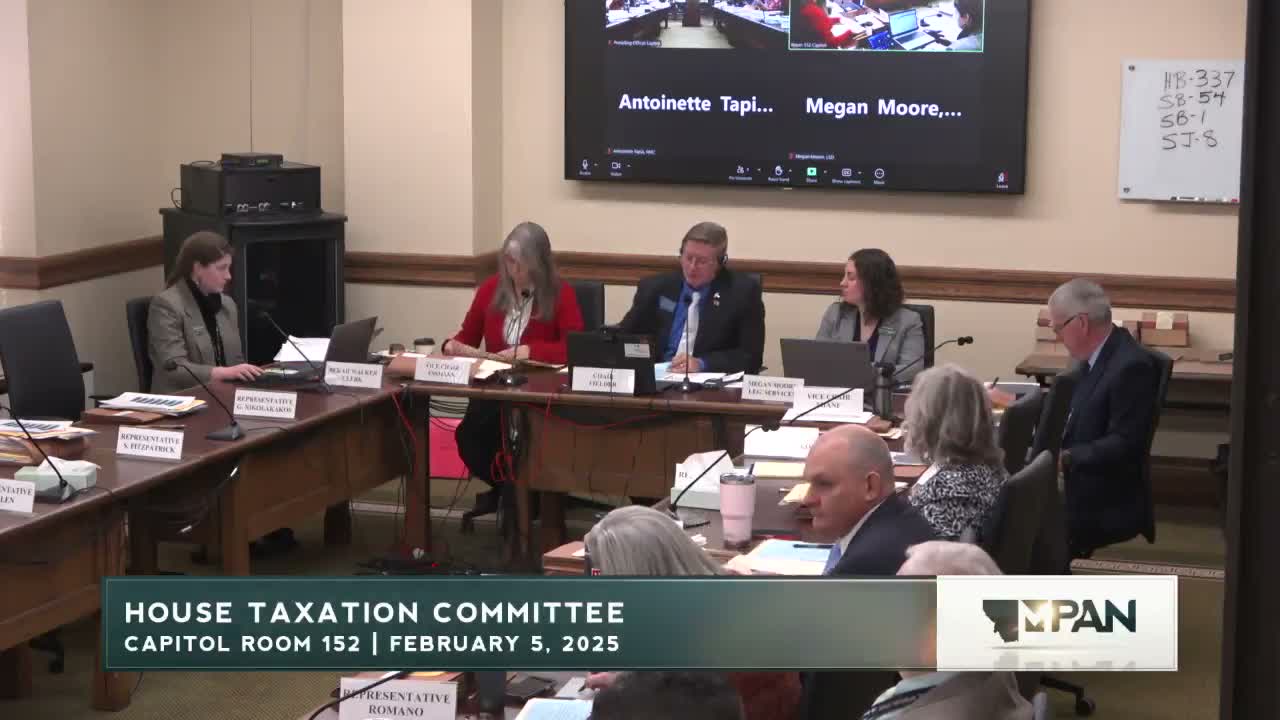
Senator Greg Hertz introduced Senate Bill 1 to the House Taxation Committee, saying the proposal updates and consolidates duplicated statutory language to clarify what constitutes a "blighted area" for municipalities using tax increment financing or urban renewal powers.
"For those of you, why is blight so important?" Hertz asked, then explained the bill's intent to ensure TIF districts are used to improve areas that are injurious to public health, safety and welfare. He said the bill grew from work by the revenue interim committee and incorporated amendments from the League of Cities and Towns.
Proponents from municipalities, local governments and business organizations testified in favor. Danny Hess (City of Bozeman) said the change would simplify criteria for local decision-makers and emphasize physical infrastructure needs and vacant or dilapidated properties requiring investment. Jennifer Olson (Government Affairs Director, Montana League of Cities and Towns) said the bill provides structure for identifying blighted properties so communities can turn them into assets through urban renewal districts.
Business and infrastructure groups including the Hospitality and Development Association of Montana, the Montana Chamber of Commerce and the Montana Infrastructure Coalition said clearer statutory language would help spur redevelopment and allow TIF to be used for curbs, wastewater systems and road paving. Proponents noted the statute had longstanding language that had not been updated in some sections since 1959.
Representative Durham asked about a policy sentence stating the legislature "finds and declares blighted areas exist within municipalities;" Hertz replied it was a policy statement to reinforce the purpose and limits of TIF spending. Hertz closed by highlighting the bill's requirement that a prospective TIF area meet at least three enumerated characteristics in statute.
Committee members heard the proponents' testimony; no opponents appeared. The sponsor requested the committee advance the bill for further consideration.