Get Full Government Meeting Transcripts, Videos, & Alerts Forever!
Get email alerts on the Taxation topic
No spam. Unsubscribe anytime.
Montana committee hears bill to tax most electricity generation; industry warns 10% levy would deter investment
Summary
Representative Gary Perry defended HB 326 as a way to capture "legacy dollars" from exporters of Montana energy by extending a severance-like tax to non-coal generation and creating an energy authority. Utilities, developers and conservation groups testified that the bill functions as a 10% sales tax, would raise consumer costs and could push projects out of state.
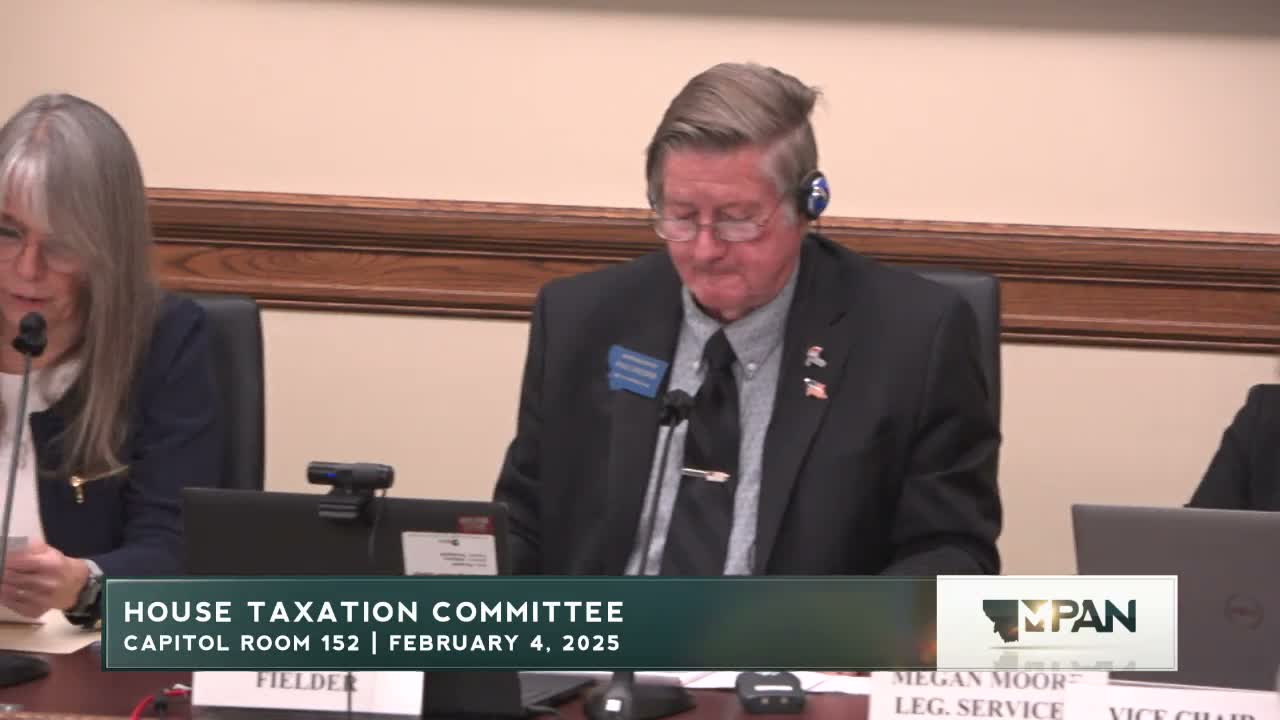
Representative Gary Perry opened a lengthy hearing on House Bill 326, telling the House Taxation Committee he wants Montana to receive long-term "legacy dollars" when out-of-state buyers take electricity generated in the state.
Perry said the bill would broadly apply a severance-style charge to most electricity produced in Montana while excluding coal (which currently pays a 15% severance tax that he proposes lowering to 10%) and noncommercial or agricultural on-site generation. He also proposed creating a state energy authority and directing funds into an energy severance tax trust and a capped permanent fund of up to $250,000,000 to finance projects and staffing.
Opponents from across the energy sector and local governments urged the committee to reject the bill. Bruce Spencer, representing the Montana Energy Business Alliance, said the measure "is not a severance tax. It's a 10% sales tax" on project revenues that developers must reflect in bids and which would threaten purchase-power agreements and project financing. Ryan Hall of the Montana Electric Cooperatives Association warned that severance assessments on power supply would directly increase rates for co-op members.
Utilities and project developers said Montana generation is already at a competitive disadvantage because of transmission costs. Alan Olsen of Northwestern Energy told the committee that adding 10% to generation costs "will raise the cost of electricity ... You'll see that on your power bill." Representatives of NextEra, Puget Sound Energy and multiple regional developers said the levy would reduce or eliminate future investment in Montana projects; Puget Sound Energy estimated the Beaver Creek wind project would face roughly $8 million in additional tax annually.
State and local agencies raised other impacts. Trevor Watson of the Department of Natural Resources and Conservation said the tax would reduce revenues from the Broadwater hydropower project and other state water projects by an estimated $150,000 per year, constraining maintenance and rehabilitation. The Montana Association of Conservation Districts warned the change could imperil operational funding for rural conservation districts that currently receive coal severance-related distributions.
In committee questioning, members pressed the sponsor and witnesses on export volumes, tax mechanics and whether Montana-generated power sold out of state can be fairly apportioned. Revenue staff said they lacked an exact percentage but that "the majority of the coal is shipped." Witnesses repeatedly called out definitional and enforcement questions for a tax that would be applied to either sales price or contract revenues, particularly for rate-regulated utilities that do not set a discrete sales price.
Perry closed the hearing by reiterating that he seeks to leave a legacy for Montana communities and to place Montanans' long-term interests ahead of short-term competitiveness concerns.
The committee did not vote on HB 326 at this meeting; the hearing record will inform any future work, amendments, or executive action.
Ending: The committee closed the hearing after extended testimony and questioning. No formal recommendation was recorded during this session; committee staff and members indicated multiple technical and constitutional questions remain to be resolved before any movement on the bill.