Get Full Government Meeting Transcripts, Videos, & Alerts Forever!
Get email alerts on the Voting Rights topic
No spam. Unsubscribe anytime.
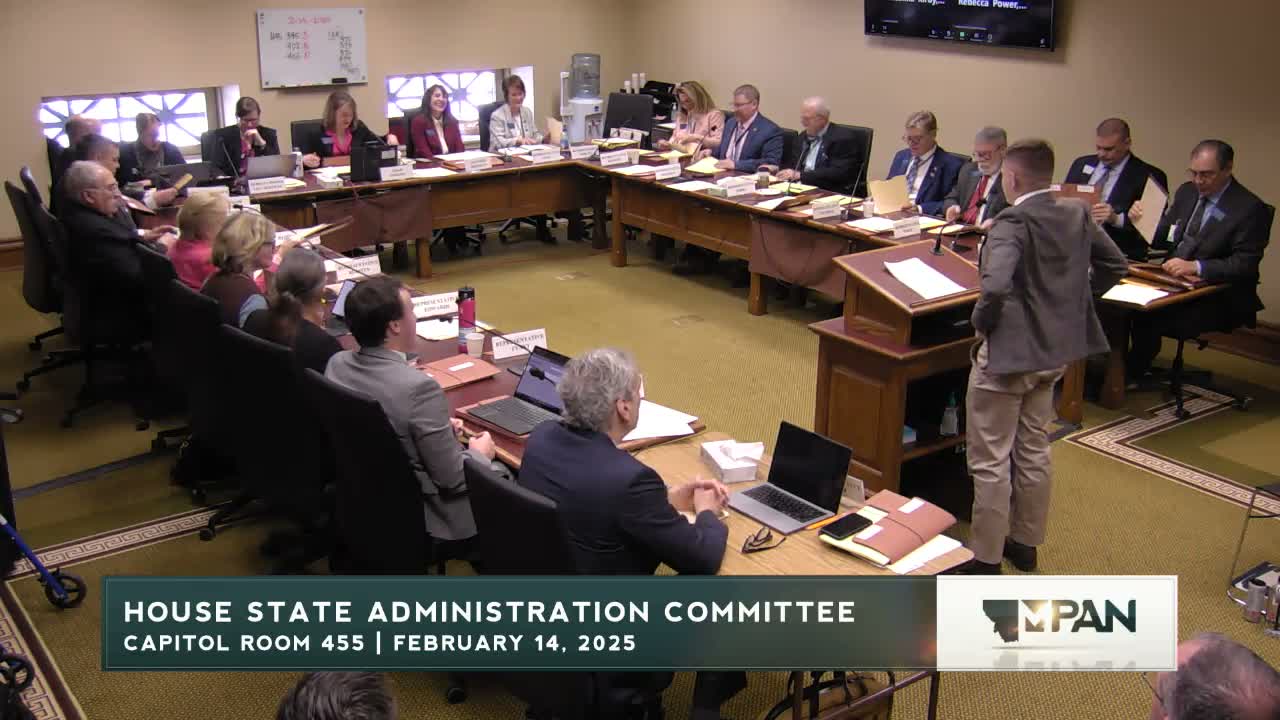
Montana hearing on bill to define 'unsound mind' for voting draws sharp opposition from disability, civil-rights groups
Summary
Sponsor says HB395 would close a judicially exposed loophole by defining 'penal institution' and 'unsound mind' for voting law; DOJ backed the need for legislative guidance, while disability advocates, the ACLU and others warned the bill's broad language could disenfranchise seniors, people with disabilities and other vulnerable voters and risk constitutional litigation.
Representative Braxton Mitchell opened House Bill 395 by saying the measure seeks to fix gaps in Montana law and the Constitution after litigation during the 2024 election cycle produced a court order that allowed at least one person at the Montana State Hospital to register to vote. “This attempts to close a loophole by defining penal institution and unsound mind,” Mitchell said, describing a court finding that relied on absent statutory definitions.
Michael Russell, civil bureau chief at the Montana Department of Justice, testified in support and referenced an Attorney General opinion and ongoing Deer Lodge County litigation; he said the lack of definitions produced "absurd results" such as someone serving a felony sentence but housed at a treatment facility being treated as eligible to vote. Russell urged the legislature to provide definitions and standards so courts have guidance.
Opponents included disability-rights organizations, veteran- and senior-advocacy groups, the ACLU of Montana, centers for independent living and legal advocates. Tal Goldin of Disability Rights Montana said the bill “will disenfranchise many more voters than you were led to believe” and urged a no vote, arguing the language reaches far beyond convicted felons. “Under this bill, any elector could be challenged on the basis that they are of unsound mind,” Goldin said.
Alex Reit, deputy director and legal director at the ACLU of Montana, told the committee the bill’s definitions of penal institution and “unsound mind” are overbroad and would likely fail the strict-scrutiny constitutional test that Montana law triggers for restrictions on voting rights. “With critical voting rights at stake, there should be a heavy thumb on the scale towards granting broad access to the ballot and not arbitrarily restricting that access,” Reit said.
Speakers for older- and disability-serving organizations (Ability Montana, AARP, Big Sky 55 Plus, NAMI Montana, centers for independent living) said the bill’s language could sweep in people with early-stage dementia, traumatic brain injury, developmental disabilities and those subject to state adjudications for unrelated administrative purposes; witnesses said restoring rights would not be simple and that the bill risks violating federal statutes such as the Americans with Disabilities Act and the Help America Vote Act.
Department of Public Health and Human Services staff participated as informational witnesses and described differences in how the state treats individuals under Title 46 (criminal) and Title 53 (civil commitment). Committee members asked about how the bill would be implemented by election administrators; the DOJ witness said the Attorney General’s office had not consulted county clerks about operational rollout.
Opponents warned the bill invites litigation; multiple witnesses said federal courts have previously invalidated broadly disenfranchising laws and that Montana courts apply strict scrutiny to voting restrictions. Sponsor Mitchell said the bill does not intend to arbitrarily take voting rights away and that it includes an automatic restoration of rights upon release from state custody.
The committee heard extensive testimony for and against and closed the hearing; no committee vote on HB395 was recorded in the transcript.