Get Full Government Meeting Transcripts, Videos, & Alerts Forever!
Get email alerts on the Federal Funding Study topic
No spam. Unsubscribe anytime.
House committee hears broad testimony on bill to study federal cuts; LFC-led measure fails and is tabled
Summary
Lawmakers heard extensive testimony on HB 879, a bill directing the Legislative Finance Committee to study how recent federal executive actions and funding shifts would affect Montana; proponents cited threats to health care, forests, tribal services and university research. The committee later voted to table the measure after a roll-call defeat.
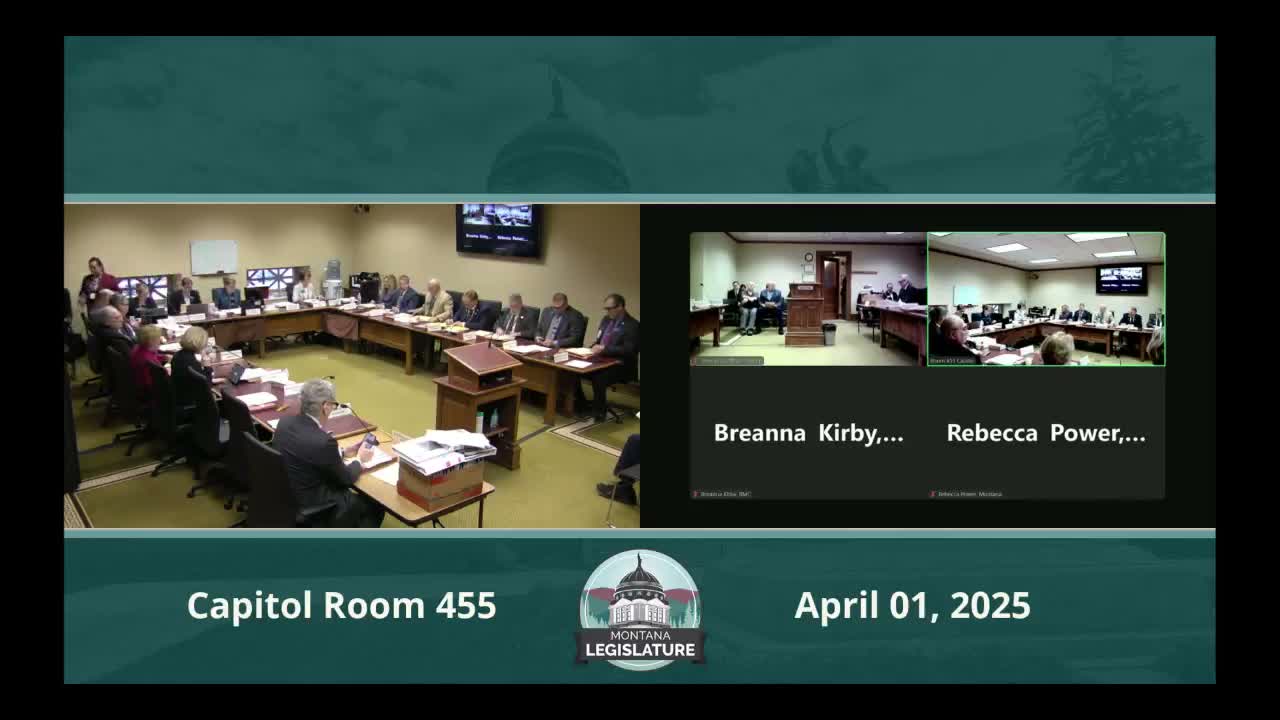
Representative Ed Staffman opened the House State Administration hearing on House Bill 879, describing it as an interim study resolution to assess the impact of recent federal executive actions on Montana and to give the state data to respond. He said the Legislative Finance Committee (LFC) would lead the study and could farm work to interim committees or hire outside economic researchers if needed.
Staffman told the committee he had prepared a multi-section notebook documenting potential impacts, and said Montana — where 43% of the state budget comes from federal funds — faces substantial exposure. "We can either act on it or we could choose to ignore it at our peril," he said, urging the committee to authorize an interim study and an appropriation of $215,000 to support the work, including roughly $150,000 intended for outside economic assessment.
Proponents from across the state described immediate and potential effects. Patrick Kawaki, representing several tribal nations, said Bureau of Indian Affairs and Indian Health Service staffing and funding changes are already disrupting services, and that tribal colleges have lost critical support. "This illegally created department isn't creating efficiency, it's creating chaos," Kawaki said, arguing a nonpartisan study would help prepare state responses.
Other witnesses cited sector-specific impacts: the Montana Farmers Union highlighted lentil markets and tariff exposure; retired Forest Service staff described lost contracts and firefighting capacity concerns; university researchers and business representatives warned that frozen NIH grants and contract cancellations are already affecting graduate research and local businesses.
Amy Carlson, legislative fiscal analyst and director of the Legislative Fiscal Division (LFD), told the committee LFD performs applied economic analysis and baseline forecasting (noting an annual contract with S&P Global Insight), but that detailed impact work would likely require outside econometric work and social-impact analysis. Carlson said the appropriation in the bill was uncertain and the cost estimates were a "guess" given the fluid federal environment.
Committee members probed scope, overlap with existing LFD and MARA work, and the adequacy of the proposed appropriation. Sponsor Staffman and Carlson agreed LFD could do some work internally but that the complexity and potential breadth of impacts (from Medicaid to national park services to cybersecurity and tariff-driven construction-cost increases) likely required contractor support to produce the timely, comprehensive report the bill envisions.
At executive action the committee considered a motion to pass HB 879. The measure failed on a roll-call vote (8 yes, 11 no) and the committee subsequently voted to table the bill.