Get Full Government Meeting Transcripts, Videos, & Alerts Forever!
Get email alerts on the Water Rights topic
No spam. Unsubscribe anytime.
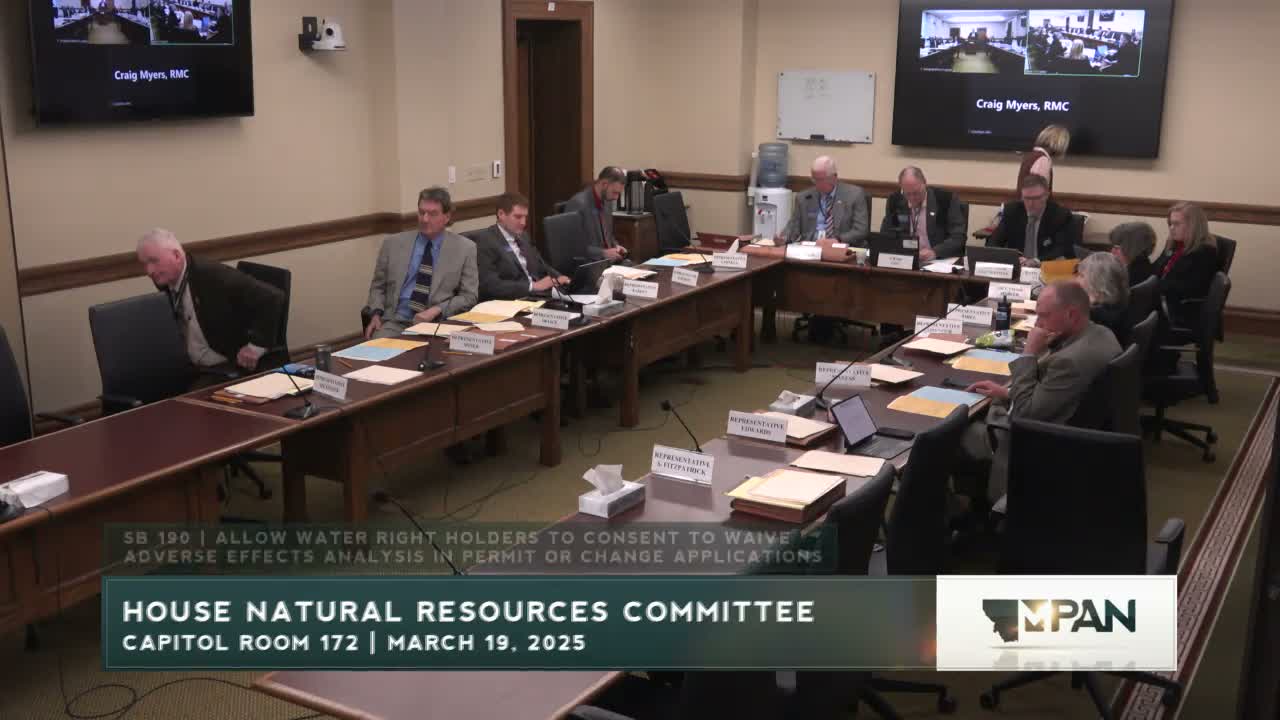
Committee hears bill to reinstate waiver of adverse effect in water-right applications
Summary
SB190 would reinstate a previously expired waiver of adverse effect in water-right permit and change applications; DNRC and water-rights stakeholders testified the waiver simplifies permitting and provides flexibility, while committee members asked whether waivers could be misused or rescinded later.
Senate Bill 190 would reinstate a statutory "waiver of adverse effect" for water-right permit and change applications that expired during a statutory sunset in 2023. Sponsor Senator Harvey said the waiver had been in place from Oct. 1, 2017 to Sept. 30, 2023 and would simplify permitting for applicants who can secure a voluntary waiver from another water-right holder.
Anna Pakenham Stevenson, Water Division Administrator at the Department of Natural Resources and Conservation, testified that the provision simplifies the application and adverse-effect assessment when a water-right holder voluntarily waives consideration of their right. She emphasized that DNRC maintains statutory duties to evaluate legal and physical availability and other criteria and that the waiver does not relieve the department of those responsibilities.
Multiple stakeholder groups testified in support, including Trout Unlimited (Clayton Elliott), the Montana League of Cities and Towns (Kelly Lynch), the Senior Water Rights Coalition, Montana Water Resources Association, Senior Ag Water Rights Alliance and the Montana Farm Bureau Federation. Clayton Elliott described the waiver as a practical tool that had been used successfully in prior applications and said the working group developing the comprehensive water review supported reinstatement.
Representative France asked a hypothetical about whether an applicant could pay an existing water-right holder to waive consideration and then later transfer the property — raising concerns about future downstream owners who might not be aware of the waiver. Clayton Elliott said the waiver is a voluntary, one-time choice at the time of the permit/change application and noted statutory sideboards and vetting when the provision was previously in law. He added that affected parties should seek counsel when considering signatory options.
The sponsor closed the hearing and asked the committee to concur. No committee action was recorded at the close of the hearing.