Get Full Government Meeting Transcripts, Videos, & Alerts Forever!
Get email alerts on the Auxiliary Containers Local Control topic
No spam. Unsubscribe anytime.
Committee hears competing views on bill to restore local authority over auxiliary containers
Summary
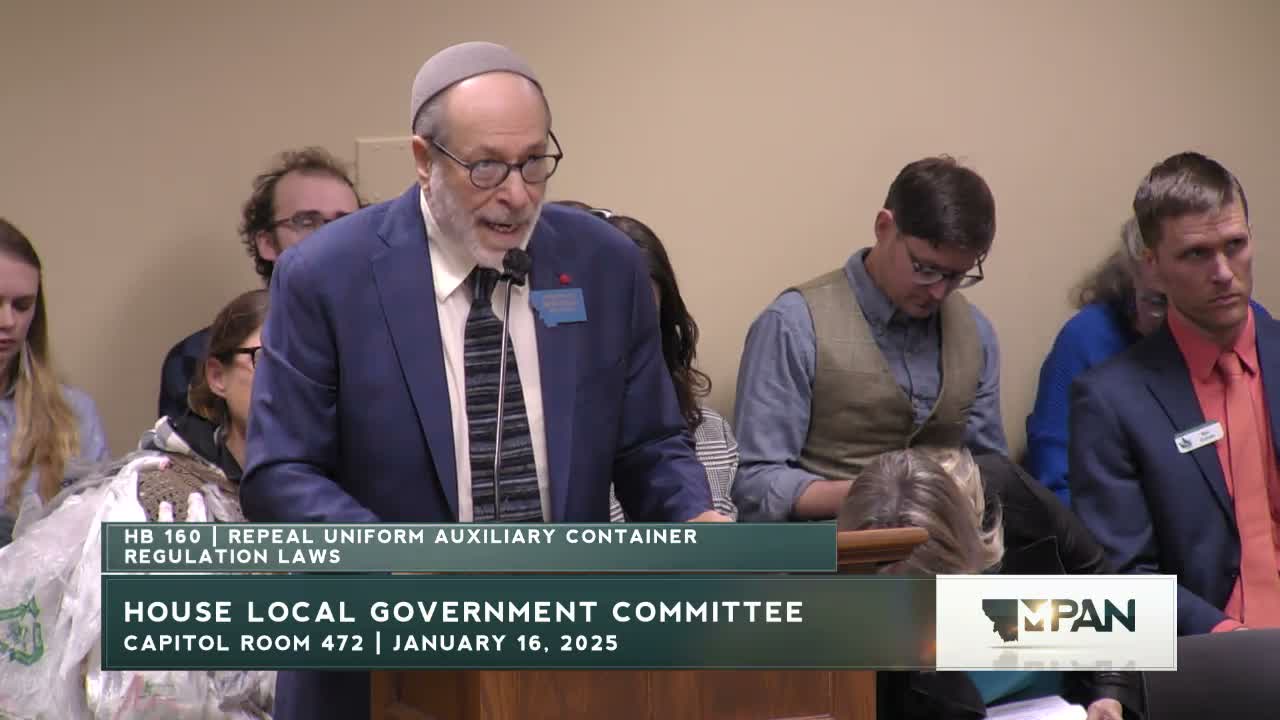
House Bill 160 would repeal statutory limits that bar cities and citizens from regulating auxiliary containers such as single-use plastic bags and polystyrene containers. Sponsors and environmental groups urged restoring local control after Bozeman voters approved a plastics ordinance; business groups and retailers warned of statewide inconsistency and costs. The committee held extensive public testimony and asked follow-up questions; no vote was held.
Representative Ed Staffman (House District 59) told the House Local Government Committee that House Bill 160 seeks to repeal provisions that prevent local governments and citizen initiatives from regulating "auxiliary containers," including single-use plastic bags and polystyrene food containers.
Staffman framed the bill as a question of local control and recounted recent legal history: a 2021 statute curbed local authority on plastics, a Gallatin County district court judge earlier found that a restriction on initiatives violated the Montana Constitution, Bozeman voters approved a plastics ordinance in November with 18,819 votes in favor, and the Montana Supreme Court later reversed the district court’s decision on at least one legal claim. "The question is who gets to decide? The local government or the citizens?" Staffman asked the committee.
Supporters at the hearing included the Montana League of Cities and Towns, municipal officials (including the mayor of Bozeman), conservation and public-health groups, local volunteer organizers and small-business owners who said they had adapted to alternatives. Thomas Jodoin of the League said the bill restores local decision-making and community control over solid waste management; Bozeman Mayor Terry Cunningham said the city’s vote reflected local priorities about waterways and public health.
Proponents made public-health and environmental arguments during testimony. Witnesses cited harms from polystyrene and single-use plastics, described volunteer signature drives that placed the Bozeman ordinance on the ballot, and said a patchwork of local options is preferable to a one-size-fits-all state ban. Several speakers cited the 63% approval rate in Bozeman and used that figure to illustrate local support.
Opponents included the Montana Petroleum Marketers and Convenience Store Association and the National Federation of Independent Businesses. Brad Longcake, representing convenience stores, argued the statute’s prohibited list covers many items used in food service and that statewide continuity prevents a burdensome patchwork of local regulation. Rhonda Wiggers of NFIB said small businesses across the state would face compliance costs and asked the committee not to pass the bill.
Committee members asked witnesses to clarify the statutory definition of "auxiliary container" (Mont. Code Ann. 7-1-1-21(4)(a)), whether many such products are petroleum-derived, and what market alternatives exist. Witnesses provided partial answers and said data on statewide business impacts and material composition were limited in the hearing.
Representative Staffman closed by emphasizing local control, citing successful citizen engagement in Bozeman and arguing the legislature should restore municipal authority. The committee closed the hearing; staff indicated executive action would likely be scheduled the following week. No committee vote occurred at the hearing.