Get Full Government Meeting Transcripts, Videos, & Alerts Forever!
Get email alerts on the Driver Privilege Card topic
No spam. Unsubscribe anytime.
Montana committee pauses driver-privilege card bill after hours of testimony
Summary
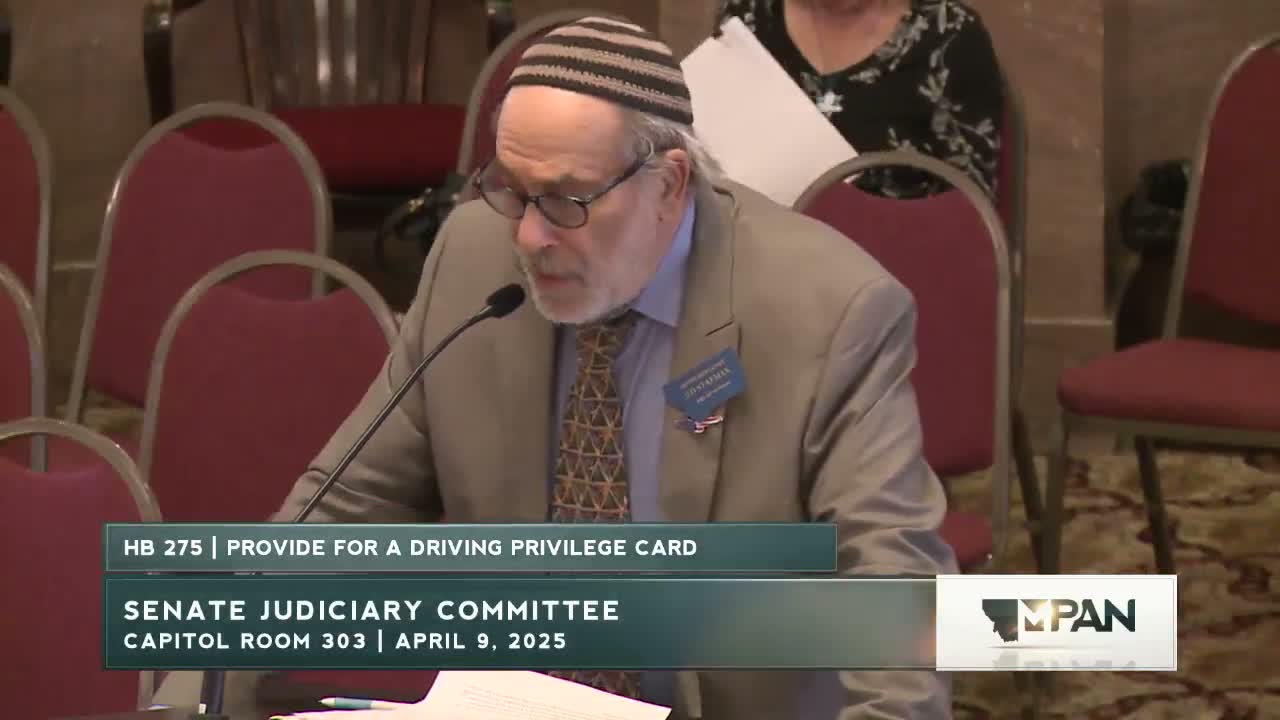
After hours of testimony from immigrant advocates, business groups and law‑enforcement supporters, the Montana Senate Judiciary Committee tabled HB 275, a bill to create a two‑year driver's privilege card for people lawfully present but ineligible for a standard driver's license.
Representative (sponsor) opened HB 275 as a plan to give certain lawful noncitizen residents limited driving privileges while excluding use of the card for federal identification, voting or air travel. He said the card would require proof of identity, multiple proofs of Montana residence, documentation that the person is lawfully present and that applicants pass the same written and driving tests and pay the same fees as other applicants.
Supporters, including refugee resettlement groups, university researchers and business leaders, told the committee the card would reduce uninsured driving, improve public safety and help employers fill labor shortages in rural Montana. Tom Waldorf of Bienvenidos described newcomers who could not obtain permits for months; a representative of MSU summarized research estimating Hispanic workers contribute more than $2.6 billion annually to the state economy and support tens of thousands of jobs. Several witnesses said the card is modeled on Utah’s law but the sponsor said Montana’s version has stricter documentation requirements.
Opponents questioned whether the bill duplicates existing processes — arguing many lawfully present noncitizens can already obtain licenses through SAVE verification — and raised concerns about the bill’s two‑year maximum and the specific documents listed as acceptable. DMV Administrator Laurie Bakri testified the department could implement the program but said asylum seekers and refugees may require special procedures because they are not always present in SAVE. Committee members debated whether the bill’s insurance language and document lists were complete and whether implementation would require additional DMV resources.
After extended questioning and consideration of a technical amendment to ensure insurance obligations align with vehicle ownership, the committee ultimately voted to table HB 275. The tabling preserves the bill for possible future consideration but removes it from immediate schedule. The sponsor and proponents said they will continue to work with agencies and committee members on documentation and implementation details.
What's next: HB 275 was tabled in Senate Judiciary; proponents and the sponsor signaled willingness to work on clarifying amendments before the bill is heard again.