Get Full Government Meeting Transcripts, Videos, & Alerts Forever!
Get email alerts on the Publisher Settlement topic
No spam. Unsubscribe anytime.
Opioid Abatement Council sets aside 35% of Publicis settlement to fund SMART initiative
Summary
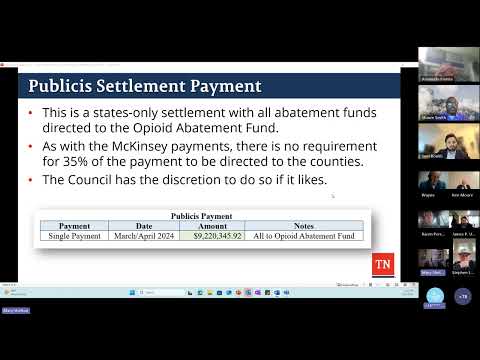
The Tennessee Opioid Abatement Council voted Jan. 23 to set aside 35% of a Publicis settlement—$3,227,121.07—for the SMART initiative for two years, with the remainder of Publicis funds to be dispersed later by the council. The motion passed by roll call.
The Tennessee Opioid Abatement Council voted Jan. 23 to reserve 35% of the state’s Publicis settlement—identified in the motion as $3,227,121.07—to pay for the SMART initiative for the next two years, with the rest of the settlement to be dispersed by the council at a later date.
Dr. Clay Jackson, who moved the motion, told the council the 35% earmark closely matches SMART’s two‑year funding need (he cited the SMART cost at about $1.4 million per year). "If we have been directed to provide 35% of this money to the counties, that'd be about $3,200,000. And it's about 2.8 that we're gonna be required to lay out for the SMART initiative," Jackson said. He recommended reserving that county portion for the SMART contract for two years and then reassessing future distributions.
Staff had presented options earlier in the meeting, saying the Publicis payment was roughly $9.2 million as presented in the deck and that the council could choose to send 35% to counties, direct funds entirely to community grants, or fund a split that would include SMART. Executive Director Mary Shelton asked the council for direction before staff issues letters of agreement to all 95 counties.
Dr. Stephanie Vanderpool offered a friendly amendment to clarify the motion’s language to read "Publicis settlement funds." Ken Moore seconded the motion as amended. Mary Shelton conducted a roll-call vote; the chair declared the motion carried.
What happens next: staff will implement the council’s direction and prepare any letters of agreement or contract documents that follow from the decision. The council did not adopt programmatic changes to SMART itself at this meeting; it reserved funds specifically to ensure funding for SMART for two years, then return to the council for subsequent decisions on remaining funds.
Votes at a glance: the motion was moved by Dr. Clay Jackson and seconded by Ken Moore. The roll-call recorded all present voting members in favor and the chair announced the motion carried.