Get Full Government Meeting Transcripts, Videos, & Alerts Forever!
Get email alerts on the Candidate Profile topic
No spam. Unsubscribe anytime.
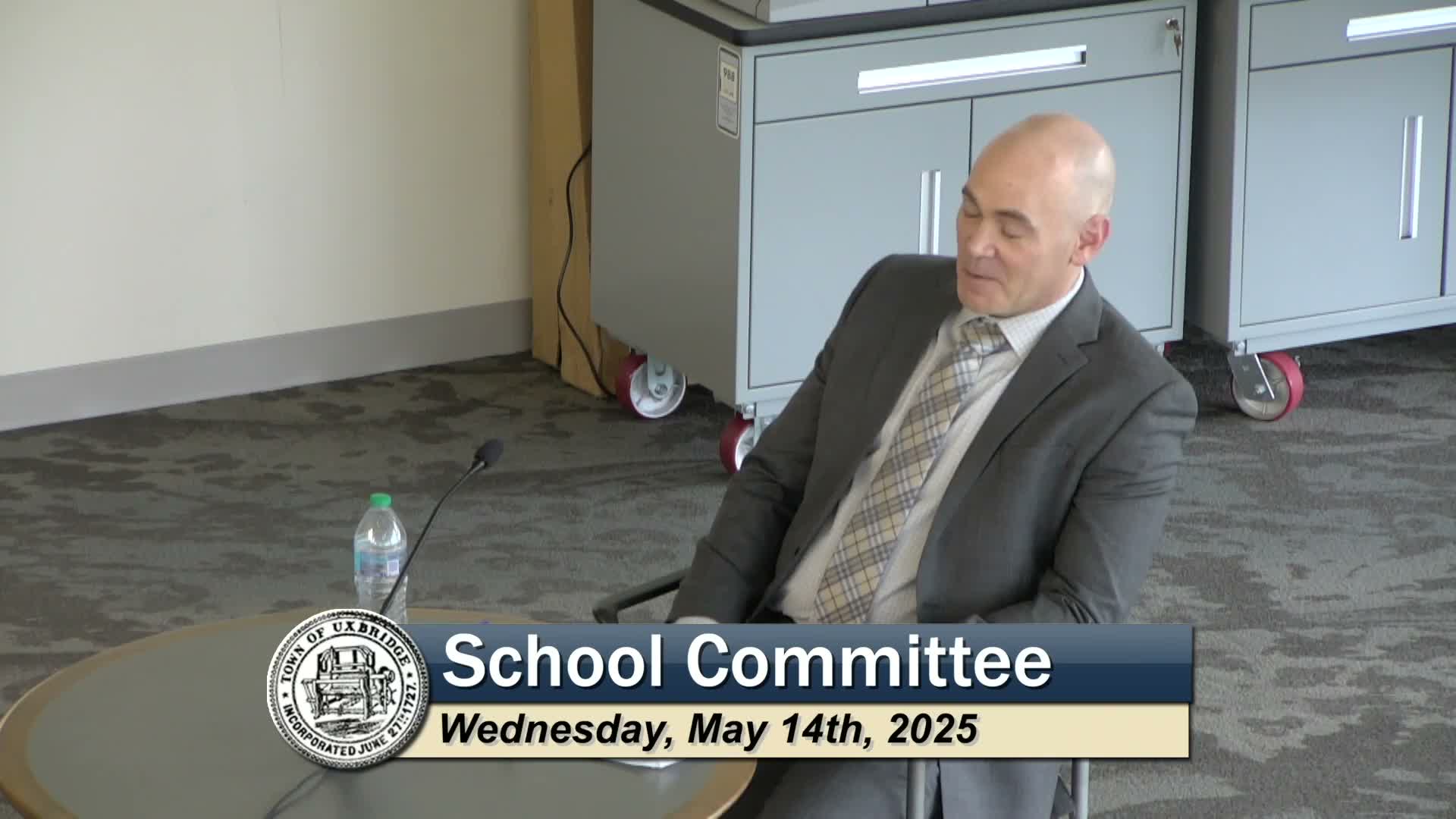
Finalist Chris Askins emphasizes classroom protection, fiscal experience and prevention‑focused bullying policy in Uxbridge interview
Summary
In his Uxbridge screening interview, finalist Chris Askins highlighted school visits, a two‑part budget ethos ('protect the classroom' and 'budget responsibly'), union negotiation experience, a 90–100 day entry plan, and a prevention‑centered approach to bullying.
Chris Askins, one of three finalists for Uxbridge superintendent, used his screening interview on May 14 to summarize his experience and approach to priorities the committee raised.
Askins opened by describing recent visits to Uxbridge schools and praised teachers, student engagement and community support. He said he was attracted to Uxbridge in part because it is "the type of community with 1,600 students roughly, where I feel I can make deep relationships." He described his 11 years as head of the Paul Cuffee Charter School and said that charter leaders are often required to "do more with less," noting charters in Rhode Island are funded "less by about $2,800 per pupil" than traditional public districts.
On budgets he offered a two‑part principle: "protect the classroom" and "budget responsibly." As an example of fiscal decision‑making, he recounted that in January 2025 his prior school identified a $1,500,000 projected deficit; leadership recommended staff restructuring, communicated broadly with the community, and explored alternatives such as job‑sharing. He emphasized transparency, repeated review of line items, and close coordination with the finance chair and business manager.
Askins described his approach to bargaining and labor relations: he is currently involved in contract negotiations, would begin by "overlearning" any local contract, meet with union leaders informally, and benchmark regional districts on salary and benefits. He recommended entering negotiations "not as adversaries, but as two sides with a mutual vested interest" in student success and a sustainable workplace.
On bullying, Askins advocated prevention and clear policy. He said his school had used a bullying policy modeled on the Rhode Island Safe Schools Bullying Prevention Act and provided an example: in one middle school of 200 students there were 23 reports with five cases meeting the legal threshold for bullying; others were handled through mediation and restorative practices.
He concluded with transition planning proposals — a 90–100 day entry plan that prioritizes listening, meeting the school attorney, inspecting district systems and producing a report to the committee for further strategic planning. The committee recessed after the interview to begin deliberations.
Quotes in this summary were taken verbatim from the candidate’s answers recorded in the meeting transcript.