Get Full Government Meeting Transcripts, Videos, & Alerts Forever!
Get email alerts on the Land Use Subdivision topic
No spam. Unsubscribe anytime.
Uxbridge conservation commission approves Old Elm Dale Road widening with new erosion-control conditions
Summary
The Town of Uxbridge Conservation Commission voted to issue an Order of Conditions for the Old Elm Dale Road widening (DEP 3121186), adding two special conditions requiring silt fencing with erosion controls and prior approval of any outfall reconstruction plans. The subdivision hearing for Old Elm Dale Estates was continued to allow more detailed phasing and erosion-control documents.
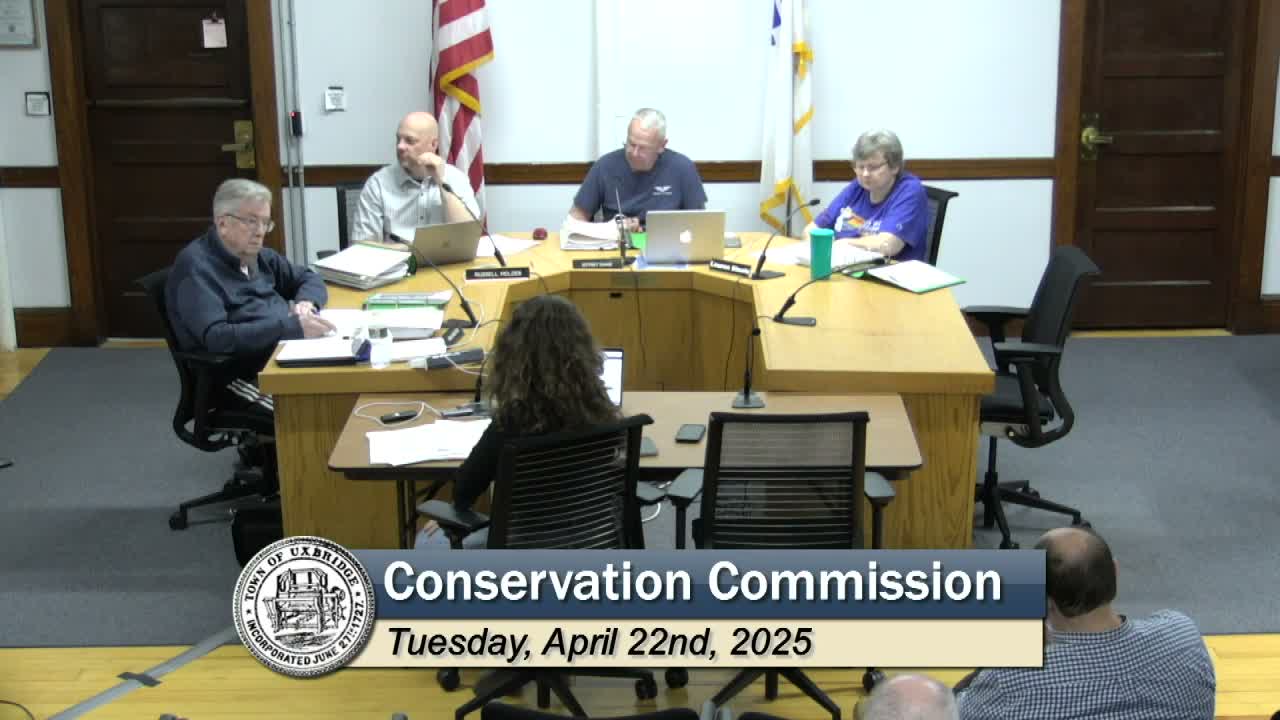
The Town of Uxbridge Conservation Commission on April 22 voted to grant an Order of Conditions for the Old Elm Dale Road widening project, while adding two special conditions intended to strengthen erosion and sediment controls during construction. The vote followed a multi-hour presentation and discussion with the applicant’s engineers and peer reviewers.
Chris Shea of Dupree Engineering, the project engineer, told the commission the revised alignment eliminated private easements and a retaining wall, reduced costs for the Department of Public Works and increased the buffer to resource areas. "As far as Old Elm Dale Road is concerned from an engineering perspective, all the work has been approved," Shea said, adding that the planning board and public safety committee had reviewed the changes.
Environmental consultant Dave Crossman of B & C Associates explained how the team had responded to Department of Environmental Protection comments and described riverfront and floodplain mapping and the proposed erosion controls. Crossman said the roadway work was limited to existing right-of-way and that the project would show limited disturbance and typical erosion controls on the plan. "We show the limit of disturbance and the sediment control," he said, noting the design includes straw wattles and the applicant agreed to back those up with silt fence where appropriate.
Commissioners pressed the applicant for a clearer, consolidated phasing sheet and for specific measures to protect a nearby vernal pool and buried outfalls. Commissioners emphasized that erosion controls must be installed and inspected before each construction phase, and that storm-season timing should avoid peak vernal-pool activity. The commission also sought clarity on whether buried outfall pipes in the area have been located and whether replacement would require a separate submission.
The motion the commission approved included two special conditions: first, that all installed erosion controls be accompanied by silt fencing in addition to straw wattles; and second, that if any outfall reconstruction or pipe replacement is needed, the applicant must file a plan and obtain Conservation Commission approval for the work and a specific erosion-control plan before beginning reconstruction. The motion passed without opposition.
The larger subdivision application for Old Elm Dale Estates (NOI 3121168) was continued so the applicant can provide a consolidated phasing sheet showing subphases (1A/1B/1C), clearer erosion-control notes, and a diagram showing where fill will be taken and where sediment basins will be sited. Commissioners said they expect the roadway widening (phase 1A) to be completed and stabilized before heavy earthwork on subsequent phases begins, and that they will inspect erosion-control installations before construction of each phase.
The commission also heard public comments from nearby residents who raised concerns about truck traffic, dust control and construction entrances; the commission and the planning board will coordinate conditions such as construction entrances, street sweeping and potential tire-wash measures to reduce tracking onto town roads. The commission required that erosion-control measures be shown on the phasing sheet and that sediment basins and catch-basin cleanouts be addressed as part of planning-board and DPW conditions.
Next steps: the applicant will submit the requested consolidated phasing sheet, updated erosion-control notes, and evidence that the buried outfall locations have been evaluated; the subdivision hearing was continued to a future meeting to permit the commission time to review those materials.