Get Full Government Meeting Transcripts, Videos, & Alerts Forever!
Get email alerts on the Historic Markers topic
No spam. Unsubscribe anytime.
Uxbridge Historical Commission advances medallion marker project, seeks $25,000 at fall town meeting
Summary
The Uxbridge Historical Commission voted to sponsor a fall town meeting article requesting $25,000 for production of a large historic medallion. Commissioners discussed production timing, Sankofa symbology on the design, fundraising through the historical society, a Select Board presentation and two subcommittees to handle publicity and commemoration.
The Uxbridge Historical Commission voted to sponsor a fall town-meeting article seeking a $25,000 appropriation to fund a large medallion-style historic marker, and formed subcommittees to develop outreach and to plan the marker dedication.
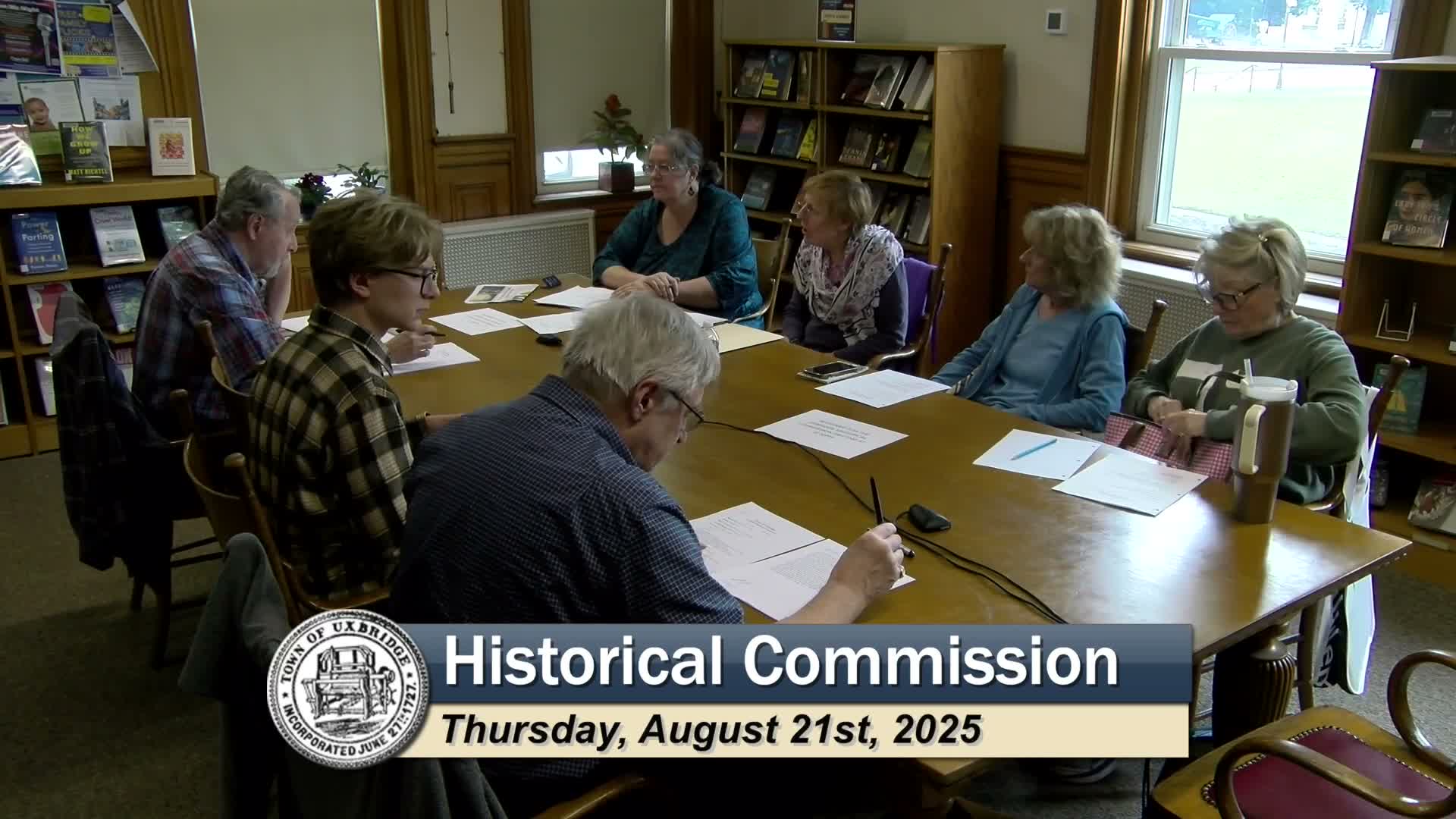
At the meeting in the Select Board Meeting Room commissioners discussed the project’s scope and timing. An unidentified commission member said, “We’re asking for 25,000,” describing that the amount would cover production costs for a single large medallion; production was estimated to take about seven months. Commissioners said they want to schedule installation when weather permits so concrete foundations can be poured and the piece need not be stored over winter.
Commissioners reviewed research tying the proposed marker site to Revolutionary-era activity, including archival references to a liberty tree and a historical photograph held by the American Antiquarian Society. Members discussed design details included in the foundry proof: a blank space reserved for a name and a set of West African symbols, including the Sankofa bird. The presenter explained the Sankofa motif as a West African symbol adopted in the African American diaspora that the group used to signal "returning for what you've left behind" and that the four smaller symbols on the medallion were translated in the proof to represent freedom, heart (courage), growth and strength.
Fundraising options reviewed included restricted donations routed through the historical society (a 501(c)(3)), outreach to local banks and businesses, and targeted appeals to groups with a direct affinity to specific sites (veterans groups for military-related markers, for example). Commissioners also discussed partnering with the historical society for in-kind assistance such as help installing marker posts and possible volunteer involvement (Boy Scouts or highway department equipment) to place foundations.
The commission agreed to a schedule of next steps: a presentation to the Select Board (noted in the meeting as August 28 in the meeting materials), preparation of a press release for local media, and a dedication event once the medallion arrives. Two formal subcommittees were created by unanimous vote: one to draft press-release materials and conduct outreach, and a second to plan the commemoration. The meeting record cautioned that subcommittee members must avoid creating a quorum during drafting and outreach and that members with potential conflicts may recuse themselves from votes on related items.
Commissioners named outreach channels (local papers including the Blackstone Valley Tribune, town events such as Uniquely Uxbridge and First Night) and discussed collaboration with the town’s 300th-anniversary committee to share research and materials. Members also described digitization efforts (noted as available on Internet Archive) and plans for a walking-tour map and a possible trifold brochure to distribute at visitor centers and events.
The commission recorded the motions and passed each unanimously. Commissioners said they will notify the Select Board when the marker is ready for dedication and circulate materials about the 300th celebration as the group builds its public program.