Get Full Government Meeting Transcripts, Videos, & Alerts Forever!
Get email alerts on the Animal Permit topic
No spam. Unsubscribe anytime.
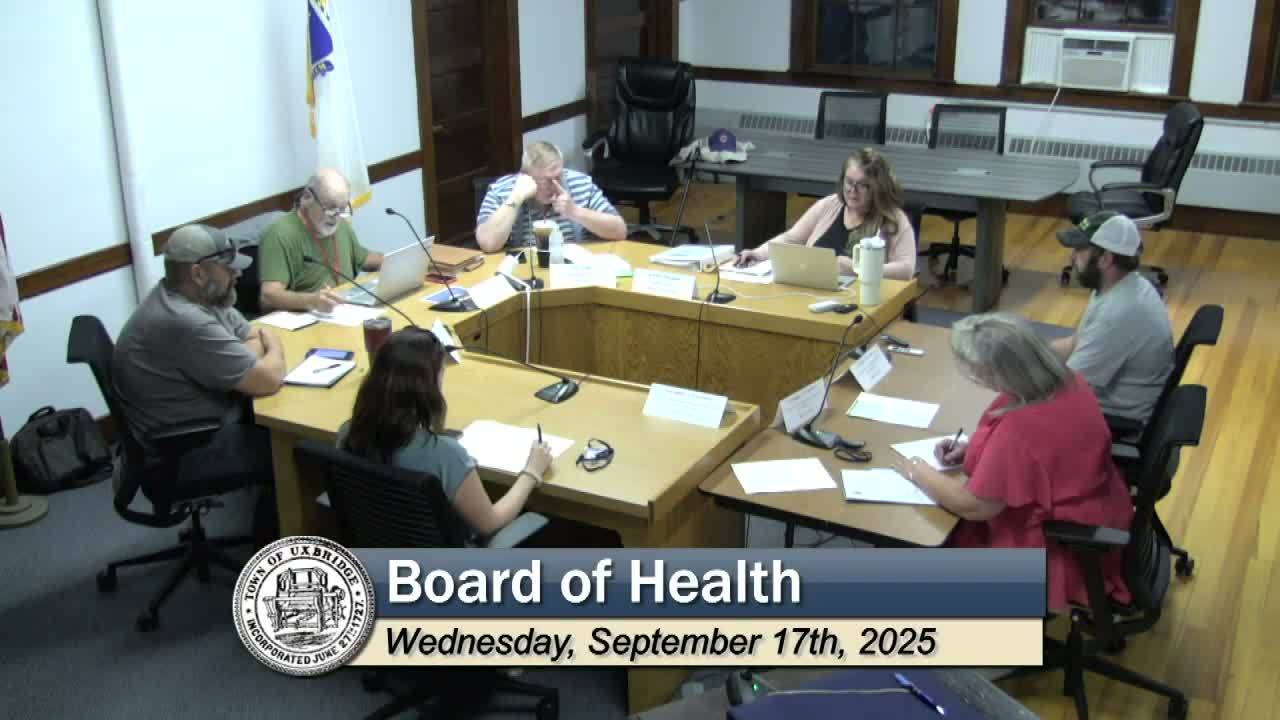
Uxbridge Board of Health approves animal-keeping permit for Lyric Farm sanctuary with conditions
Summary
The Board granted a keeping-of-animals permit for 130 Stanfield Road (the Refuge at Lyric Farm) but required removal of roosters, adherence to the manure-management plan (2–3 month removal), and improved gate security after neighbors reported odor and two escapes by mules.
The Uxbridge Board of Health voted to grant a keeping-of-animals permit for 130 Stanfield Road, the refuge at Lyric Farm, after hearing neighbors’ complaints about odor and two prior incidents where mules left the property. The board approved the application "as presented and as compliant with Uxbridge regulations," while clarifying that roosters are not permitted under current bylaws.
Michelle Williams, the property owner, told the board she runs a nonprofit animal sanctuary and that she had delayed renewing paperwork while caring for family members. "We are the refuge at Lyric Farm," Williams said, noting she had provided a manure-management plan, feed plan and pest-management plan to staff.
Neighbors raised specific concerns. Matt Carter of 125 Stanfield Road said animals had entered his yard twice and that odor and the presence of roosters were affecting quality of life and resale prospects. "I don't like the smell," Carter said, and requested consistent manure removal and improved fencing to prevent animals from escaping.
Inspectors and board members said the property is roughly 8.64 acres and that staff have seen improvements in manure removal since earlier complaints. Board members repeatedly recommended operational conditions that mirrored the applicant's plans: regular manure removal (the applicant said removal occurs every two to three months), and improved gate hardware such as a safety chain to prevent the mules from escaping.
Board members also discussed whether the property qualifies as a commercial farm under Massachusetts law, which could affect how odor is treated legally. A member cited the state threshold of approximately $1,000 in gross sales per acre for commercial-farm status; the applicant said gross egg sales run about $1,000 per year and the parcel size does not meet that per-acre threshold.
The board made and reworded a motion to approve the permit with conditions; a final motion to approve the permit as compliant with Uxbridge regulations carried. The board advised the applicant to make reasonable efforts to rehome roosters and suggested a practical window (about 30 days) for compliance while leaving follow-up and enforcement options to staff if a nuisance recurs. One board member noted that "if it becomes a nuisance again, we can pull any permit," underscoring the board's enforcement authority under local regulations.
The permit was approved with the board's expectation that the applicant follow the submitted management plans, remove roosters to comply with local regulations, schedule regular manure removal, and secure gates for the mules. The board did not grant a rooster variance.