Get Full Government Meeting Transcripts, Videos, & Alerts Forever!
Get email alerts on the Agriculture Economy And Exports topic
No spam. Unsubscribe anytime.
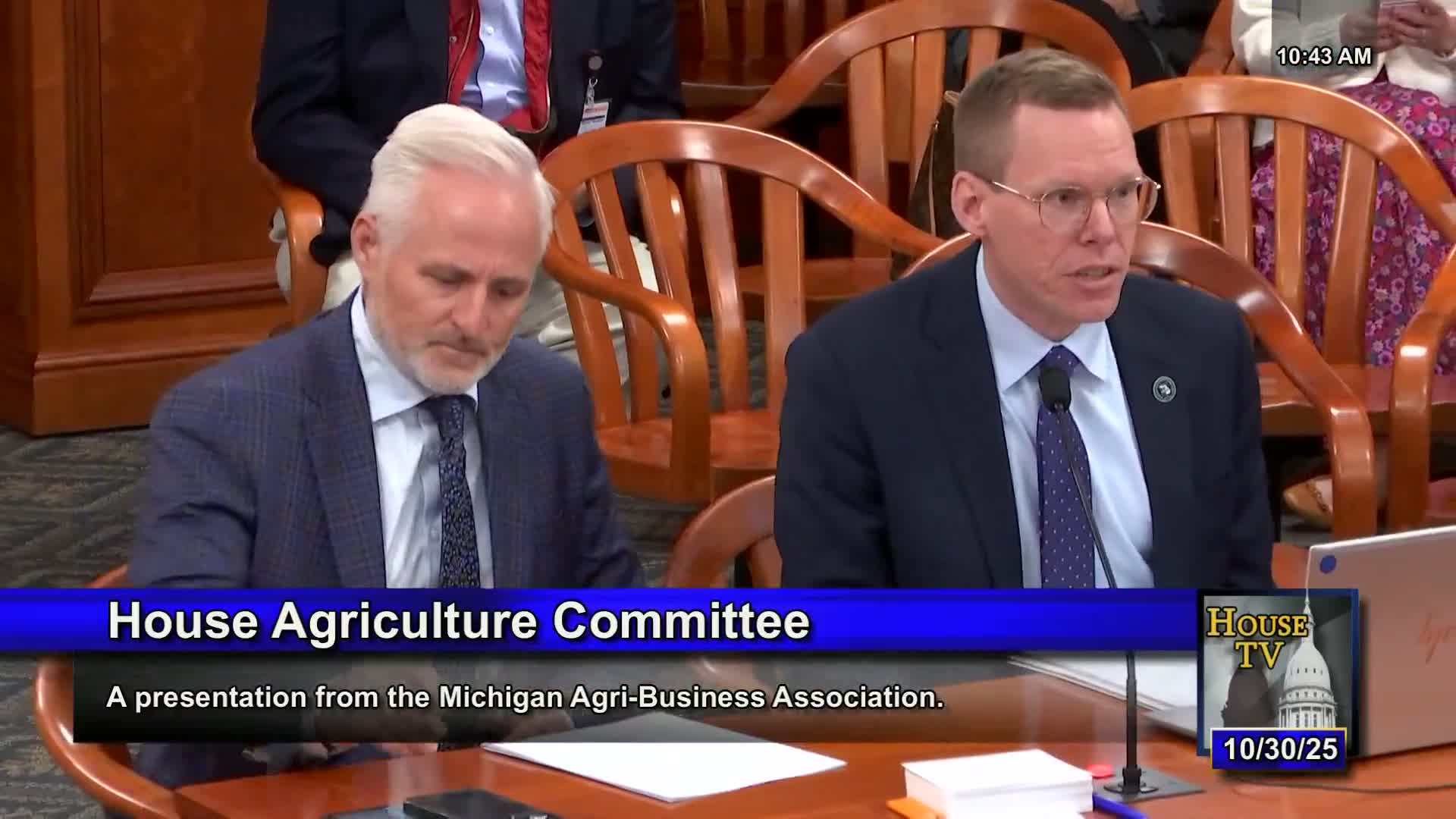
Agribusiness leaders brief Michigan House panel on exports, economics and regulatory certainty
Summary
Michigan Agribusiness Association and Cooperative Elevator Company told a House Agriculture Committee that exports, regulatory certainty and new markets such as sustainable aviation fuel are crucial as farmers face lower commodity prices and labor challenges; legislators pressed on insurance, food-bank diversion, and support for small and organic farms.
Michigan Agribusiness Association and Cooperative Elevator Company representatives told the Michigan House Agriculture Committee on the record that exports, stable regulation and new market opportunities are key to navigating a softer agricultural economy.
Chuck Lipstrew, president of the Michigan Agribusiness Association, said the association — which he said has existed since 1903 and represents about 300 business members — is tracking multiple challenges for 2026, including lower commodity prices, export uncertainty and labor shortages for specialty crops. "Things are uncertain for farmers and rural businesses," Lipstrew said, adding that impacts vary by sector: "Land values are holding. In some cases, land values have increased. Our livestock producers are having maybe an easier time economically than crop farmers." He told the committee the legislature’s full funding for MDARD's export inspection programs in the FY '26 budget was "incredibly important."
Scott Gordon, president and CEO of Cooperative Elevator Company in Pigeon, described his cooperative’s century-long role in the Thumb region and beyond, saying the cooperative supports more than 1,100 family-owned operations and handles export logistics. "We export around 400 rail cars to Mexico a year," Gordon said, and he urged lawmakers to recognize how Michigan-grown crops feed national and international brands and markets.
During questions, Representative Pies asked whether grain storage insurance or bankruptcy protections for elevators were adequate. Lipstrew described two related concerns: physical insurance for silos can be difficult to obtain, and the state has a statutory mechanism administered by the Department of Agriculture (the Farm Produce Insurance Authority) that is designed to step in if an elevator bankruptcy would otherwise harm growers. Lipstrew said Michigan had not recently experienced such a bankruptcy and that the Authority maintains a fund to address such a contingency.
A lawmaker asked whether planned exports could be redirected to food banks to respond to a short-term SNAP disruption. Gordon and Lipstrew said diversion capacity is limited, noted existing government programs that sometimes direct packaged goods to domestic programs, and emphasized that trade commitments and export logistics complicate ad hoc redirection of large export volumes. Lipstrew said reopening federal programs and restoring SNAP distributions is a prerequisite to addressing immediate food access concerns.
On the future of small farms and organics, Lipstrew said the Department of Agriculture has focused on supporting diverse production and farms of all sizes, and Gordon said cooperative membership and expansion into organic markets have helped some smaller growers remain viable. "There's a future for small farms," Gordon said, while acknowledging consumer price sensitivity has pressured some organic end-use markets.
Lipstrew also identified sustainable aviation fuel as a priority growth opportunity for corn growers and related businesses, urging consideration of state measures to avoid losing out as other states attract production and major carriers increase demand.
The presentation concluded with an invitation from Gordon for lawmakers and staff to visit the Cooperative Elevator Company's headquarters in Pigeon to see operations and logistics firsthand. The committee then moved to other business and adjourned.
Next steps: no formal legislative action on the presentation itself was taken; committee members referenced budget and rule actions elsewhere on the agenda.