Get Full Government Meeting Transcripts, Videos, & Alerts Forever!
Get email alerts on the Environmental Policy topic
No spam. Unsubscribe anytime.
Counties, planners and environmental groups urge 'do not pass' on SB 168 over lakeshore enforcement concerns
Summary
Senate Bill 168 would add a forward‑looking statute of limitations for lakeshore enforcement and allow some local enforcement in narrow cases; county officials, the Montana League of Cities and Towns, planners and environmental advocates warned the bill’s two‑year window and broad minor‑modification language would create enforcement loopholes and shift monitoring burdens to local governments; sponsor said illegal constructions causing material harm remain excepted and will consider amendments.
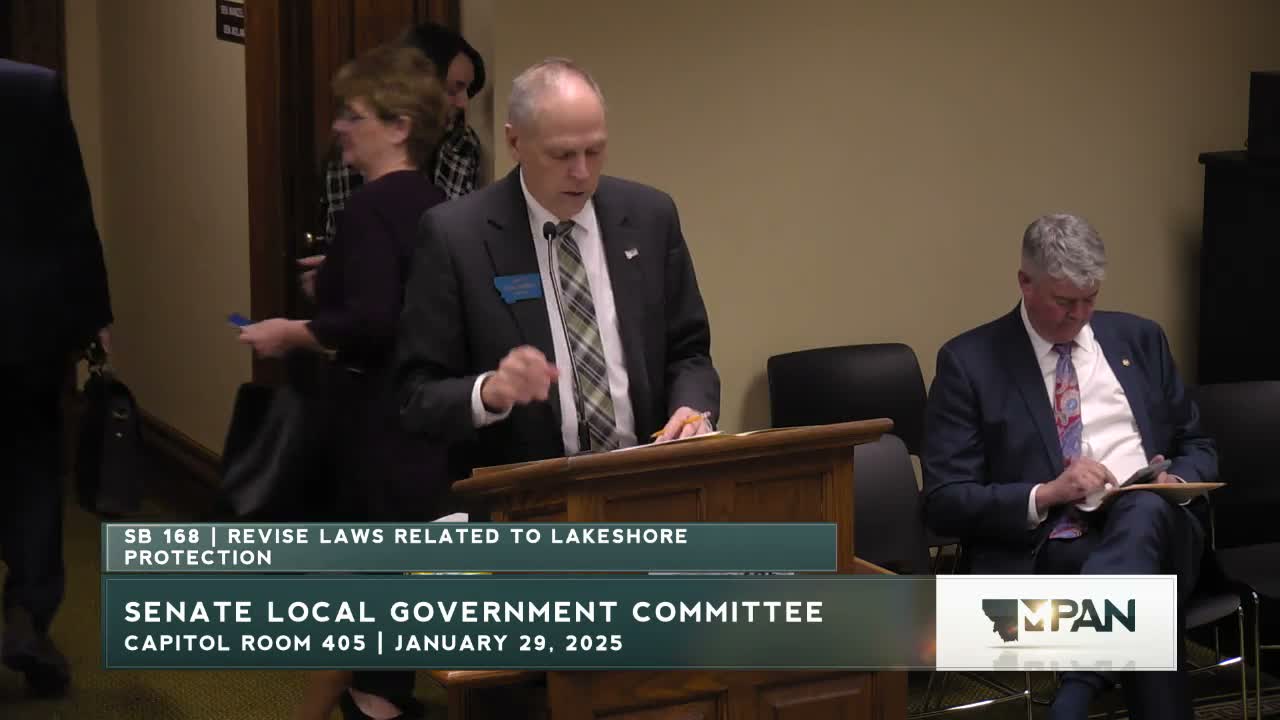
Senate Bill 168, introduced by Senator Greg Hertz, would create a forward‑looking statute of limitations and limit the time for local enforcement of shoreline regulations, while including limited exceptions for documented material harm. The bill prompted widespread opposition from county officials, municipal associations, planners and environmental groups at a Senate Local Government Committee hearing.
Karen Alley, associate general counsel for the Montana Association of Counties, told the committee the proposed two‑year limitation would leave local governments without a reliable mechanism to know when work is completed and would shift the burden of discovery to counties. She said the bill’s minor‑modification language — which allows maintenance or remodeling under a $10,000 threshold in a five‑year period — could encourage landowners to stay under enforcement radars and undermine shoreline protections.
Other opponents included Shane Gorder, a Richland County commissioner and past MACo president, who asked that the committee table the bill; Kelly Lynch, executive director of the Montana League of Cities and Towns, who urged that terms such as 'boats' and 'boat docks' remain undefined by statute and that minor‑modification determinations be left to local regulation; Laura Collins of the Montana Environmental Information Center, who warned the bill may permit illegal work to become effectively permanent if not detected within two years; and Tim Worley of the Montana Association of Planners, who said many jurisdictions lack resources to actively patrol shorelines and that the proposal would skew enforcement in favor of violators.
Missoula County floodplain administrator Matt Heimel noted that local regulations already aim to protect shorelines within a narrow zone (about 20 horizontal feet from high‑water elevation) and argued that the bill would create unequal application of protections and likely prompt litigation over how 'documented material harm' is proven and when the limitations clock starts.
Sponsor Senator Hertz responded to concerns by stressing that the bill does not shield illegal structures that cause material harm: "The limitation in section 1 ... does not apply to an item that was constructed illegally and that causes … material harm," he said, adding that he would consider proposed amendments from local governments that would tie the limitations period to knowledge or notice. Hertz framed the bill as protecting long‑time landowners from retroactive enforcement that can impose costly repairs when rules change or new neighbors arrive.
The committee heard several amendment proposals and requests for technical fixes; Senator Hertz said he would review the amendments provided by county and municipal groups. No vote was taken at the hearing; the sponsor indicated he would return with amendments for committee consideration.