Get Full Government Meeting Transcripts, Videos, & Alerts Forever!
Get email alerts on the Education Nondiscrimination topic
No spam. Unsubscribe anytime.
Senate Judiciary advances House Bill 300 after heated debate over sex‑based protections in schools
Summary
House Bill 300, which would define sex‑based discrimination in education to protect female athletics and private spaces, drew competing testimony: proponents said the bill enshrines Title IX‑style protections for women and girls, while civil‑rights groups argued it singles out transgender students and risks constitutional challenges. The committee voted to concur (5–3).
Representative Carrie Seekins Crow opened debate on House Bill 300 by saying the measure clarifies protections against sex‑based discrimination in educational institutions and that it "seeks to close those gaps" to ensure students, educators and staff do not face discrimination based on sex. She told the committee the bill is intended to align state law with Title IX's protections for female athletics and private spaces such as bathrooms and locker rooms.
Proponents presented legal and policy arguments that the bill preserves fair competition and privacy. Erica Steinmiller Perdomo, legal counsel for Alliance Defending Freedom, told the committee: "Discrimination based on *** means discrimination based on being a male or female," and argued that biological sex differences justify separate women's spaces and separate athletic categories to protect female athletes' opportunities. Speakers representing the governor's office, the Montana Family Foundation and the Office of Public Instruction also supported the bill, noting prior state action — the 2021 Save Women's Sports Act — and urging a complaint pathway under state education discrimination law.
Opponents — including Legal Voice, Planned Parenthood Advocates Montana, the ACLU of Montana and LGBTQ‑support organizations — said the bill would exclude transgender students, create intrusive investigatory obligations for schools, and likely invite constitutional challenges. Robin Turner (Legal Voice) warned the bill "compromises the safety, the privacy, and the dignity" of transgender and gender‑diverse students. Several opponents also urged investment in women's sports and alternatives to exclusionary rules.
Committee members probed definitions, evidence and enforcement. Questions focused on how many Montana athletes would be affected, how schools would determine biological sex in practice, and whether the bill might prompt litigation. Proponents cited national examples and asserted physiological performance differences; opponents emphasized constitutional protections and the practical difficulty and cost of enforcement by local schools.
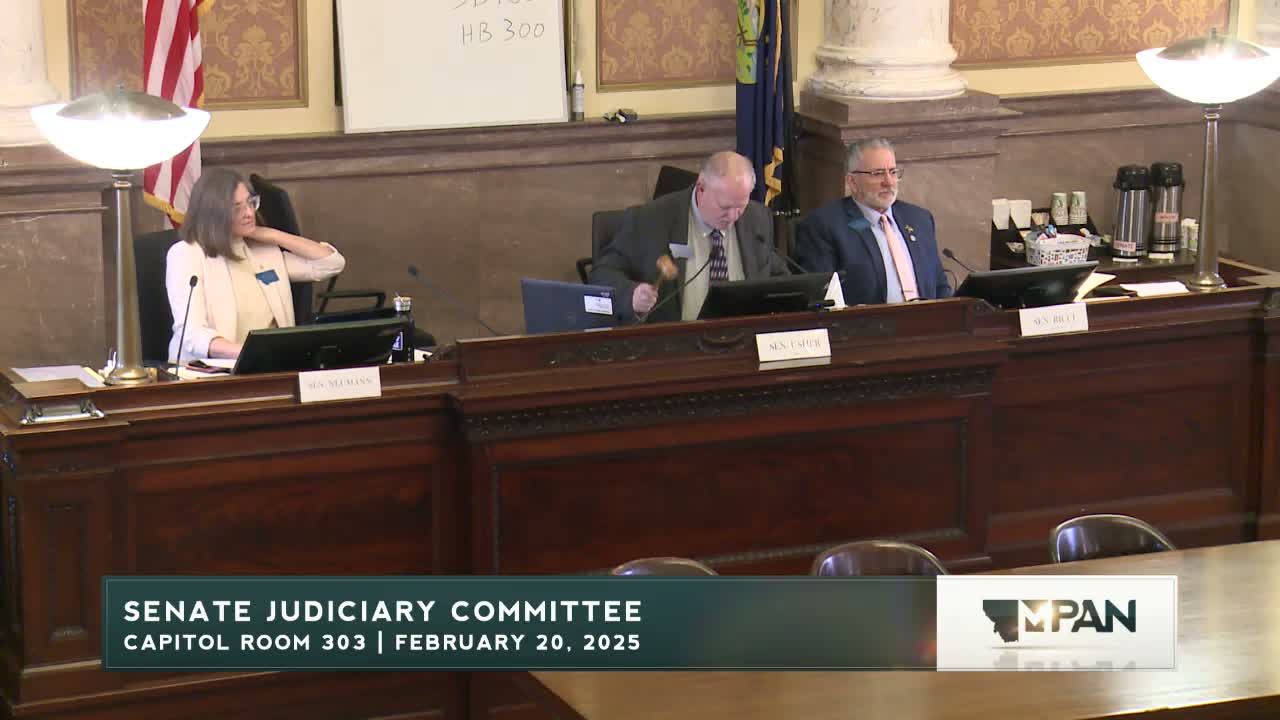
After extended debate during committee business, the Judiciary Committee took executive action on HB300. Senator Ricky moved concurrence and, following further debate about enforcement burdens and litigation risk, the committee voted by roll call to concur in House Bill 300 with a 5–3 tally (Yes: Ricky, Emrich, Mansella, Vinton, Chair Usher; No: Olsen, Newman (proxy), Smith (proxy)). The committee record shows discussion about potential future litigation and calls from some members to delay action pending additional definitional guidance; nevertheless the measure was advanced.