Get Full Government Meeting Transcripts, Videos, & Alerts Forever!
Get email alerts on the Criminal Justice Perjury topic
No spam. Unsubscribe anytime.
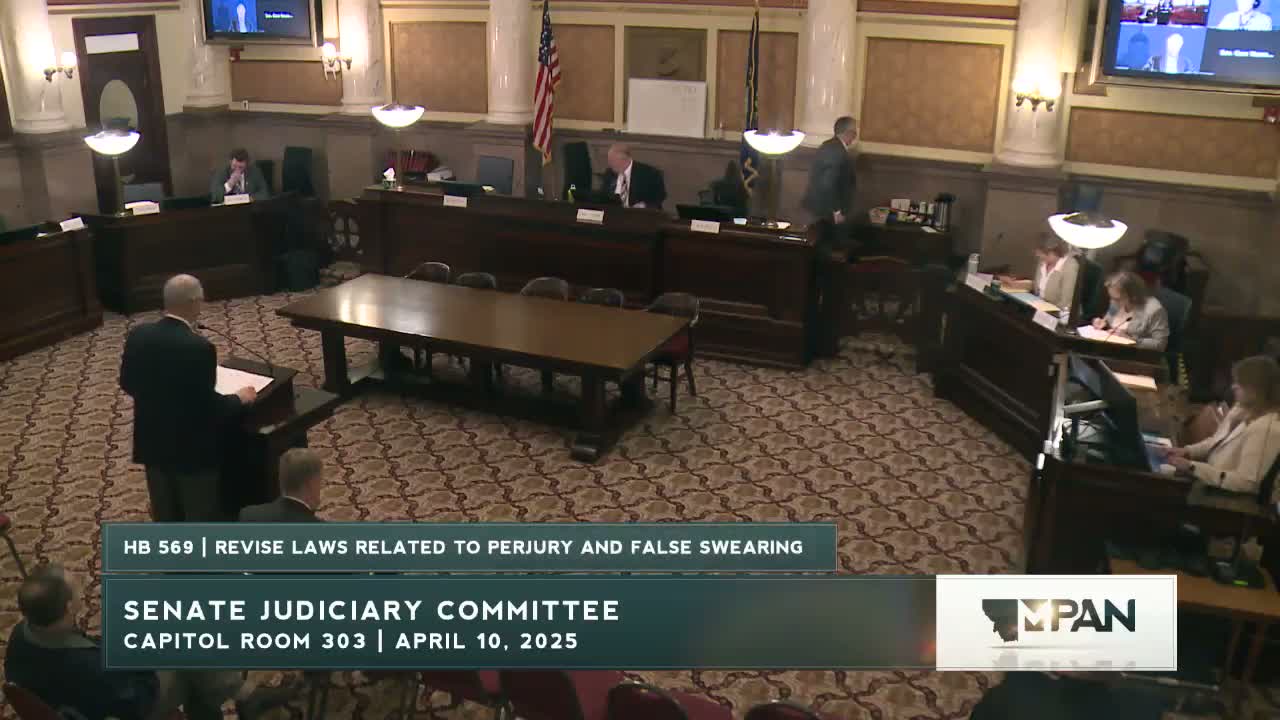
Senate Judiciary panel hears bill to toughen perjury penalties; amendment passes, final concurrence fails
Summary
Lawmakers debated HB569 to increase penalties for perjury and false swearing and require outside investigations of credible allegations. An amendment to raise mandatory minimums passed in committee but the bill failed final concurrence and was then tabled for further work.
Representative Shane Clacken introduced House Bill 569 on behalf of his House colleagues, saying the bill would “revise laws related to perjury and false swearing, requiring an investigation of credible allegations” and adjust penalties. Clacken proposed making perjury a felony with a higher mandatory minimum and added a separate mandatory minimum for false swearing in county jail.
The bill would amend statutory sections 45-7-201 (perjury) and 45-7-202 (false swearing) to (a) increase imprisonment ranges (Representative Clacken described raising a six‑month floor toward a one‑year minimum for the felony provision) and (b) require that “credible allegations” of perjury or false swearing be investigated by an agency outside the judiciary.
Proponents told the committee the changes are meant to deter false testimony and improve justice outcomes. Bart Crabtree of the Montana Citizens Council on Judicial Accountability said recent data indicate perjury and false swearing figure prominently in exonerations: “perjury and false swearing accounted for about 72 percent of exonerations in America,” he told the committee. Kent, the Fergus County attorney, described two pending perjury prosecutions and urged mandatory minimums to give prosecutors and courts clearer sentencing guidance.
Alan Doane of the Montana Department of Justice, representing the prosecution services bureau, urged the committee to pass HB569. During questioning, members raised whether certain voter‑registration attestations or other non‑court filings could fall under the bill; Clacken answered that his focus was courtroom perjury and affidavits supporting judicial proceedings and deferred some technical questions to staff.
In executive action, the committee debated an amendment that would explicitly make the offense a felony and set mandatory minimums. The amendment initially failed on a roll call but, after procedural motions and reconsideration, the amendment later passed on a second roll call. When the committee voted on concurrence of HB569 as amended, the motion to concur failed on a roll call and the sponsor subsequently moved to table the bill for further work.
Next steps: HB569 will remain in committee (tabled) while sponsors and staff reconcile amendment language, fiscal notes and procedural concerns.