Get Full Government Meeting Transcripts, Videos, & Alerts Forever!
Get email alerts on the Water Rights topic
No spam. Unsubscribe anytime.
Montana lawmakers debate phasing out Water Court, proponents tout local control while judges warn of practical gaps
Summary
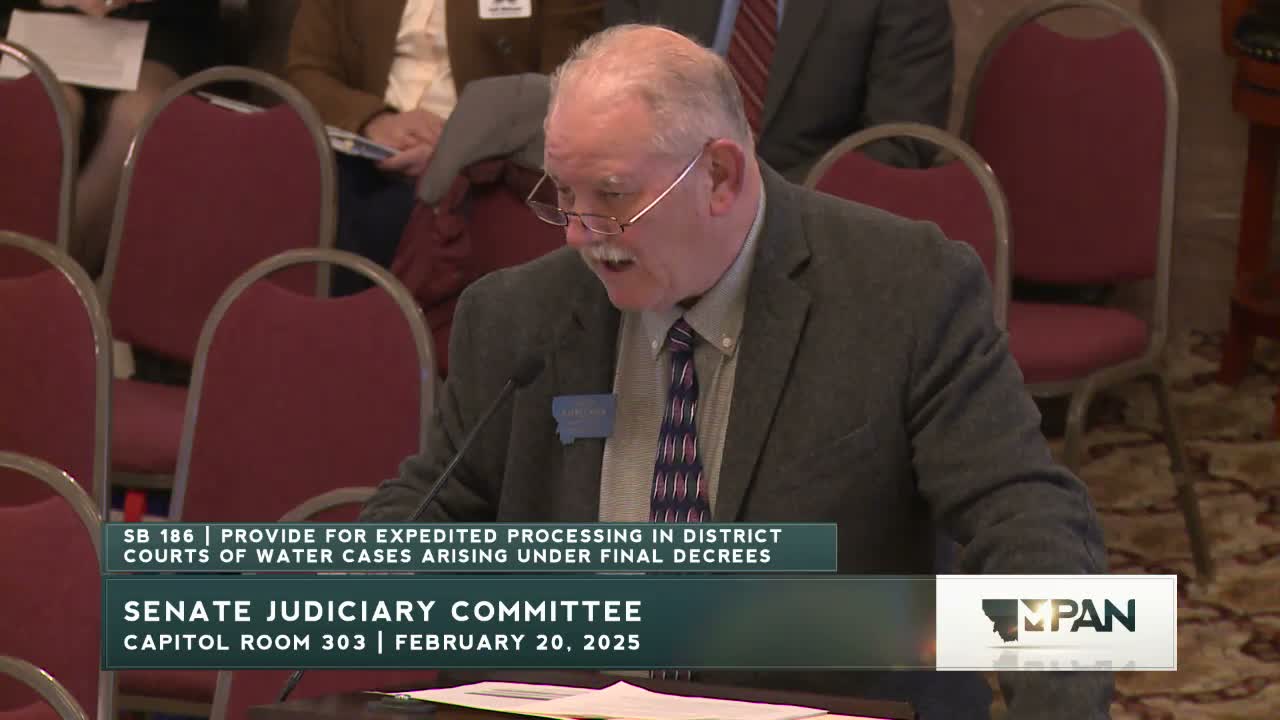
The Senate Judiciary Committee heard hours of proponent and opponent testimony on SB186, which would transfer post‑decree water‑rights enforcement from the Montana Water Court to local district courts as basins receive final decrees. Backers said the change restores local accountability; opponents warned of statutory gaps, clerical burdens, and unresolved Powder River basin claims.
Senator Barry Usher opened the Senate Judiciary Committee hearing on Senate Bill 186 by framing the measure as a return to the original intent behind Montana's water‑rights adjudication: "Montana's Water Court was established in 1979 as a temporary institution... This bill fulfills that intent and promise because it provides for the systematic phase out of the water court as it completes its work basin by basin." Usher said the bill would transfer enforcement, administration and post‑decree litigation back to the district courts once final decrees are issued for each basin.
Proponents at the hearing — including irrigators, ranchers, water commissioners and the Senior Ag Water Rights Alliance — argued the district courts and local water commissioners better reflect local knowledge and accountability. Ross Salmond, a fifth‑generation rancher and El Dorado Cooperative Canal Company president, urged the committee to “please pass Senate Bill 186” and said the bill would keep adjudication and enforcement close to the communities affected. Several witnesses from the Teton River Basin described having resolved enforcement concerns through local commissioners and district court processes without the need for a permanent statewide tribunal.
Opponents raised technical, practical and legal objections. Ryan McLean, a private water‑rights attorney, said the bill contains provisions that could invite relitigation and jurisdictional conflicts, including language directing district courts to take actions that might still fall under the water court’s exclusive jurisdiction for pre‑1973 rights. Chief Water Judge Steve Brown warned that the bill’s plain language would remove the water court’s jurisdiction immediately upon issuance of a final decree for a basin — an outcome he said could leave ‘‘exempt from filing’’ domestic and stock water claims in six Powder River basins without a workable adjudicative forum.
Legal and organizational witnesses also flagged administrative burdens. Brown and other opponents noted that the water court currently performs tasks such as centralized clerical corrections, maintains a statewide database and prepares basin tabulations used by district courts; shifting those responsibilities to individual clerks and judges could slow corrections and add filing costs and delays. Colleen Coyle, a water‑rights lawyer who supported the bill, acknowledged those concerns but said district courts already have tools — temporary judges, special masters and standing masters — to handle technical cases and can coordinate across judicial districts where necessary.
Committee members asked detailed questions about venue and multi‑district rivers, the Powder River basins, and caseload data. Coyle pointed to current interjudge practices and a small number of water cases historically reaching district court outside adjudication (she cited roughly 15 water‑related district court matters in recent years versus some 55,000 total district court filings), and said she believes district courts can use masters and pro tem judges to manage any surge. Opponents countered that district dockets are heavily occupied with criminal and child‑welfare matters, and that specialty courts were created to prioritize technical areas that district courts cannot reliably expedite.
The hearing closed with the sponsor requesting a "due pass" and the committee moving on to other items on the agenda. No formal action was taken on SB186 during the session.
What happens next: The committee may hold follow‑up work on statutory fixes to address specified technical issues (clerical corrections, jurisdictional definitions, and publication requirements for certain basins) before any executive action is scheduled.