Get Full Government Meeting Transcripts, Videos, & Alerts Forever!
Get email alerts on the Child Endangerment topic
No spam. Unsubscribe anytime.
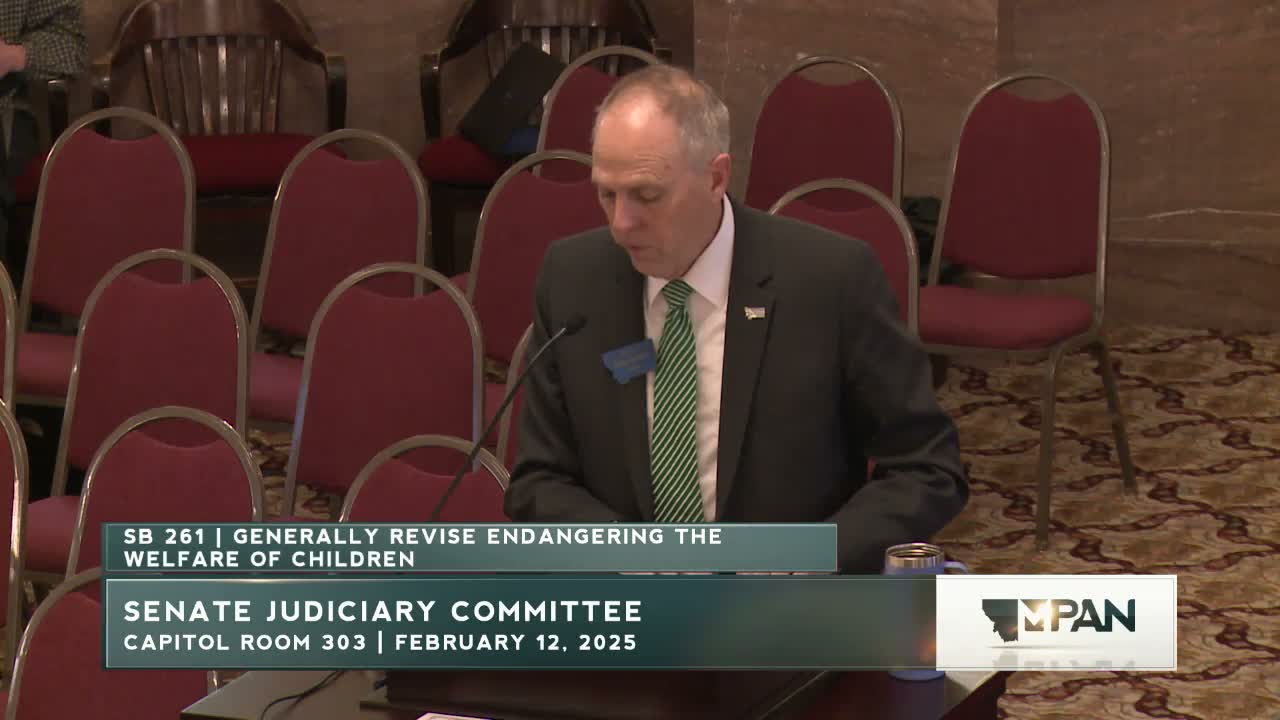
Senate Judiciary hears bill to add fentanyl and THC exposure to child endangerment statute
Summary
Sen. Greg Hertz sponsored SB 261 to expand Montana's child endangerment law to cover causing or permitting a child to inhale, be exposed to, or ingest marijuana/THC products and certain drug-production locations; Attorney General Austin Knudson and prosecutors urged 'do pass' while senators questioned testing and proof standards.
A Montana Senate Judiciary Committee hearing on Senate Bill 261 focused on closing a gap in the state’s child endangerment law to cover fentanyl, marijuana and other controlled substances.
Sen. Greg Hertz (sponsor) said SB 261 expands the offense of endangering the welfare of a child to include “causing or permitting the child to inhale, be exposed to, or ingest marijuana, including marijuana, THC products, such as ingestible foods or drinks,” and extends prohibitions to places where child exposure to criminal production of dangerous drugs or adult-use dispensaries is promoted or assisted.
The bill drew support from Attorney General Austin Knudson, who told the committee the change responds to what prosecutors and investigators described as a missing tool after last session’s fentanyl-related bills. “When we go into a house ... if we find meth precursors, meth paraphernalia we can charge felony criminal endangerment of a child if there’s children in the home. But he said you guys forgot that for fentanyl,” Knudson recounted, arguing SB 261 would give officers “another tool in the toolbox to make sure that our children are safe across the state.”
Assistant Attorney General Celine Koepke, who helped draft portions of the bill, emphasized prosecutorial burdens: to bring charges the state must prove someone “knowingly exposed their child” to a listed drug and that criminal cases remain a facts-and-circumstances analysis. Koepke said that in many custody-dispute hypotheticals, charges would be unlikely without evidence of knowing conduct.
Senators questioned forensic testing methods and evidentiary thresholds. The state crime lab’s chemistry supervisor said the lab typically tests items found in the home (toys, walls, swabs) for residue and that hair-follicle testing is not performed by the lab. On how tests are reported, witnesses described many existing investigative tests as returning positive/negative results rather than finely calibrated concentration levels.
Sen. Hertz framed the measure as a response to concerns about high-potency marijuana and the public-health risk to children: “When you’ve got somebody in their home ... blowing smoke into the child’s face to get them to inhale smoke we have a problem.” He asked the committee for a do-pass recommendation and invited colleagues to propose amendments as needed.
The committee closed the hearing on SB 261 with proponents from law enforcement and the attorney general’s office available for follow-up.
Next steps: the bill was left before the committee for further consideration; sponsors and the attorney general indicated willingness to work on amendments to clarify application and evidentiary questions.