Get Full Government Meeting Transcripts, Videos, & Alerts Forever!
Get email alerts on the Land Use Data Centers topic
No spam. Unsubscribe anytime.
Coweta commissioners narrow data‑center draft: permit in light industrial zones, 300‑ft residential buffer, weekday generator testing
Summary
After extended review of public comments and technical issues, commissioners directed staff to make data centers a permitted use in LM (and therefore in M), require will‑serve letters for utilities, set a 300‑foot buffer from residential property (first 100 feet undisturbed), adopt building-design and noise-testing controls, require construction-traffic plans and bonds, and return a redlined ordinance for August 19 public review.
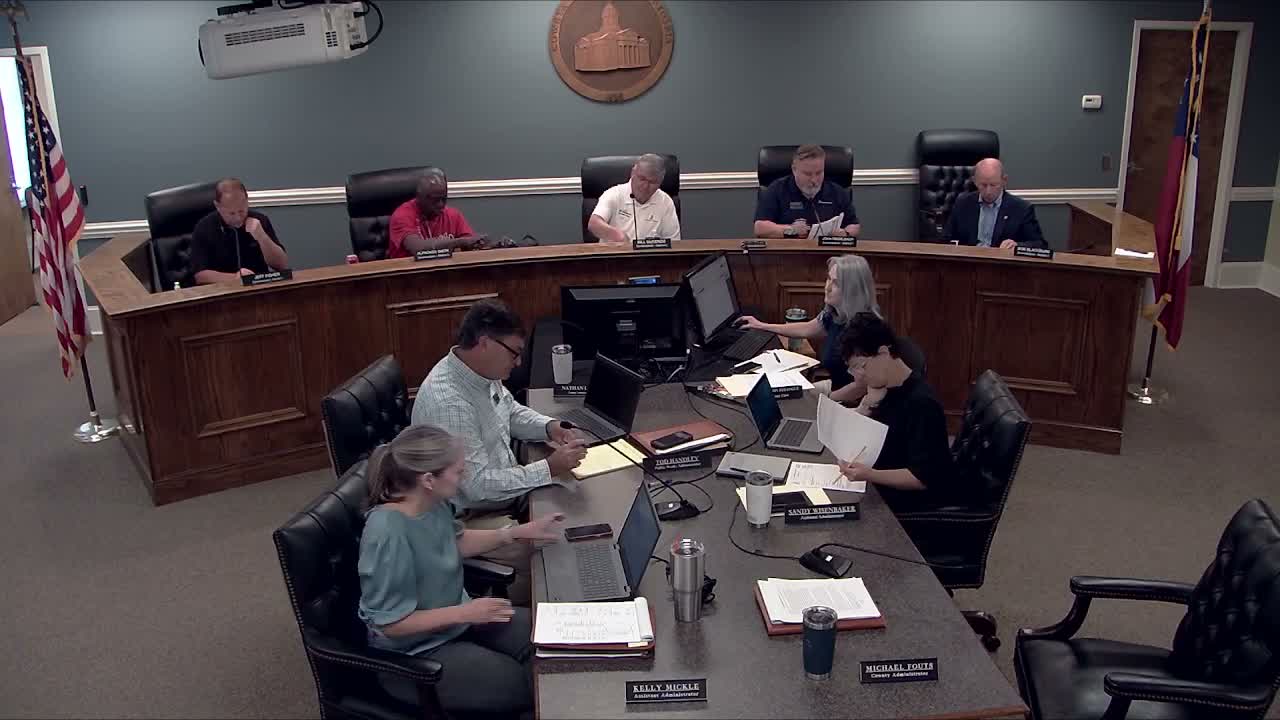
The Coweta County Board of Commissioners spent the afternoon of July 22 working through a detailed, redlined draft of a proposed data‑center ordinance and the public comments the county received. After extended discussion, the board gave staff direction on several major points that will be incorporated into a revised draft and returned for public review before a continuation of the public hearing on August 19.
Zoning and entitlements: Staff asked whether data centers should be allowed by right in the Light Industrial (LM) district and therefore automatically permitted in M (Industrial). Several commissioners favored allowing data centers by right in LM (with LM minimums and conditions), noting that developers may still seek rezoning or other entitlements if required by the comprehensive plan. Staff said the ordinance will retain will‑serve requirements for electrical, water and sewer capacity.
Utilities and power: Commissioners and staff discussed the practical limits of utility service and the role of Georgia Power, EMC and MECA. Staff agreed that applicants must provide written verification from applicable utility providers demonstrating adequate existing supply or documented plans for service (a “will‑serve” letter or equivalent). Staff noted issues when multiple utilities and feeder arrangements are involved and the need to clarify what happens when utility providers cannot commit capacity.
Design, buffers and visibility: The board directed staff to require a 300‑foot buffer between data‑center footprints and property zoned or used for residential purposes, with the first 100 feet maintained as undisturbed vegetation or equivalent berm/landscape treatment. If buildings are publicly visible from the roadway, the draft’s building‑design standards will apply: façade articulation, non‑reflective high‑quality materials (brick, stone, architectural metal panels, composite panels), and screening for mechanical equipment and substations.
Height and emergency response: The draft’s base height was left at the ordinance’s standard (about 34 feet) with an administrative variance pathway to 60 feet (staff, fire marshal and airport official sign‑off). Coweta fire representatives confirmed ladder and apparatus reach for the adopted height limits and said the county has a 100‑foot ladder on order.
Noise and generator testing: Staff and a consultant proposed pre‑construction noise surveys and thresholds tied to preconstruction ambient noise levels. The board directed staff to require acoustical testing as part of final inspections and to limit routine generator testing to weekdays (Monday–Friday) during daytime hours (approx. 9 a.m.–5 p.m.), excluding holidays, and to remove the narrower “three days per week” testing restriction. If acoustical measurements exceed thresholds before CO issuance, equipment must be enclosed, baffled or mitigated.
Construction traffic, bonds and waste management: Commissioners asked that construction‑traffic plans be reviewed and approved by public works and the sheriff’s office and that developers provide bonds to cover potential road damage. For e‑waste and equipment disposal, staff will require an annual, public waste‑management report from operators; enforcement of hazardous‑materials or air‑quality issues remains with state regulators (EPD) where applicable.
Next steps: Staff will incorporate board direction—making data centers permitted in LM/M with the noted conditions, adding line numbers for redline review, and drafting decommissioning language—and post the revised draft for public review before the August 19 continuation of the public hearing.