Get Full Government Meeting Transcripts, Videos, & Alerts Forever!
Get email alerts on the Corrections topic
No spam. Unsubscribe anytime.
Coweta County to begin phasing out local work-release/transitional center use and explore housing more state inmates
Summary
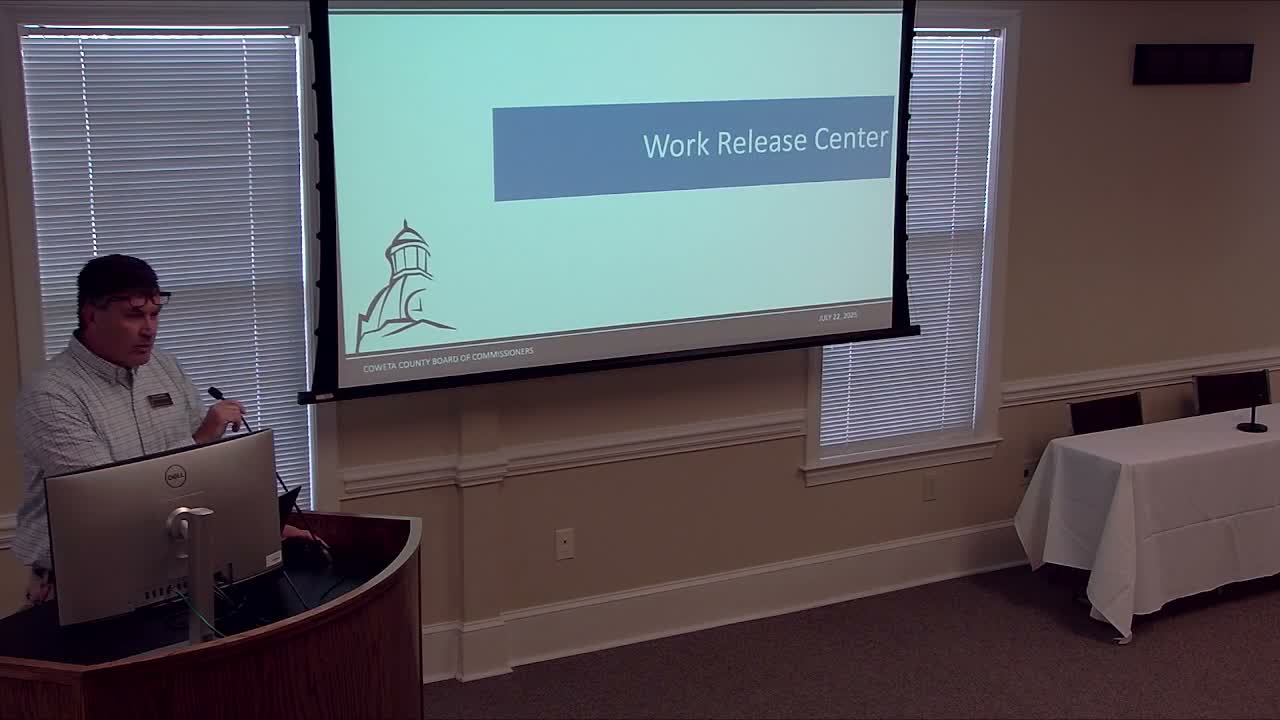
Warden Rogers and jail administrators proposed stopping new local work-release applications and shifting available capacity to house more state inmates for public-works details; the board directed staff to phase out the TC/work-release component and return with a detailed implementation plan, including staffing and court coordination.
Coweta County’s corrections leadership told commissioners on July 22 that the county’s work-release/transitional center (TC) has not reached capacity for many years and that operational and state-policy changes have limited local courts’ use of the program. Warden Rogers and county corrections staff proposed phasing out the county’s transitional-center/work-release function and replacing those beds with additional state inmates, which would allow the county to increase the regular workforce assigned to public-works and outside details.
Officials said the county’s current capacity arrangement includes roughly 248 beds in the county facility with a configuration historically described as 216 for state inmates and 32 for transitional/work-release inmates. Staff reported the transitional center side has often been underused (generally filling 10–20 beds rather than 32) while the county sends about 140 offenders out daily on work details. County corrections staff suggested stopping new applications to the work-release program as a first step and managing current county offenders as their sentences permit, working with courts and attorneys to seek sentence modifications where practical.
Corrections leadership estimated the change would require hiring additional correctional staff (roughly one floor officer per shift, four officers total) and noted some revenue is available from state per-diem subsidies when housing state inmates. Commissioners asked about selection criteria for work assignments, compensation for offenders (which staff said is paid by employers and includes a nominal rent to the work-release center), security risks when offenders work unsupervised, and how the county would phase the proposal without leaving current participants without options.
The board instructed staff to pursue a phased approach: stop accepting new local work-release applications, work with courts and defense counsel on transition plans for inmates currently in the program, and return with a costed implementation plan for board review before any formal budget changes. No binding policy change or appropriation was adopted at the July 22 work session; staff will present detailed operational and fiscal analyses before the board takes formal action.