Get Full Government Meeting Transcripts, Videos, & Alerts Forever!
Get email alerts on the Funeral Services topic
No spam. Unsubscribe anytime.
Senate Business and Labor advances interim study on funeral services, alternative dispositions
Summary
The Senate Business and Labor Committee voted to pass House Joint Resolution No. 27, directing an interim study of morticians, funeral-service regulation and alternative final dispositions such as natural organic reduction (green burial) and alkaline hydrolysis (water cremation). The resolution passed in executive action and will move to the floor.
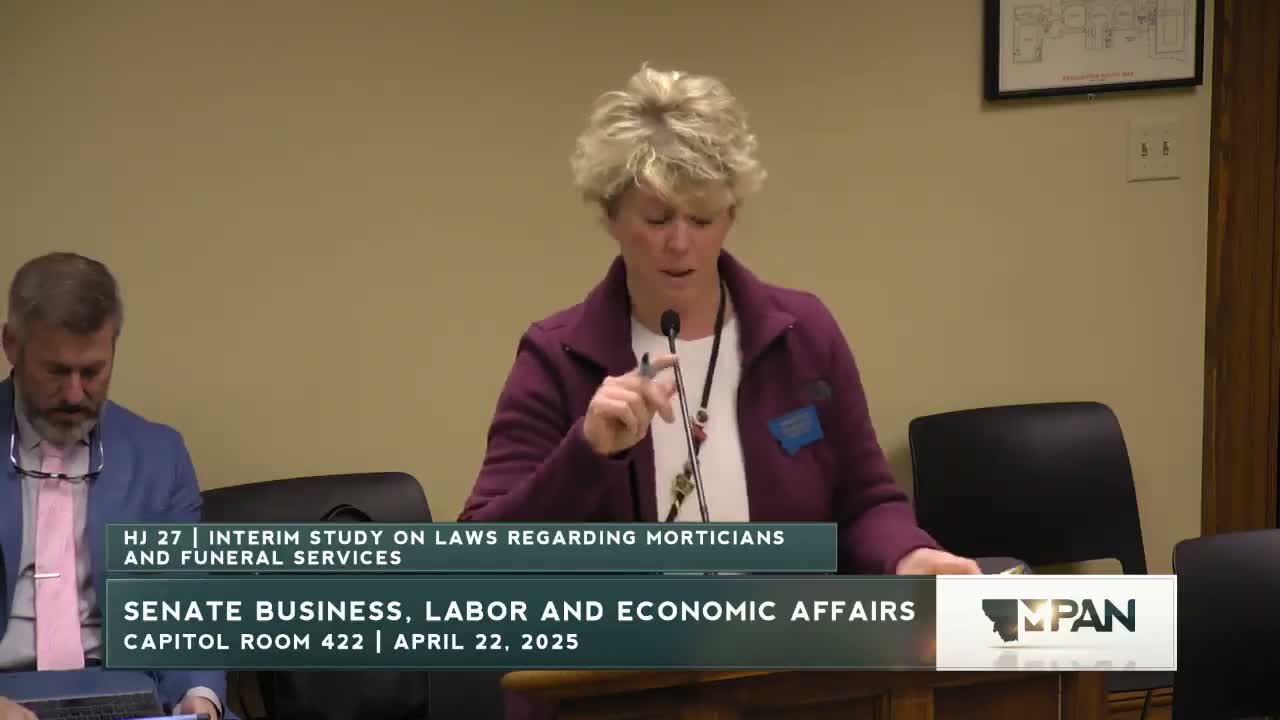
Representative Denise Baum (House District 45) presented House Joint Resolution No. 27 on behalf of constituents seeking alternatives to traditional burial and cremation, and the Senate Business and Labor Committee voted to pass the resolution in executive action. The measure requests an interim study into morticians, funeral services, licensing and emerging final-disposition methods including natural organic reduction and alkaline hydrolysis.
Baum told the committee HJ 27 grew out of constituent experience with multiple family deaths and a desire for more time to grieve and for additional disposition options. "I bring before this committee today HJ 27, which is a request for an interim study on morticians and funeral services along with studying alternative final dispositions such as natural organic reduction and alkaline hydrolysis," she said. Baum said boards anticipate bringing substantive legislation in 2027 and that the interim study would allow code cleanup and coordinated definitions across statute and administrative rules.
Brad Longcake, testifying for the Montana Funeral Directors Association, said existing law is fragmented and estimated roughly 80 pages of code would require streamlining. "By utilizing the services and the expertise of the Funeral Directors Association as well as working with the Board of Funeral Services, we can clean this up, streamline the process, and ensure that this is done correctly moving forward," Longcake said.
Kevin Bragg, bureau chief in the Professional Licensing Bureau at the Department of Labor and Industry, said the bureau is administratively attached to the Board of Funeral Service and supports an inclusive interim process. He said the department expects to involve the board, the Funeral Directors Association, licensees who are not association members, and legislators so the study reflects stakeholder input rather than a single‑agency solution.
Committee members raised questions about scope, cultural inclusion, cost and technical details. Senator Weber asked whether federally recognized tribal governments would be included; Baum agreed tribal representation should be included. On costs and environmental impacts, Baum and witnesses cited model programs in Washington and Colorado and noted private firms such as Recompost that accept soil from green-reduction processes for restoration forestry projects. Baum also cited data from the Green Burial Council on funeral‑industry resource use and claimed natural organic reduction uses roughly one‑eighth the energy of cremation and saves more than a metric ton of CO2 per person versus some traditional practices.
Members also asked about current Montana law on private burials. Baum said private property burials are permitted with limits — currently up to five persons on private land without a county cemetery permit — and that Mountain View Cemetery in Billings is an established site that offers green burial in the region.
The committee moved to executive action. Representative Maugham moved the do‑pass motion on HJ 27. After brief additional discussion and a roll call that included a proxy vote for Vice Chair Trebes, the committee recorded HJ 27 as passed and designated a floor carrier. The committee then adjourned.
The resolution does not itself change statute or administrative rules; it requests an interim study to develop recommendations and possible draft legislation for a future session. Next steps: the interim study process, stakeholder meetings and any draft bill language would occur before the 2027 legislative session as noted by the sponsor.