Get Full Government Meeting Transcripts, Videos, & Alerts Forever!
Get email alerts on the Insurance Wildfire Risk topic
No spam. Unsubscribe anytime.
Montana bill would let homeowners demand explanation of wildfire risk scores used by insurers
Summary
House Bill 533 would require insurers that use wildfire or natural‑catastrophe scores for underwriting Montana residential property to provide, upon request, explanations of how a property was scored. Proponents said the change would help consumers contest nonrenewals; insurers largely signaled support with minor language edits.
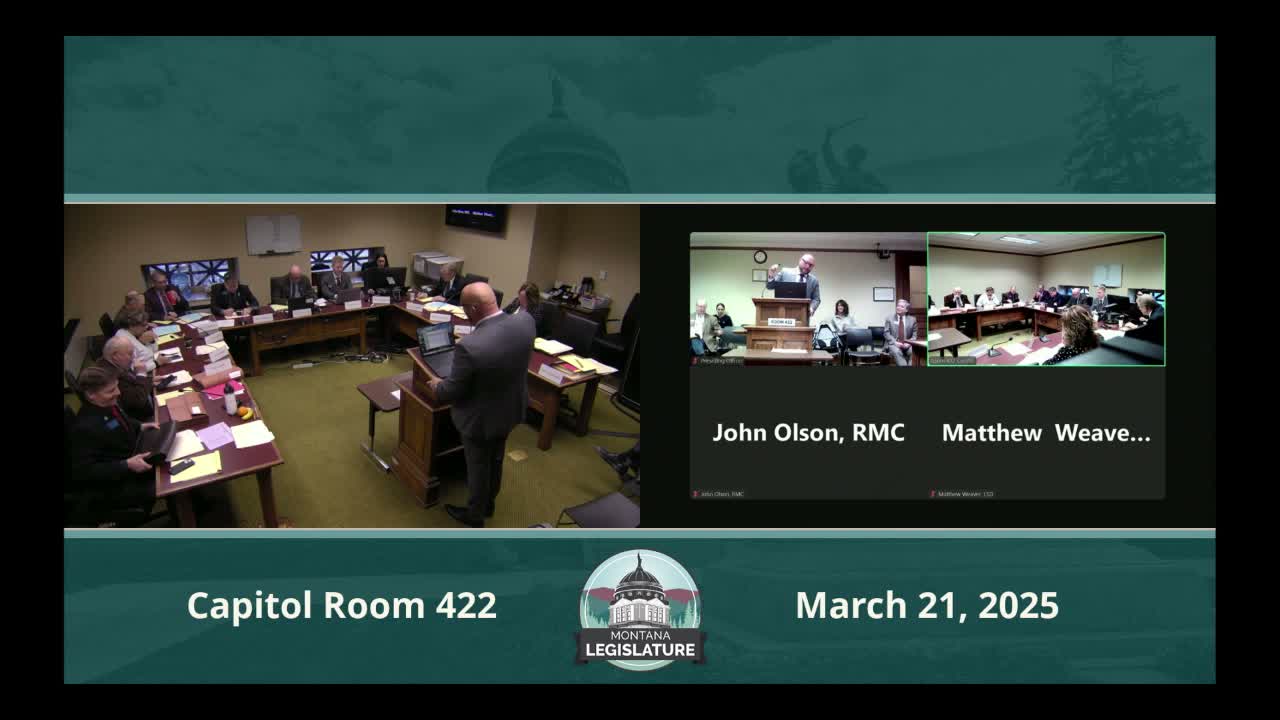
Representative Curtis Schomer, House District 48, opened a committee hearing on House Bill 533, saying the measure is a consumer‑protection bill that would require insurers using wildfire risk scoring to provide certain information to an insured or the insured’s producer upon request. "House bill 533 requires insurers in Montana using a wildfire risk score for underwriting residential property to provide certain information upon request to enhance transparency," he said.
Industry and mitigation advocates described cases in which homeowners were nonrenewed or moved to surplus lines markets after third‑party fire‑risk scores were applied. Bob Biskupiak, representing the Independent Insurance Agencies of Montana and FireSafe Montana, told the committee homeowners have been "canceled or non renewed by insurance companies because of their fire score," and said third‑party vendors and algorithms can produce inconsistent results for similar homes. Proponents urged that disclosure would permit an appeal or mitigation that could preserve coverage.
Representatives of State Farm and NAMIC testified they generally support the transparency concept and commended the sponsor for working with industry; a State Farm representative said the company has "a robust analysis, process and algorithm" and would follow up on technical expert contacts requested by senators. Amy Grimales of the American Property and Casualty Insurance Association proposed a narrow wording change (a one‑word substitution in section 1) to clarify whether the statute applies to rating "in" evaluation or to rating "or" evaluation; proponents and insurers indicated that minor drafting changes could be acceptable.
Committee members asked witnesses to provide sample score reports or the wildfire risk score materials used in underwriting; State Farm and Rocky Mountain Insurance Services committed to attempt to locate examples and follow up with the committee. No formal action or vote occurred at the hearing; Representative Schomer closed the hearing urging concurrence.
Next steps: The bill sponsor said stakeholders had largely been cooperative and the committee will consider any technical amendments to address the industry’s one‑word suggested change. The hearing concluded without a recorded vote.