Get Full Government Meeting Transcripts, Videos, & Alerts Forever!
Get email alerts on the Wildlife Management topic
No spam. Unsubscribe anytime.
Farm Bureau says grizzly delisting is prompting safety concerns; asks for livestock‑loss funding and tools
Summary
Carly Johnson of the Montana Farm Bureau recounted close encounters with grizzly bears, advocated for shifting from individual-bear responses to population-level state management, and asked for more funding for the livestock-loss board and mitigation measures such as electric enclosures.
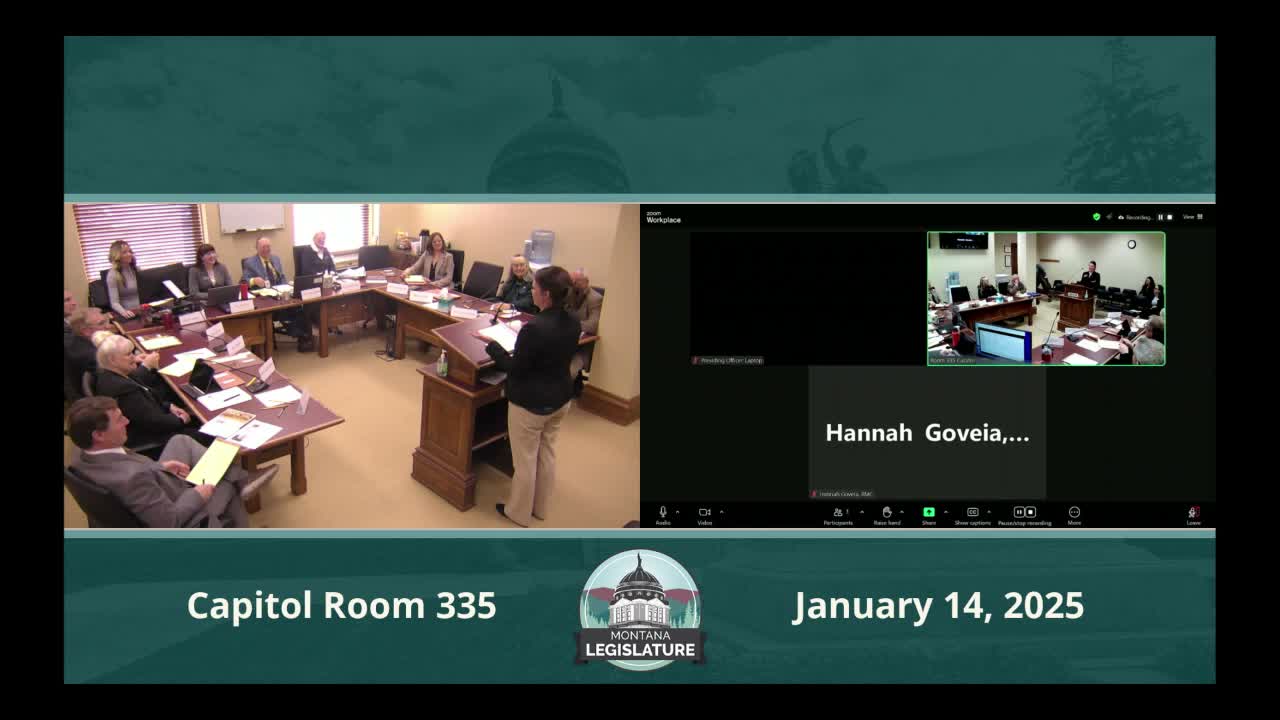
Carly Johnson, state affairs coordinator for the Montana Farm Bureau, told the Agriculture committee that a recent delisting decision complicates local management and reduces tools available to address bears that repeatedly use lands near towns and ranches.
Johnson described repeated encounters on her property near town and urged lawmakers to consider population‑level management powers rather than focusing solely on individual bears: "we could switch to a state management system where we weren't focused on individual bears necessarily," she said, arguing that the current approach can allow problem bears to survive and breed near communities.
She recounted a sow that appeared in a town park and later walked through her yard, then returned the next spring with three cubs, and described the limitations of hazing and nonlethal responses in some situations. Johnson said the livestock‑loss board helped pay for a 12‑acre grizzly enclosure on her property, but she noted that there is no comparable funding stream available for in‑town human‑protection uses.
Committee members and other witnesses shared anecdotes and photos of problem bears; one witness described a radio-collared boar and said the tracking device no longer worked. Johnson discussed mitigation tools—bear‑management specialists using cracker shells for hazing—and estimated an electric woven-wire enclosure had cost roughly $15,000 several years ago.
Johnson asked the committee to consider additional funding for prevention and for livestock‑loss compensation programs. The testimony was framed as a request for more tools and resources rather than a specific statutory text presented for immediate action.