Get Full Government Meeting Transcripts, Videos, & Alerts Forever!
Get email alerts on the Income Tax topic
No spam. Unsubscribe anytime.
Committee tables Sen. Yakawich’s bill to redraw income tax brackets after split testimony on who benefits
Summary
Senate Bill 203, proposed by Sen. Mike Yakawich to raise the threshold for higher income tax rates and cut marginal rates for many filers, drew sharply divided testimony over distributional impacts and fiscal cost; the committee later tabled the measure pending further review.
Sen. Mike Yakawich introduced Senate Bill 203 to raise the income threshold before the top personal income rate applies and to lower certain marginal rates, saying the change would ease the tax burden on middle-income Montanans.
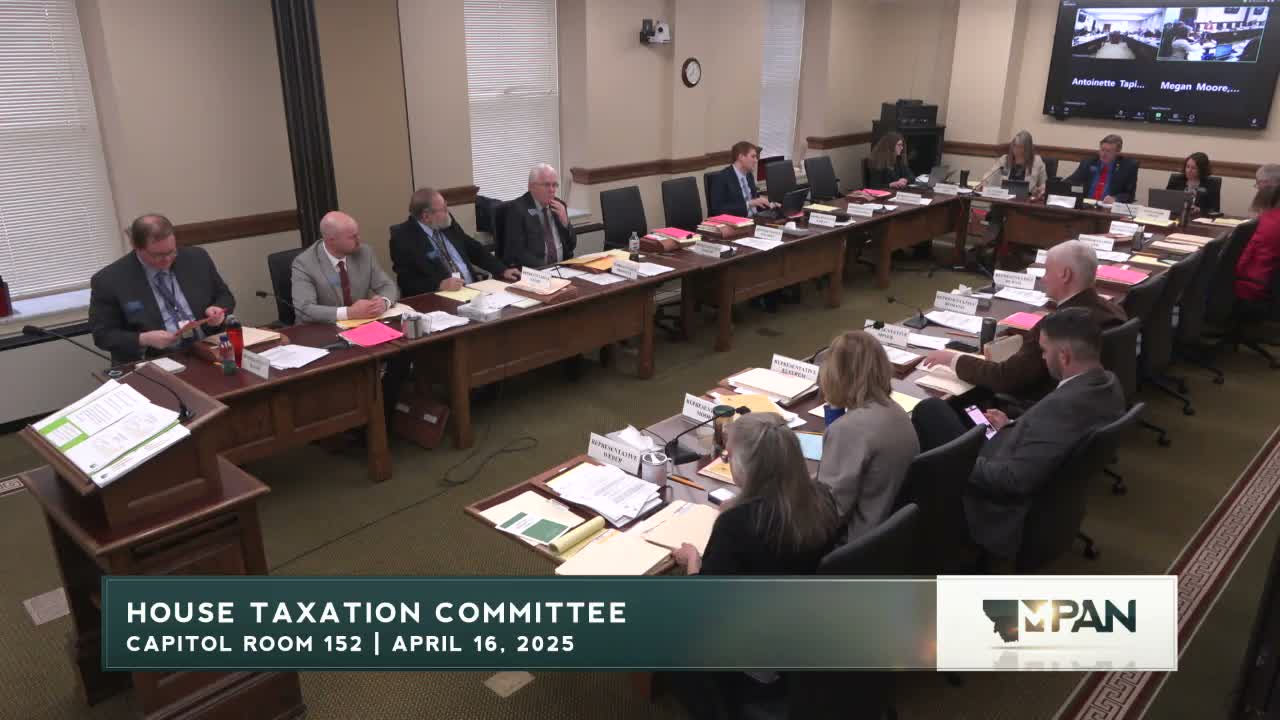
Yakawich told the House Taxation Committee the bill ‘‘focuses on the middle class’’ and offered examples showing a married couple with $150,000 federal adjusted gross income would see an estimated $933 annual reduction in state tax liability, a roughly 14 percent decrease compared with current law. He asked the committee to carry the bill to the floor for fuller consideration.
Opponents, including Rose Bender of the Montana Budget and Policy Center and Dylan Saarb of Catalyst Montana, countered that the fiscal note projects a sustained, large loss of income tax revenue. Bender cited modeling (Institute on Taxation and Economic Policy cited in testimony) showing the largest share of the bill’s benefits would go to higher-income households and said the proposal would reduce the income tax system’s ability to offset regressivity in sales and property taxes.
Dylan Saarb told the committee SB203 would ‘‘not benefit low-income Montanans’’ and estimated the measure could cost roughly $500 million per biennium in near-term years, urging members to vote no and to invest revenue in services such as housing, child care and behavioral health instead.
Department of Revenue witnesses Aaron McNay and Jake Ford were available to answer questions on the fiscal note and administration. Committee members asked about distributional impacts and fiscal forecasts; Yakawich acknowledged the cost and urged the Legislature as a whole to weigh the trade-offs.
At the executive-action session the committee first voted on a motion that SB203 be concurred in; the roll call recorded opposition and the motion failed. The committee then moved to table SB203; the tabling motion passed by voice vote with the committee recording the tabling as 21–0.
The committee’s action leaves SB203 inactive pending further fiscal analysis or floor action.
Ending: The committee saved the bill for later consideration and will consider it again when further fiscal information and floor scheduling are available.