Get Full Government Meeting Transcripts, Videos, & Alerts Forever!
Get email alerts on the Budget topic
No spam. Unsubscribe anytime.
Fullerton council reviews $137.8 million general‑fund budget, weighs reserves and tax options
Summary
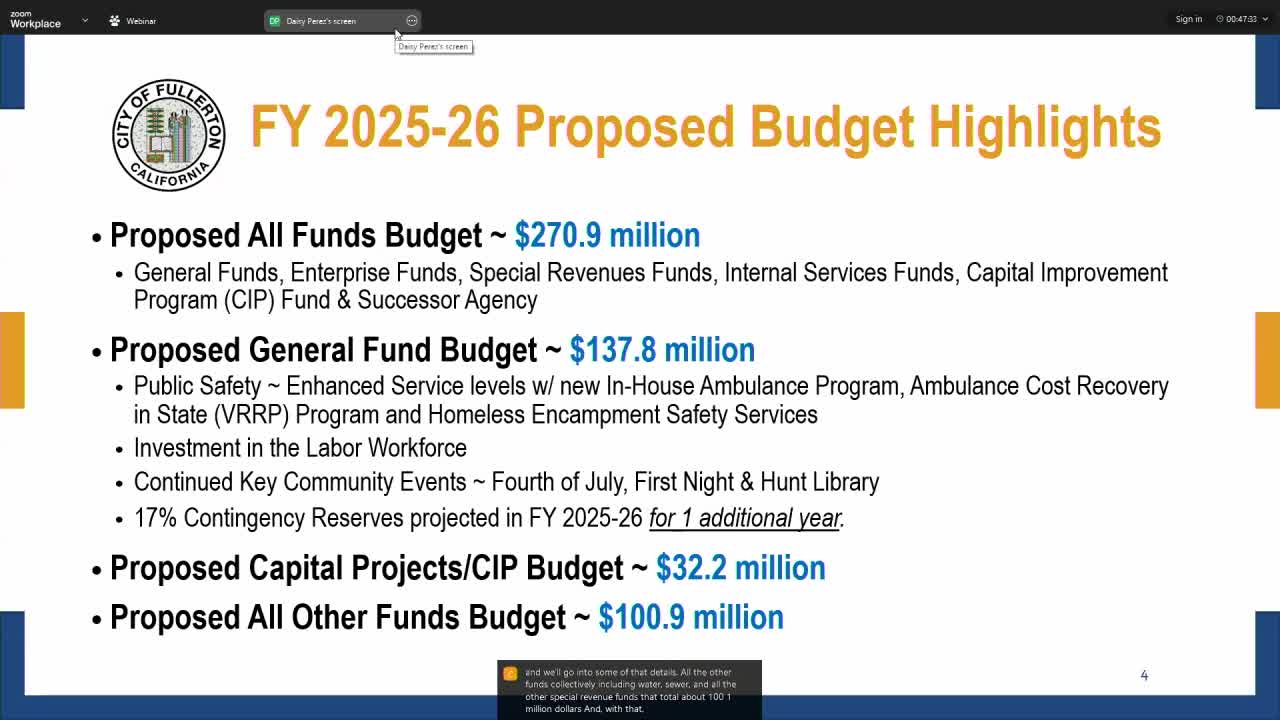
City staff presented a proposed FY 2025–26 general fund budget of $137.8 million that would be balanced using cost containment and a $3.95 million draw from reserves; council asked staff for more analysis and agreed to agendize sales‑tax options for public review.
City staff on May 13 presented the City of Fullerton’s proposed FY 2025–26 operating and capital budgets, telling the council the general fund plan totals roughly $137.8 million and will rely on a mix of ongoing revenues, spending reductions and a one‑time draw of about $3.95 million from reserves to balance the year.
The budget managers framed the proposal around the council’s priorities for public safety, infrastructure and organizational stability. "The proposed budget will be balanced with ongoing revenues, cost reductions, and use of $3,950,000 of reserves," City Manager Steven Avalos said, adding that public‑safety enhancements and recently approved labor agreements are a primary driver of higher expenditures.
Staff warned of longer‑term structural pressures even with this one‑year balance. The five‑year forecast presented at the meeting shows the budget gap reopening in later years because of rising pension liabilities (CalPERS unfunded actuarial liability), salary and benefit increases tied to approved labor agreements, and ongoing infrastructure needs. "You can't cut your way into making those numbers turn black," the administrative services director said when outlining the projection.
To limit the draw on reserves, staff outlined alternative options that the council could consider: deferring or delaying capital and IT projects (a fire‑network upgrade and PC refresh were cited), adopting a 3 percent department vacancy hold, seeking additional 2 percent operating reductions, or eliminating some community events. Staff estimated the citywide proposed CIP at about $32.2 million and said roughly half of the CIP work is water system projects and a significant portion is street rehabilitation.
The council and staff also reviewed recommendations from the ad hoc fiscal sustainability committee. That panel recommended consideration of changes to the transient occupancy tax (TOT) — the committee supported examining an increase from 10 percent to 12 percent — and discussed a range of sales‑tax measures, including a half‑cent dedicated streets measure and a separate half‑cent for public safety, and a 1 percent general sales tax option. Staff estimated a half‑cent measure would generate roughly $15 million and a 1 percent increase roughly $30 million annually, depending on the economy.
Public commenters urged prioritizing parks and trail projects, maintaining library hours, and preserving community events while urging greater transparency about ad‑hoc votes and program costs. Several speakers stressed that the city should publish a department‑level breakdown of the positions held as part of the 3 percent vacancy factor.
Council members asked staff to provide clearer, public‑facing materials and cost comparisons of the revenue options. The council agreed to agendize the sales‑tax options for further discussion and comparison at a date certain for May 20, directing staff to return with analysis comparing dedicated and general measures. Staff said the proposed crystallized budget is planned to return to council for formal adoption on June 3.
What’s next: staff will prepare more detailed department‑level information, cost comparisons of ballot measures, and the final budget materials for the June 3 adoption hearing. The council also scheduled public outreach (a community meeting is planned for May 21) to gather resident input before formal action.