Get Full Government Meeting Transcripts, Videos, & Alerts Forever!
Get email alerts on the Electronic Legal Materials topic
No spam. Unsubscribe anytime.
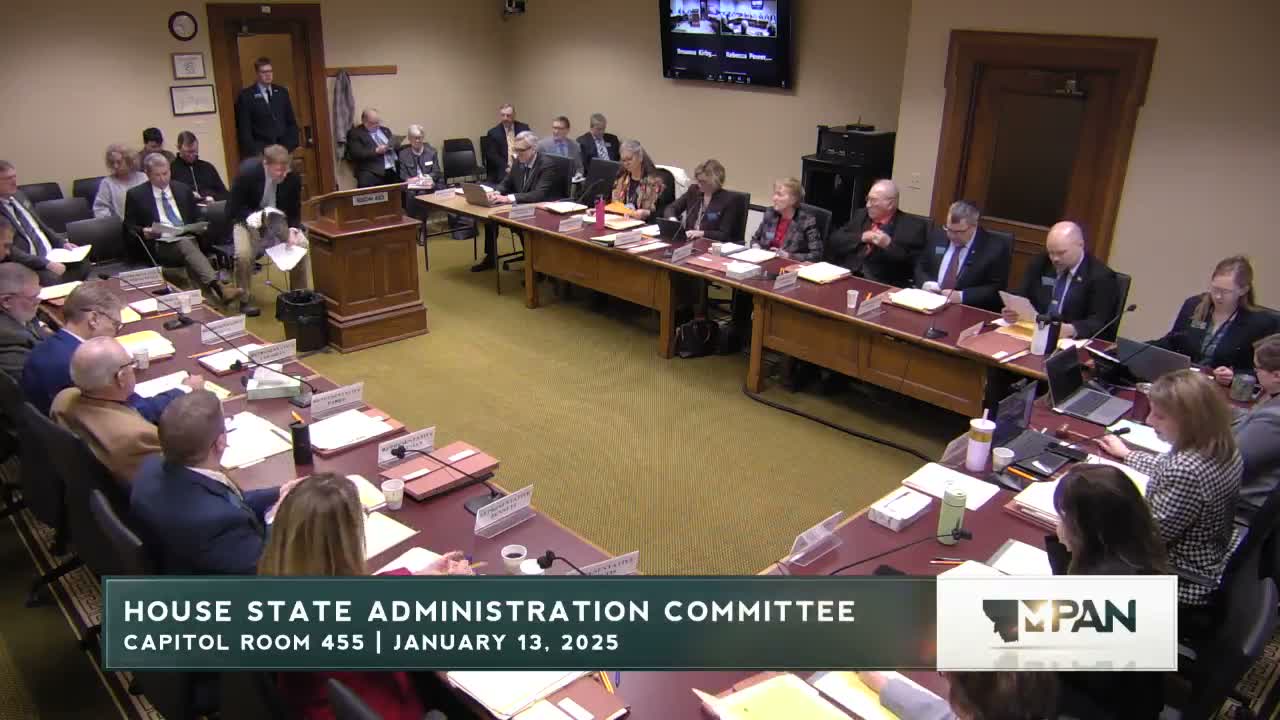
Committee hears bill to let Montana designate official electronic legal materials
Summary
A House committee heard House Bill 111, which would allow the co-commissioner’s office to authenticate and designate electronic versions of Montana’s constitution, session laws and Montana Code Annotated as official records while preserving paper copies and requiring verification and backup systems.
The House State Administration Committee heard testimony on House Bill 111 on a bill to adopt the Uniform Electronic Legal Material Act, which sponsors say would let the Legislature and its staff designate official electronic versions of Montana’s legal texts and provide ways for the public to verify authenticity.
Representative Steve Fitzpatrick, the sponsor, told the committee the bill’s goal is to “enable the end users of legal materials to verify the trustworthiness of the legal material” and to set procedures for preserving and authenticating online law so older versions are not lost.
Proponents included Jacqueline Landmark, a uniform law commissioner, who urged the panel to give the measure a favorable recommendation and described the Uniform Law Commission’s work producing model acts for states. Bruce Spencer, representing the State Bar of Montana, said legal practice is now largely paperless and that recognition of online legal materials would benefit lawyers, businesses and the public.
Jared Coles, a nonpartisan attorney in the Legislative Services Division who drafted the bill, told the committee that under current practice “those are the only official laws in Montana at this point in time,” referring to the printed code volumes. He said the bill would allow the co-commissioner’s office to designate an electronic record as an official document — limited in this draft to the constitution, the session laws and the Montana Code Annotated — and to include measures for verification so users can confirm they are seeing an authentic, official text.
Coles also said the legislation would not require eliminating printed books: “The books probably will be around way after my time,” he said, adding that electronic publication could make official materials available earlier than the printed volumes.
Committee members pressed staff on costs. Coles said the fiscal note reflects conservative IT estimates for developing authentication tools and that some states have implemented similar systems with lower costs; he noted any electronic designation would proceed only if money were allocated.
Representative Fitzpatrick closed the hearing; the committee did not take immediate action and will consider the bill at a later executive session according to the panel’s schedule.