Get Full Government Meeting Transcripts, Videos, & Alerts Forever!
Get email alerts on the Water Rates topic
No spam. Unsubscribe anytime.
Uxbridge consultants recommend 22% water rate increase to fund multi‑year capital plan; commissioners ask for alternatives
Summary
Town consultants told the Water & Sewer Commissioners a 22% water rate increase is needed to build reserves for roughly $37 million in upcoming projects; commissioners requested alternative models that delay or remove certain projects and asked staff to return with senior and need‑based discount scenarios.
Consultants from Ty and Bond told the Town of Uxbridge Water & Sewer Commissioners that large capital needs — including a projected $20 million PFOS treatment project and roughly $4 million in water main work — require a near‑term increase in rates to avoid much larger spikes later.
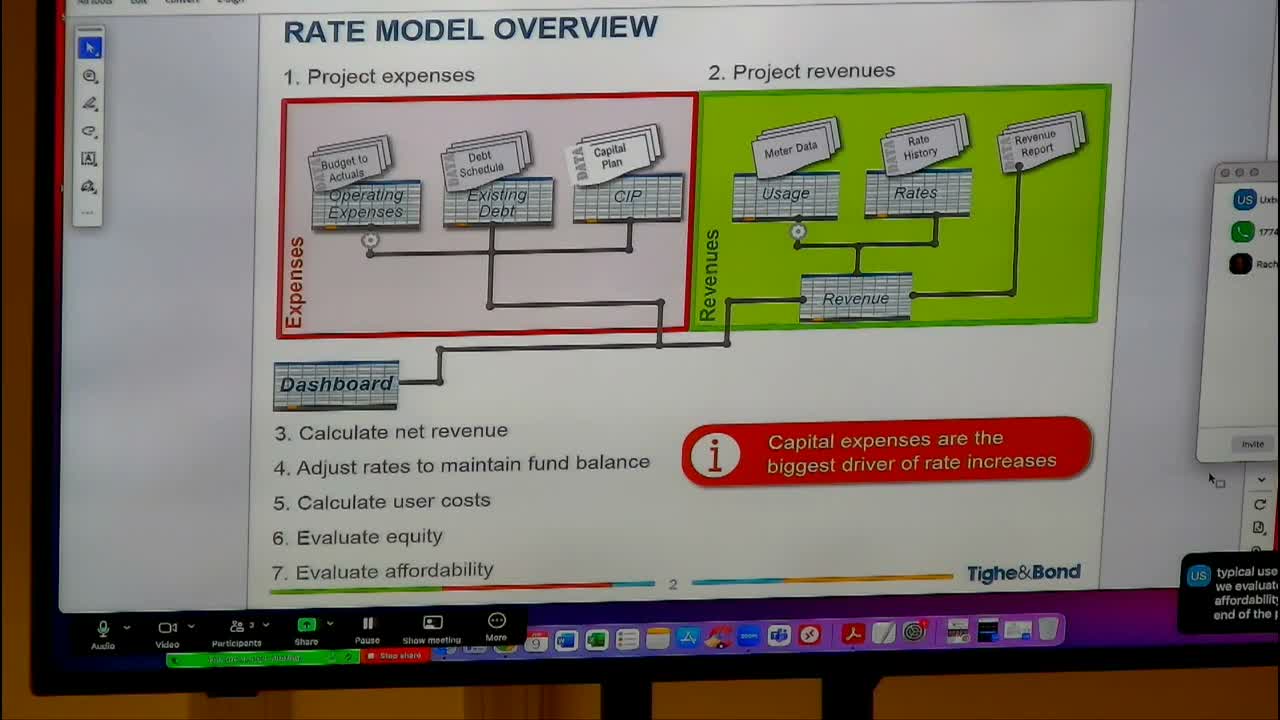
"We are projecting the need for a 22% rate increase," Joshua Bouchard, project engineer for Ty and Bond, told commissioners during the continued public hearing. He said the 22% increase would be applied broadly and is intended to build retained earnings in fiscal 2026 so the town can spread future debt service more evenly and avoid a potential 40–50% jump in later years.
The recommendation rests on the consultants’ assumptions about capital costs, projected usage growth and debt service. Bouchard summarized the capital pipeline as roughly $37 million in projects across the plan horizon, with FY26 including a $90,000 one‑time draw on retained earnings and later years including a $20 million water treatment project and a $4.0 million water main improvement. The consultants modeled escalators for operating line items and assumed modest customer growth (about 1% per year) and a conservative usage trend.
Public‑facing dollar impacts were emphasized by commissioners and speakers. Under the model shown, a typical three‑bedroom household’s water bill would rise from about $514.73 to $627.97 annually with the 22% increase — roughly $25–$30 per quarter, the consultant said.
Commissioners pressed staff for alternatives. Several members asked the director of public works and the consultants to re‑run the model with specific projects removed or deferred (examples discussed included a $3.0 million alternate project and the $4.231 million Douglas Street water main), and to show an option that spreads rate increases more evenly across the five‑year window. Joshua and Ben Sherman, the town’s director of public works, cautioned that flattening the near‑term increases without changing project timing would leave retained earnings vulnerable and likely force larger increases when major debt payments begin to hit in FY28.
The board also discussed affordability measures. The consultants presented a senior discount example — a 15% usage reduction applied to qualifying senior customers — and estimated its tradeoffs. Peter (a commissioner who asked for clarification) and others urged that any discount combine age and financial need rather than using age alone; staff agreed to return with two scenarios: an Option A that pairs age plus income qualification and an Option B that is strictly need‑based.
Several members of the public addressed the commission during the hearing. Pat Steffen urged stronger conservation outreach and praised the town’s new meters for leak detection; Mike Petoskey criticized presenting a broad 22% increase in a legal notice as misleading, calling the reserve‑building approach a form of an advance fund. Jeff Shaw asked whether a more moderate 15% increase today followed by steadier rises would be feasible; consultants responded that doing so without trimming capital projects would result in much larger increases later.
What’s next: Commissioners directed staff to provide alternate model runs that remove or delay selected capital projects, to supply competitor septage‑fee tables (for the related sewer/septage discussion), and to return with the two affordability options and the senior/need‑based cost impacts before the continued hearing on 06/23/2025. No rate was adopted at the meeting.