Get Full Government Meeting Transcripts, Videos, & Alerts Forever!
Get email alerts on the Merchandising topic
No spam. Unsubscribe anytime.
Committee tables mascot and asks merchandising subcommittee to refine options
Summary
After debating an ox mascot and stuffed‑animal merchandising (pricing and sponsorship), the Uxbridge 300th committee voted to table mascot decisions and asked a subcommittee to develop affordable production and sponsorship options.
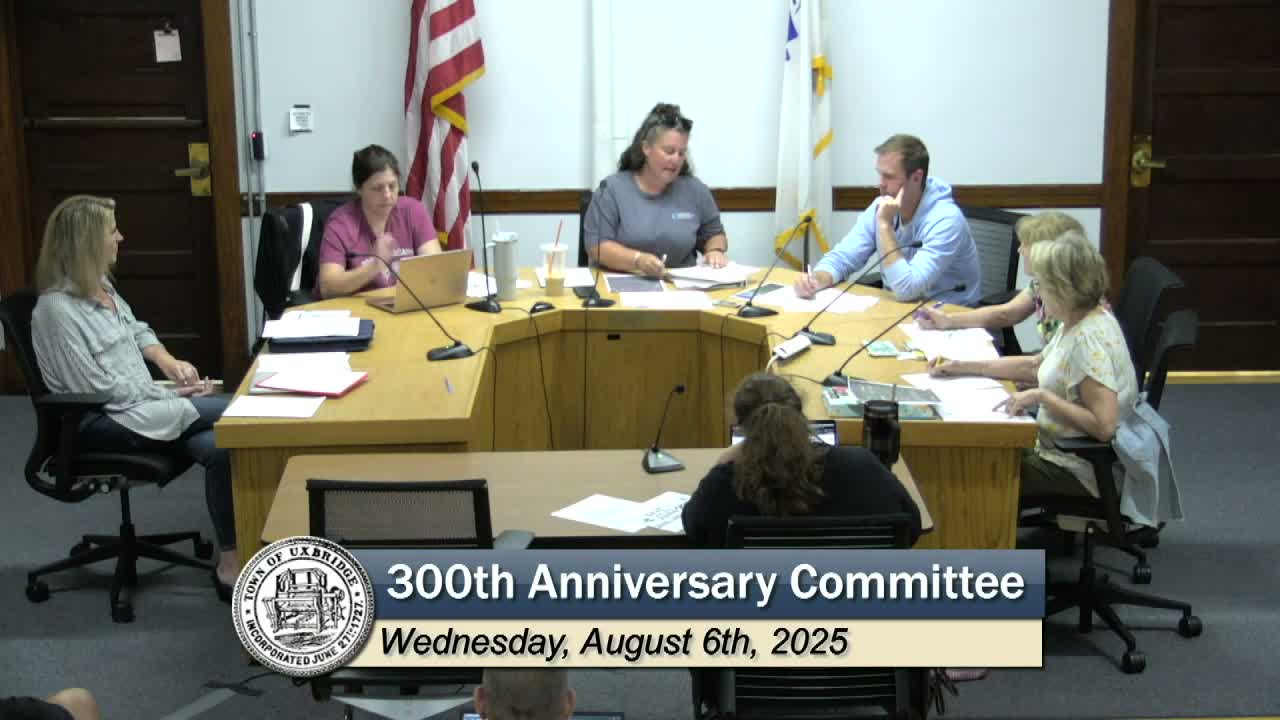
The Uxbridge 300th Anniversary Committee discussed a proposed mascot — a stuffed ox concept dubbed in conversation as 'Bridget the ox' — and marketing options on Aug. 6, but ultimately tabled a final decision so a subcommittee can produce cost estimates and merchandising proposals.
Members reviewed initial pricing (a suggested retail of about $25 per stuffed mascot) and several production options, including domestic sourcing, preorders, corporate sponsorship and a tiered pricing model aimed at making merchandise accessible to families. One member noted that lowering the price to $15 or securing corporate sponsors would broaden access; another cautioned that ordering large quantities risks leaving unsold inventory in a town of roughly 14,000 residents.
The committee approved a motion to refer the mascot and merchandising discussion to a subcommittee and to return a range of options — including per‑unit cost, suggested retail price, sponsorship models and potential local manufacturers — to the full committee for a future vote. The motion carried by voice vote.
Separately, committee members discussed other merchandising items and fundraising concepts such as branded banners, buttons, patches and a potential pre‑order or corporate sponsorship program to offset production costs. Committee members emphasized the need to avoid rushing into production without firm cost and demand data.