Get Full Government Meeting Transcripts, Videos, & Alerts Forever!
Get email alerts on the Plaza Expansion topic
No spam. Unsubscribe anytime.
Plaza expansion at Blue Water Bridge: component 1 under way, later phases depend on federal leases and bond financing
Summary
Administrator Amy Wynne told the subcommittee component 1 of the plaza expansion is funded and under construction with InfraGrant support and DTE substation work; component 2 has a design/construction budget estimate of about $300 million and later components (3 and 4) are unfunded and contingent on GSA/CBP lease commitments and prospectus approval.
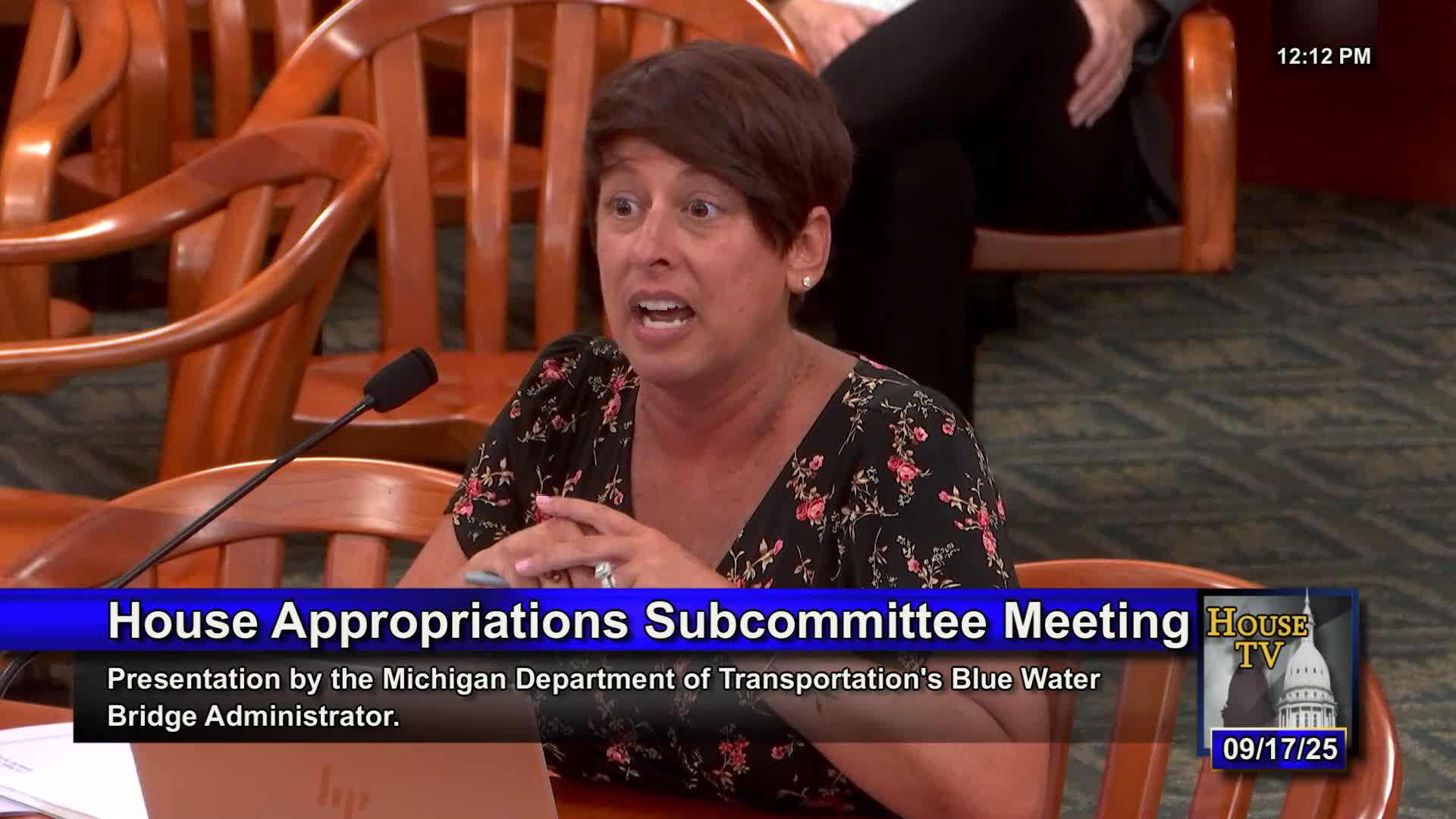
Blue Water Bridge administrator Amy Wynne told the Appropriation Subcommittee the bridge’s plaza expansion is organized in multiple independent components so each can function alone and so work can proceed if later phases are delayed.
Wynne said Component 1 (described as funded and shown in blue on project materials) includes intersection reconfiguration, relocation of the Pine Grove connector ramp, noise-wall installation and minor reconfiguration of the I‑94 connection. She said Component 1 has received a $25,000,000 InfraGrant and that the Blue Water Bridge has budgeted amounts for the work; Wynne also noted $11,600,000 has been spent to date toward the plaza expansion and cited a component 1 price tag referenced near $40,000,000 to $46,000,000 in committee materials.
The testimony said the DTE substation relocation was a $35,000,000 contribution by the bridge and that the overall DTE substation upgrade cost is about $115,000,000 with DTE paying the remainder. Wynne said component 2 (green on the map) would relocate the duty-free store inside the plaza, create new toll and administrative facilities, add maintenance cold storage, construct a plaza loop to improve commercial traffic flow and add CBP outbound inspection booths. She described an expected design and construction cost of approximately $300,000,000 for component 2.
Wynne said component 2 procurement was advertised in May 2025, with evaluation of technical proposals expected in January 2026 and a contract award planned in March 2026; substantial construction was described as most likely beginning in 2027 and lasting two to three years depending on the design-build proposal schedule. She said components 3 and 4 — which include additional Homeland Security/CBP infrastructure — are not funded because GSA and CBP have not committed to leasing the space; Wynne said federal tenant commitments usually require a prospectus process that can take about two years, and the bridge will not construct spaces it cannot secure tenants for.
On cost risk, Wynne presented a range for components 3 and 4 of $379,000,000 to $714,000,000 for construction and engineering (excluding tenant furniture, fixtures and equipment and leasing costs), with a most likely outcome near $562,000,000 as derived from an FHWA cost-schedule-risk workshop. She warned that project delays would escalate costs. Wynne said the bridge plans to bond for component 2 when financing is needed, and she characterized the Blue Water Bridge entity — not MDOT — as the likely bond issuer for that work.
Committee members asked for clarification on numeric figures (committee materials included multiple related dollar figures) and on the timeline for federal leasing and potential impacts on project sequencing. Wynne said components are being designed so they can stand alone and that the project will pause on unfunded components until tenant commitments are secured.
The subcommittee took no funding votes at the hearing itself; members will consider budget line items as part of the broader appropriation process.