Get Full Government Meeting Transcripts, Videos, & Alerts Forever!
Get email alerts on the Candidate Replacement topic
No spam. Unsubscribe anytime.
Lawmakers hear bill to clarify candidate-replacement rules after county candidate deaths
Summary
The House Committee on Election Integrity heard testimony on HB 4,736, which would clarify statutory procedures when a county-level candidate dies after filing deadlines; Allegan County Clerk Bob Janetsky and sponsor Chair Smith said the change would avoid inconsistent local practices and litigation.
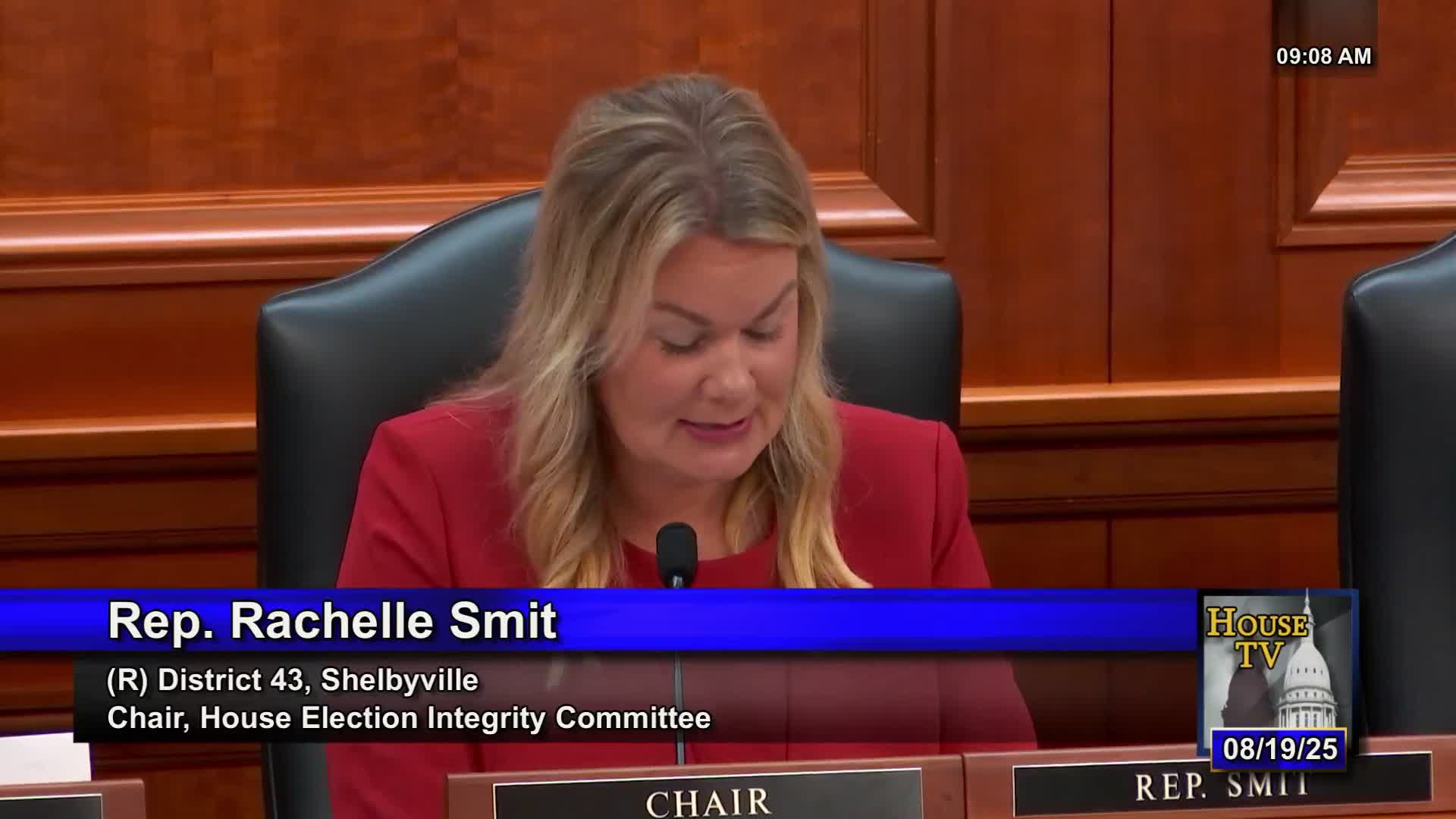
Chair Smith introduced House Bill 4,736 on the House Committee on Election Integrity’s agenda, saying the measure would clarify what happens when a county-level candidate dies after qualifying deadlines and is not explicitly covered under current law.
"These omissions create legal ambiguities and require county clerks to rely on guidance from the secretary of state's office rather than the clear process laid out in law for almost every other political office held," Chair Smith said in opening testimony, citing recent examples from 2024.
Allegan County Clerk Bob Janetsky testified that his county faced a sudden vacancy when a long-term county commissioner died shortly before the primary deadline, leaving no candidate on the ballot. Janetsky said Public Act 116 of 1954 (Michigan Election Law) addresses candidate death in many contexts but omits the county commissioner primary scenario, leading to inconsistent treatments across counties.
"It left no one on the ballot whatsoever," Janetsky said. "When my office sought the law as to how to handle such a vacancy, we were concerned to find that there was no remedy in the law for a vacancy only for county commissioner."
Janetsky told the committee the omission creates the potential for 83 different county clerks to handle similar situations in 83 different ways, which can lead to lawsuits and uncertainty. He and Chair Smith both urged the committee to support HB 4,736 so county offices would be treated consistently when a party is left without a candidate due to a death after qualifying.
Members asked how the bill would work for county commissioners elected by district, noting that county party executive committees often operate at the countywide level while commissioners represent districts. Chair Smith acknowledged the concern and said precinct delegates — who live in the district — are part of executive committees and could be the mechanism for selecting a replacement, but she said she had not fully researched every option and welcomed further questions.
The committee recorded support cards from the Michigan Department of State and other individuals "not wishing to speak" and then moved on to additional items on the agenda. No committee vote on HB 4,736 is recorded in the transcript of this session.
What happens next: HB 4,736 received sponsor and clerk testimony and was left in committee for further consideration, with additional written or in-person comments to be read into the record as indicated by the chair at the hearing’s close.