Get Full Government Meeting Transcripts, Videos, & Alerts Forever!
Get email alerts on the Judgment Levies topic
No spam. Unsubscribe anytime.
Montana Senate committee hears bill to require voter approval for judgment levies
Summary
Sen. Greg Hertz introduced SB 108 to bar local governments from placing judgment or settlement levies on property tax bills without voter approval. County officials warned the change could force cuts to services or large general-fund payouts if voters reject levies; the sponsor said he will consider amendments.
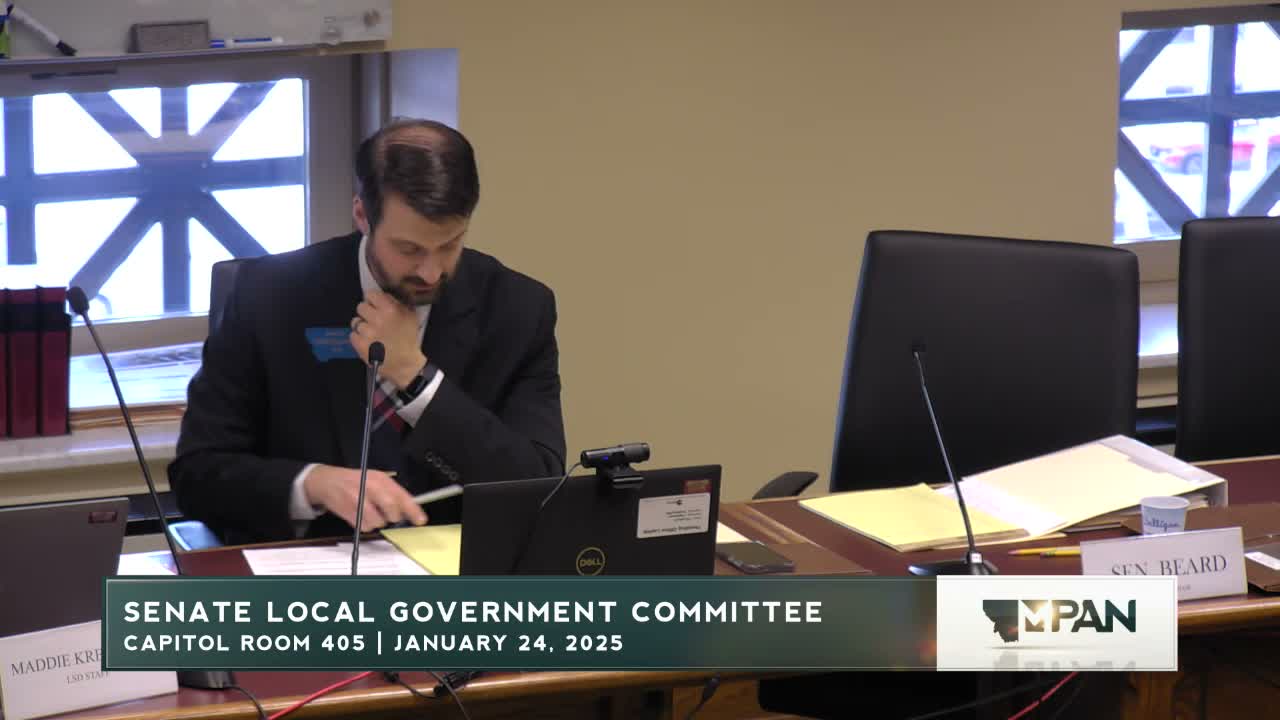
Senator Greg Hertz (Senate District 7) told the Senate Local Government Committee that Senate Bill 108 would bar local governing bodies from placing judgment levies or levies for settlements on property tax bills without first submitting the measure to voters. "Local governing bodies cannot do that without voter approval," Hertz said during his opening remarks, framing the bill as returning decision-making power to taxpayers and possibly improving the government's negotiating position in settlements.
Opponents — chiefly county and municipal officials — argued the change would hamper local governments' ability to satisfy court orders quickly and could produce severe budgetary stress. "Turning judgment levies into voted levies would add an additional very costly step for both the counties and the taxpayers," said Lindsey Rick Meyer, chair of the Broadwater County Commission, adding that some judgments can only be satisfied through judgment levies and that a failed vote could leave counties without funds to meet court-ordered payments.
Karen Alley, associate general counsel for the Montana Association of Counties, told senators that requiring voter approval "is unnecessarily" burdensome and could put counties in an untenable position. Alley warned counties could exhaust general funds to pay judgments and noted Montana law prevents counties from declaring bankruptcy. She used a hypothetical rural example in which a county with about $12,000,000 in annual general-fund revenue faces a $10,000,000 judgment to illustrate the scale of the risk.
Other witnesses opposed the bill for related reasons. Kelly Lynch, executive director of the Montana League of Cities and Towns, highlighted the separate problem of protested taxes — funds withheld from budgets while disputes are resolved — and said those uncertainties already force municipalities to use permissive levies and contingency funding. Bob Storeyman of the Taxpayers Association outlined the constitutional and statutory history behind current exemptions for judgment levies (he referenced statute language implemented after a 1999 initiative) and warned taxpayers ultimately bear the cost either through reduced services or higher levies.
Committee members questioned witnesses about insurance coverage, including errors-and-omissions or pool coverage, and witnesses said coverage is fact-specific and varies by policy; Alley and Lynch offered to provide follow-up information to the committee. Hertz acknowledged the concern from opponents and said he may consider amendments, including a possible dollar threshold for when voter approval would be required and clarifications about overlapping jurisdictional impacts.
No formal action or vote was taken. The hearing on SB 108 closed after testimony and questions; the sponsor said he will work on potential amendments and provide drafts to the committee.