Get Full Government Meeting Transcripts, Videos, & Alerts Forever!
Get email alerts on the Education STEM topic
No spam. Unsubscribe anytime.
Chippewa Falls students showcase robotics program, donate CNC equipment and plan local tournament
Summary
High school robotics students described their robot 'Mustard,' recounted competition success and outreach, and said the team secured grants and donated about $20,000 in CNC equipment to the middle school; they said they hope to host a 30–40 team tournament in Chippewa Falls.
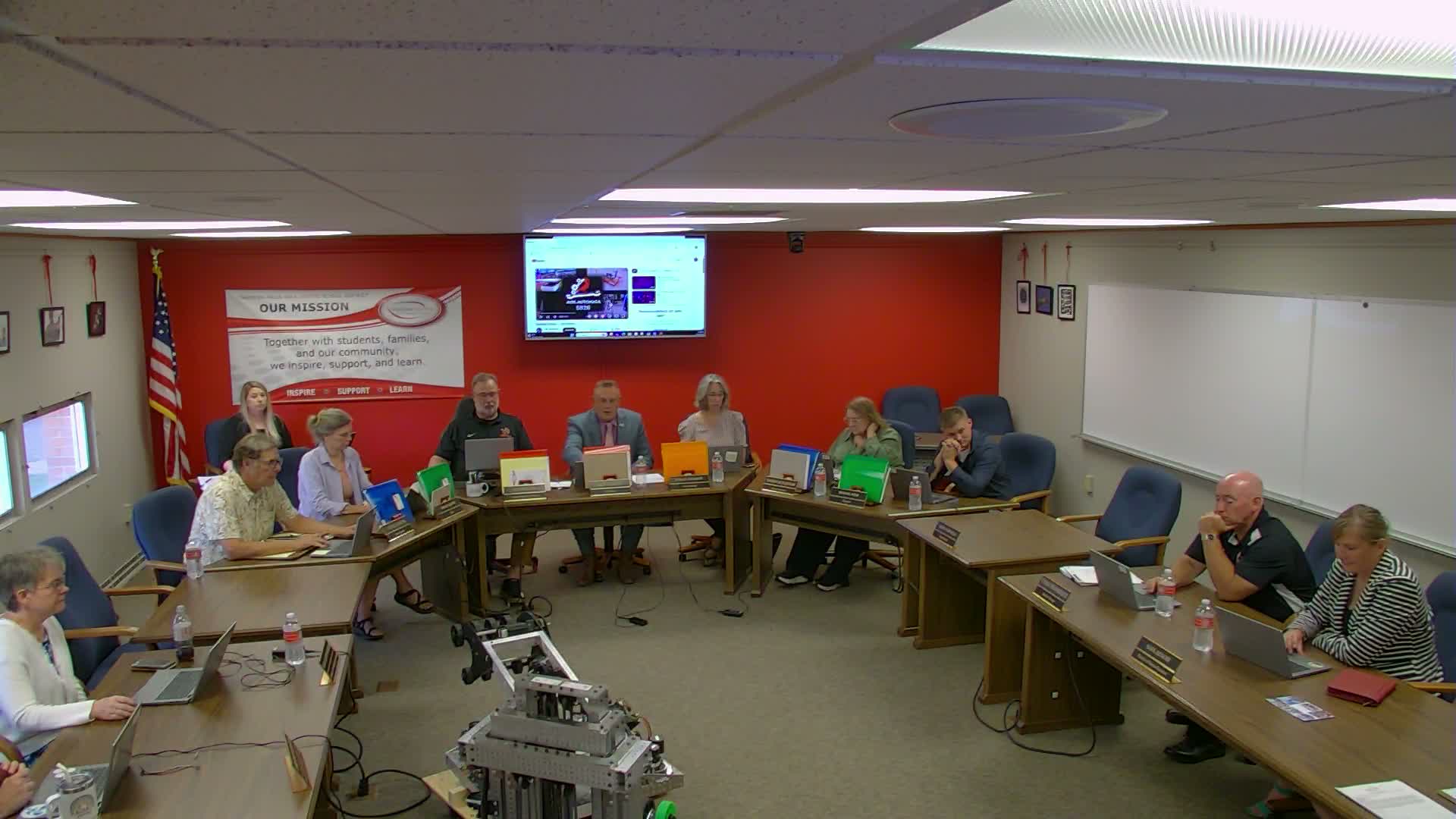
High school robotics students and their coach presented the Chippewa Falls Area Unified School District board with a demonstration of the district’s FIRST Robotics program, outlining skills learned, recent competitive results and plans to expand outreach.
Quentin Felske, a student team member, described this year’s main robot, nicknamed Mustard, saying it uses four cameras for vision tracking, four lidar sensors for distance measurement, and “over 12 motors” including an elevator and a wrist to manipulate game pieces. He said the drivetrain uses four swerve-drive modules that let the robot move in any direction.
Coach Wolter and students said the program teaches teamwork, engineering, programming and real-world problem solving. Wyatt Schafer, who worked on software for the team, said being on the team opened doors for postsecondary study in computer science and highlighted broad student benefits including marketing, communication and leadership skills.
The presenters credited recent grant funding with allowing an upgrade in manufacturing capacity. They said the team purchased CNC equipment and donated roughly $20,000 in machinery to the middle school’s technology-education area so students can go from CAD drawings to aluminum prototypes more quickly.
Students described a three-tier outreach approach: maintain the high-school competition team, sustain a middle-school build team called “Ketchup” (built by sixth–ninth graders), and expand outreach toward elementary schools. They said the middle-school robot was assembled in short build sessions and that the program intends to host a 30–40 team district tournament to grow participation.
Board members asked whether artificial intelligence is part of the team’s instruction. Quentin said the team does not formally teach AI as a team-wide curriculum but that some older students use AI tools for research; he and other students said they have implemented core robotics techniques such as path planning and vision processing rather than chat-style generative tools.
The presentation closed with board appreciation for the students’ achievements and an invitation to notify the district when the tournament date is set.