Get Full Government Meeting Transcripts, Videos, & Alerts Forever!
Get email alerts on the Animal Health topic
No spam. Unsubscribe anytime.
State veterinarian warns of brucellosis surveillance needs and ongoing avian influenza risks
Summary
Montana's state veterinarian briefed the Senate Agriculture Committee on persistent brucellosis in the Greater Yellowstone wildlife population and ongoing highly pathogenic avian influenza (HPAI) risks, noting surveillance, voluntary dairy milk testing, federal cooperation and potential budget pressures.
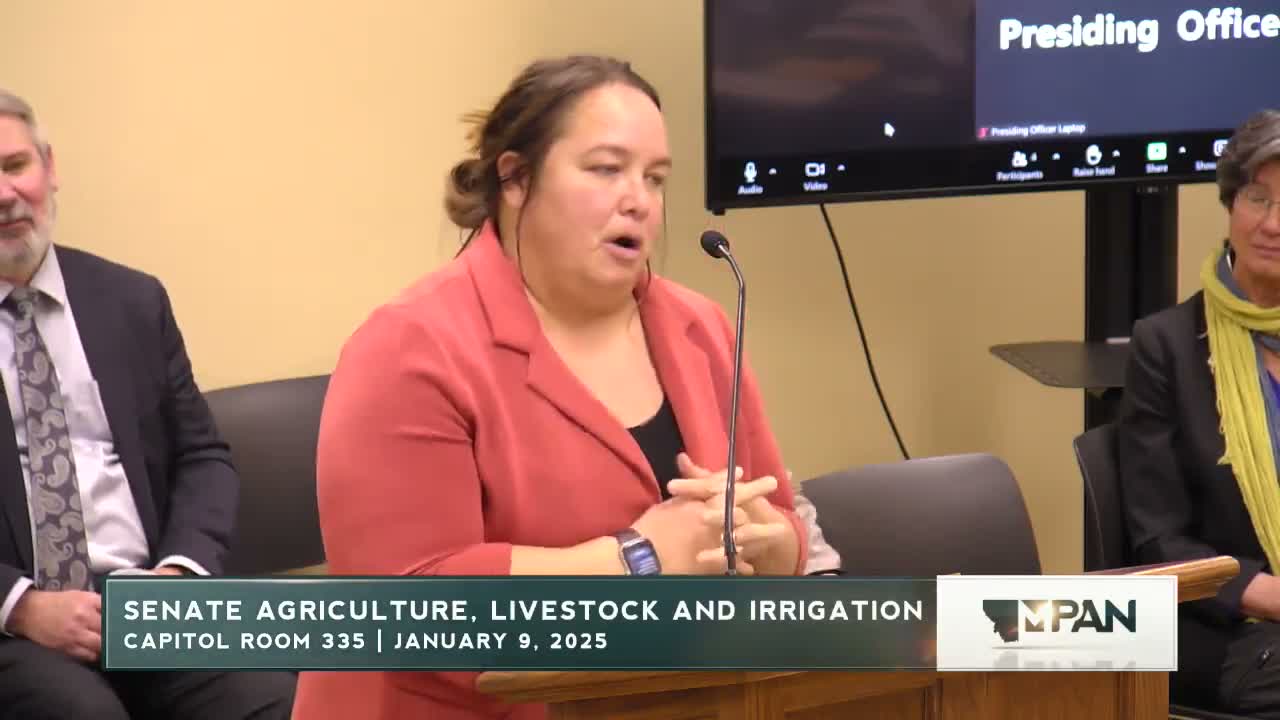
Dr. Szymanski, Montana’s state veterinarian, told the Senate Agriculture Committee that two animal‑health issues dominate the department’s workload: brucellosis in wildlife of the Greater Yellowstone area and a national outbreak of highly pathogenic avian influenza (HPAI) that has also affected dairy cattle.
On brucellosis, Szymanski said the disease remains present in Yellowstone bison and elk and that Montana runs an active surveillance program in southwest counties to detect transmission into domestic cattle and domestic bison. ‘‘All of the work that's done in Southwest Montana keeps the cattle from the rest of the state of Montana moving without additional restrictions when they cross state lines,’’ Szymanski said, emphasizing surveillance to avoid export restrictions.
On avian influenza, Szymanski summarized a multi‑year national outbreak with recent spillover into dairy animals. The department has used genotyping and coordinated with federal partners to track strains, and Szymanski described a voluntary milk surveillance program for licensed dairies; the initial round of samples returned negative. ‘‘We have federal funds to support that,’’ Szymanski said, noting federal cooperation and the need for continued readiness and funding if the landscape changes.
Szymanski urged lawmakers that the most consistent constraint in outbreak response is financing and described occasional emergency cooperative agreements from federal partners that have helped Montana respond. She offered to provide more detailed information to the committee and to coordinate future briefings with public health partners.
Next steps: state veterinarian will prepare additional information for the committee and said the department will continue voluntary surveillance and coordination with federal and public‑health agencies as the situation evolves.