Get Full Government Meeting Transcripts, Videos, & Alerts Forever!
Get email alerts on the Agency Priorities topic
No spam. Unsubscribe anytime.
Departments of Agriculture and Livestock outline hemp program, new diagnostic lab and meat-inspection needs
Summary
Agency leaders briefed the Senate Agriculture Committee on hemp regulation and testing limits, a planned 55,000-square-foot veterinary diagnostic lab at MSU, federal funding cuts to meat inspection, and House Bill 119 (a proposed state cattle checkoff referendum).
Department leaders used the committee’s organizational meeting to brief members on regulatory activities and infrastructure priorities that could affect Montana producers this session.
Ian Foley, Ag Sciences Division Administrator at the Department of Agriculture, described the state’s long involvement with hemp regulation and clarified that Montana focuses on grain and fiber production. ‘‘99% of the crop grown in Montana is grain and fiber,’’ Foley said, adding that the department uses the MSU analytical lab (a DEA-licensed facility) to test samples for THC compliance and that the lab can process only regulatory/enforcement samples under its DEA permit.
Foley explained the department follows federal rules developed after the 2014 Farm Bill and said the state had high early acreage in 2018–2019. He told lawmakers the department supports a federal-style grain-and-fiber exemption if Congress alters the farm bill definitions.
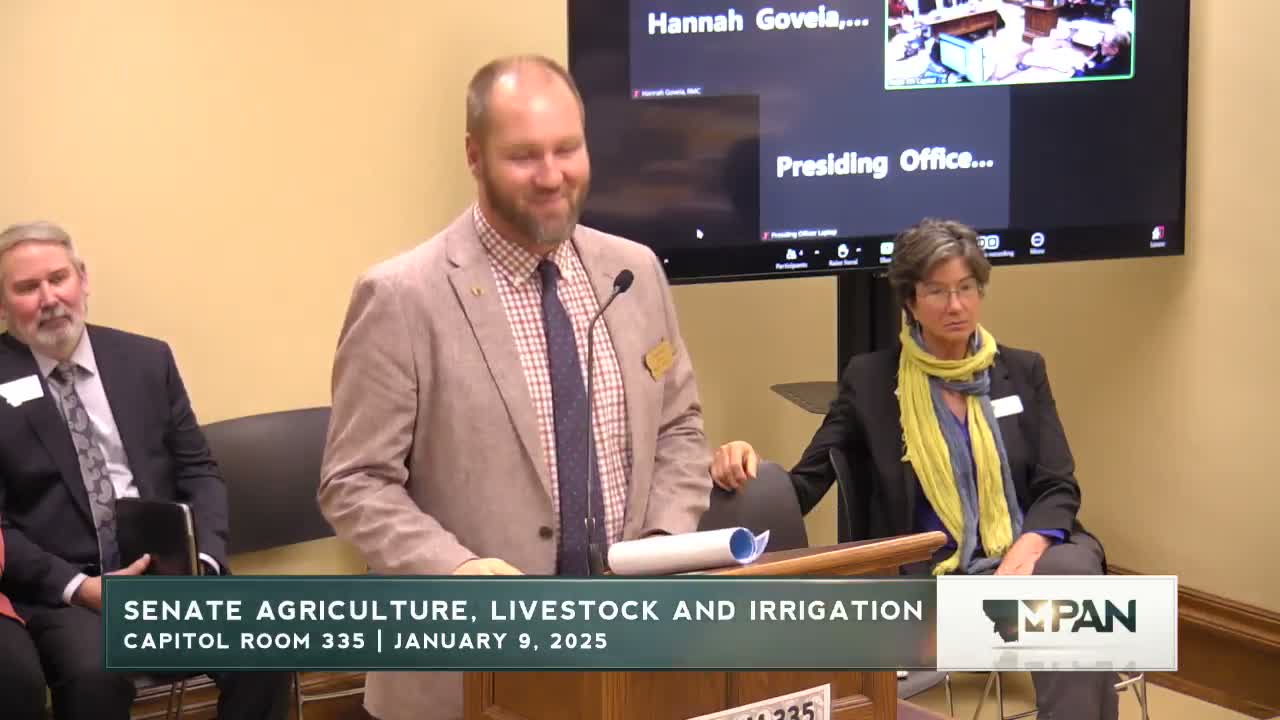
Brian Simonson, Deputy Executive Officer for the Department of Livestock, outlined the agency’s structure and priorities and described a planned 55,000-square-foot Montana Veterinary Diagnostic Laboratory (NVDL) at MSU. ‘‘We’re pretty proud of that thing,’’ Simonson said, adding the lab aims to be operational and open in February 2026 and that the lab currently processes roughly 200,000 tests per year.
Simonson also described federal cuts to meat inspection and disease investigation funding and said the department will request additional resources in the next budget (House Bill 2 items), including about eight new FTEs to bolster meat inspection capacity and support processing initiatives. He said the department is working to compensate for federal reductions so state programs can continue core functions.
On policy, Simonson summarized House Bill 119 as a proposal to create a state-level cattle checkoff modeled on the federal program; proponents plan a referendum among producers to create a state checkoff and, if passed, the plan envisions an additional assessment of about $1 per head though exact language was not specified in the committee briefing.
The departments also discussed brands enforcement (a ~50,000-brand registry), livestock-loss funding (about $450,000, with roughly $100,000 for mitigation grants), predator-control cooperative agreements (about $675,000/year), and the Cooperative Interstate Shipment (CIS) mechanism that allows state inspection equivalence and USDA stamping for meat that crosses state lines.
Next steps: departments said they will return with targeted briefings on specific topics such as grizzly-bear/livestock conflict and will file or track the listed cleanup and budget proposals during the session.