Get Full Government Meeting Transcripts, Videos, & Alerts Forever!
Get email alerts on the Comprehensive Plan topic
No spam. Unsubscribe anytime.
Planning commission transmits comprehensive‑plan EAR amendments to Council, asks for native‑plant and wetlands language changes
Summary
After a lengthy discussion on housing, water capacity and local plant policies, the commission voted to transmit the EAR amendments to City Council and asked that language be amended to encourage Brevard‑native landscaping and to remove a wetlands 'study' requirement (policy 1.6.0.8).
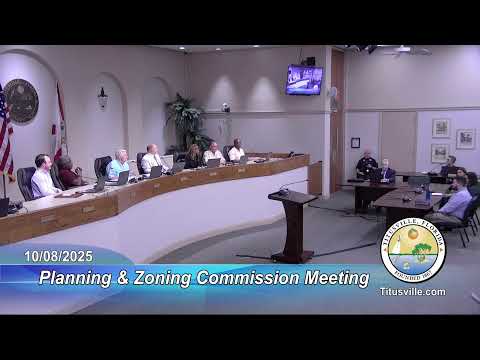
The Titusville Planning and Zoning Commission voted Oct. 8 to recommend City Council transmit the Evaluation and Appraisal Review (EAR) comprehensive‑plan amendments to the state with two edits: (1) add language encouraging the use of Brevard‑native plantings in landscaping policy and (2) delete policy 1.6.0.8, which called for a study to research wetland best practices.
Consultants from Kimley‑Horn presented the EAR as the seven‑year update required by state statute, describing required changes (for example, ending storm‑related moratoria), updates to school impact notifications and septic/sewer references, and recommended additions to conservation, historic‑preservation and housing policies. Presenters said staff found the current densities adequate to meet projected population and that homeownership in Titusville is about 72 percent while 35 percent of households are cost‑burdened (spending more than 30 percent of income on housing).
On housing incentives, the EAR adds language encouraging accessory dwelling units and includes a provision, consistent with the recent state framework, that would allow the city to waive impact fees for projects that commit to serving low‑ or very‑low‑income households. A Kimley‑Horn presenter said the city can use HUD income categories for definitions of 'very low' and 'low' income and that the waiver is targeted to those lower income bands rather than the broader 'live local' audience.
A substantial portion of the discussion focused on data and infrastructure. Commissioners raised concerns that the EAR relied on University of Florida/BEBR data (2023) and may understate near‑term growth tied to the commercialization of NASA activity. The consultant and commissioners explained statutory reliance on BEBR projections while noting the city’s water‑supply plan and other studies could use more aggressive estimates; the consultant also reported current water usage at about 4,500,000 gallons per day and system capacity of roughly 6,500,000 gallons per day with a projected need of about 400,000 gallons under the plan’s assumptions.
Public commenters — including Laura Lee Thompson of the Technical Review Committee — urged the commission to strengthen wetlands policy and to prefer Brevard‑native vegetation over the broader 'Florida‑friendly' standard in the EAR. Thompson asked that policy 1.6.0.8 be removed and that language be changed to 'Brevard native' rather than 'Florida friendly.' Staff cautioned that narrowing to an exclusive 'Brevard native' requirement would change review practice and implementation detail would need to be fleshed out in ordinance.
Member Grama moved to recommend transmittal to Council with the two edits described above; the motion passed on a roll call with Member Faison recorded as No and the remaining members voting Yes. The EAR amendments and commission suggestions will be considered by City Council at its Oct. 28 meeting and then transmitted to the state for review per statutory procedures.
(Reporting based on the Planning and Zoning Commission meeting Oct. 8. All quotes and numbers come from meeting statements and staff materials.)