Get Full Government Meeting Transcripts, Videos, & Alerts Forever!
Get email alerts on the Housing Infrastructure topic
No spam. Unsubscribe anytime.
Senate committee hears plan to seed $100 million housing-infrastructure trust to spur development
Summary
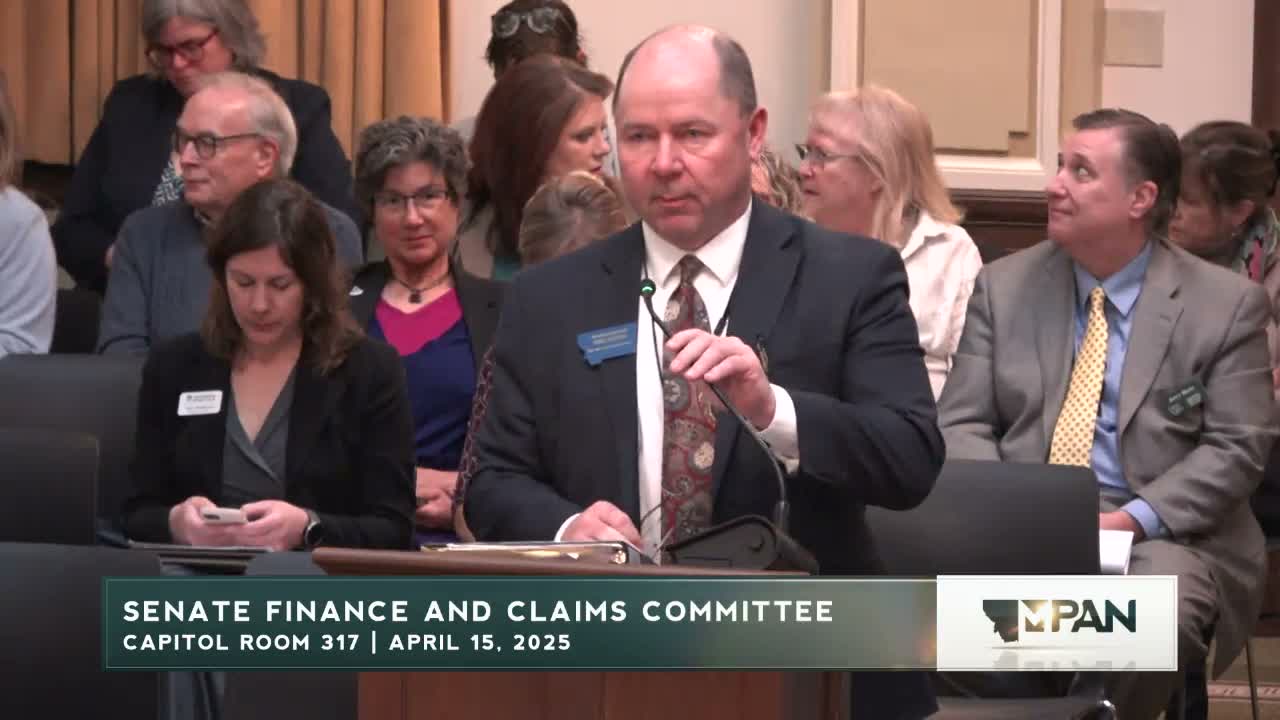
Rep. Mike Vinton told the Senate Finance and Claims committee that House Bill 505 would transfer $100 million into a housing trust to finance water, sewer and other infrastructure for new development; industry and local government groups told the committee the fund would unlock lots and lower housing costs by enabling projects that otherwise 'don’t pencil out.'
Representative Mike Vinton (House District 40) urged the Senate Finance and Claims committee to approve House Bill 505, a proposal to transfer $100,000,000 from the general fund into a housing trust to finance infrastructure — water, sewer and related systems — for new residential development across Montana.
"House Bill 505 is a bold pro-housing reform," said Adrian Cotton of the Montana Building Industry Association, noting builders face large costs to extend municipal infrastructure and that access to water is a particular constraint in many rural communities. Kelly Lynch of the Montana League of Cities and Towns and representatives of the Montana Infrastructure Coalition and Montana Housing Coalition also testified in support, saying the tool would help local governments partner with developers and make more lots buildable.
Proponents described the program as a financing tool that can be used with cities, counties and water or sewer districts to extend infrastructure into undeveloped areas. Representative Vinton said the aim is to incentivize development of more lots rather than subsidize particular housing product types: "We did not restrict HB 505 funds to any particular type of housing because we need all types."
Committee members questioned program design details: Senator Ben asked whether funds could be used for preliminary engineering reports or only for construction; Vinton said the bill is intended primarily for on-the-ground infrastructure and not general planning, although the availability of funds should incentivize projects earlier in development. Senator Caffaro asked about fund prioritization if demand exceeds supply; Vinton said the Board of Investments model envisioned would operate on a first-come, first-served basis with lender participation.
Board of Investments staff, the Montana League of Cities and Towns, and local economic-development representatives described how loans and leveraging other capital sources could be combined. Supporters said the fund could be a "game changer" for rural and smaller communities where extending utilities increases per-lot costs.
The committee recessed after discussion; the sponsor closed by urging a do-concur recommendation.
Ending: The committee left the bill open for executive action; no final vote or appropriation was taken in this hearing.