Get Full Government Meeting Transcripts, Videos, & Alerts Forever!
Get email alerts on the Education Workforce Pathways topic
No spam. Unsubscribe anytime.
Senate panel hears bill to create "advanced opportunity facilitator" to expand dual credit and work‑based learning
Summary
Senate Bill 278 would let school districts hire a liaison — eligible for quality‑educator payment and fundable with advanced opportunity dollars — to connect students with dual credit, CTE and internships. Proponents cited local gains; members pressed for funding clarity and implementation details.
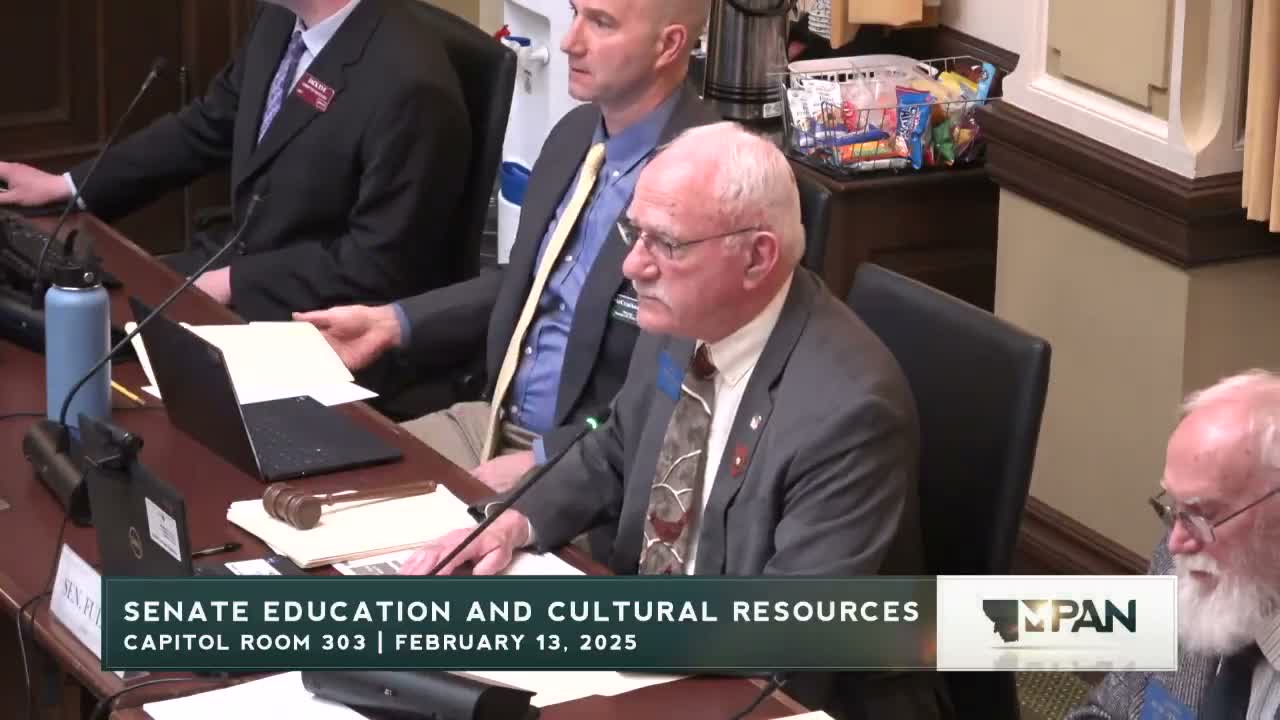
Senator Sarah Novak introduced Senate Bill 278 on behalf of her district, saying the measure "creates an advanced opportunity facilitator" to help schools expand dual credit, career and technical education (CTE) and work‑based learning by serving as a liaison to employers, higher education and workforce partners. Novak told the Senate Education Committee the role could be funded with existing advanced opportunity aid and be eligible for quality educator payment as an incentive.
Supporters described tangible results where districts already use advanced opportunity funds. Dan Rispens, superintendent of East Helena Public Schools, said his district used advanced opportunity funds to help students earn dual credit and credentials: "In the two full school years prior to this year, students at East Helena High School earned 618 college credits" and about 200 students took AP courses, yielding an estimated $180,000 in tuition savings and $14,000 in AP fees avoided. Rispens said a facilitator — "a career coach in my district" — would build employer relationships, expand internships and apprenticeships, and coordinate students, families and industry.
Rob Watson of the Coalition of Advocates for Montana’s Public Schools urged passage but flagged a potential funding conflict in the bill. Watson noted the bill allows districts to use up to 20% of advanced opportunity grant funds to pay a facilitator while existing state law requires 75% of those funds go directly to student expenses. He warned that a district might interpret both allowances to mean 20% could be used plus the 25% already available for non‑student expenses, effectively reducing student‑directed funds to 55%, and suggested removing the 20% explicit allowance to avoid that outcome.
Kim Popin of MFPE told the committee a dedicated facilitator would "do the leg work" now done informally by teachers and counselors, freeing school staff to focus on classroom and counseling duties and enabling districts to scale advanced offerings.
Informational witnesses from state agencies described how the role might interface with existing programs. Paul Taylor of the Office of Public Instruction said districts could include the facilitator in FTE and quality educator component calculations but that the $3,000–$4,000 quality educator payment likely would not fund a full FTE. Sarah Swanson, commissioner of the Montana Department of Labor and Industry, said her agency’s apprenticeship, career development and business engagement teams could coordinate with facilitators.
Committee members focused on funding mechanics and staffing models. Senator Vinton asked whether the bill creates a new position or relies on existing funds; witnesses said the bill authorizes use of existing advanced opportunity funds and the quality educator payment but that districts would likely need to combine multiple sources or create partial‑time positions (for example, a .4–.5 FTE) to make a facilitator role feasible. Rispens said East Helena’s allocation this year was about $102,000, of which up to 25% could be used for staffing, and described how districts can supplement with donations, tax‑credit revenue or other local funds.
Novak closed by reiterating the bill’s goal to "empower local districts to really expand offerings for students," said she would accept a friendly amendment to preserve that 75% of funds continue to go to student expenses, and asked the committee for a due pass. The committee concluded the hearing on SB278 and moved into executive action on other bills.
Next steps: SB278 concluded its committee hearing and is eligible for executive action or further committee consideration depending on the sponsor's request.