Get Full Government Meeting Transcripts, Videos, & Alerts Forever!
Get email alerts on the Public Law 280 topic
No spam. Unsubscribe anytime.
Senate passes bill to move a Public Law 280 funding vehicle to House after committee hearing
Summary
Senators advanced Senate Bill 393, a legislative vehicle to carry appropriations addressing county costs under Public Law 280 on the Flathead Reservation; proponents including the governor's office, Lake County and CSKT urged a one-time transition fund while lawmakers pressed for specific dollar amounts and return review when the House adds appropriations.
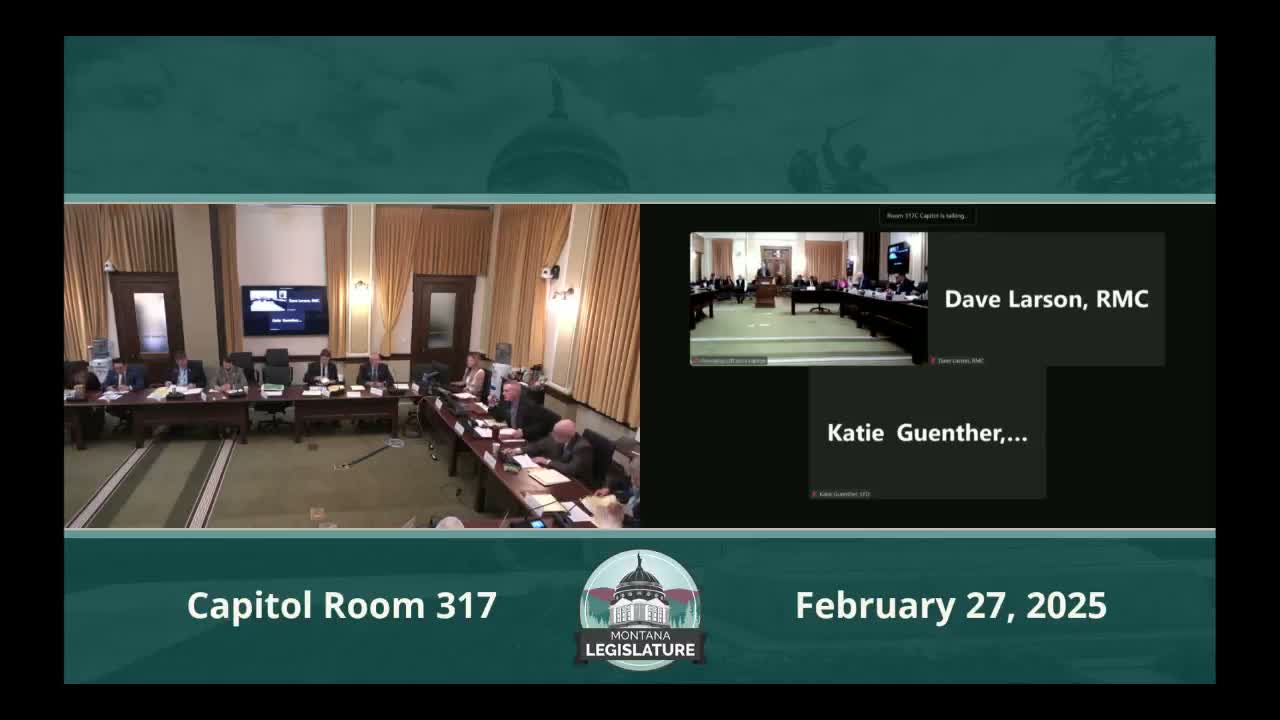
Senators on the Finance and Claims Committee on Monday advanced Senate Bill 393, a shell bill described by sponsor Senator Greg Hurts as a vehicle to carry appropriations to reimburse local governments and support a transition of felony criminal jurisdiction on the Flathead Reservation.
Hurts, Senate District 7, said the bill would allow the Legislature to get a funding vehicle over to the House, where appropriations must start. "It's a vehicle. It's a shell," he said, adding the goal is to get a mechanism in place so the House can insert appropriation language and the Senate can later review the details.
The lieutenant governor, Kyrastin Juras, spoke for the governor's office in support and framed the measure as a one-time transition fund rather than ongoing state support. "The governor supports a one-time-only solution to help both the tribes and the state transition," Juras said, arguing the goal is to make enforcement financially viable for counties and the Confederated Salish and Kootenai Tribes (CSKT).
Lake County Commissioner William Barron described the practical pressures counties face under Public Law 280, which shifted criminal enforcement responsibilities to state and local governments. Barron described decades of rising costs and jail pressures and asked for state help. "This bill I think opens the door to get that started," he said, noting Lake County's expense and jail capacity constraints.
CSKT witnesses described growing tribal capacity and demand. Martin Charlo, a tribal council representative, told senators the tribal police "do a great job" and have prosecuted hundreds of felony drug cases that previously fell to county authorities. Jordan Thompson, acting executive officer for CSKT, said the tribe has prosecuted roughly 150 felony cases in the past year and has programs such as a transitional supportive housing center and a drug healing court. "Every case we prosecute means that's a case the counties don't need to prosecute," Thompson said.
Committee members pressed for specificity about dollars and implementation. Senator Kauff asked for an amount, calling the bill "a blank check" without a figure; Hurts replied that discussions with the governor's office have ranged "around $5,000,000 to $7,000,000," and he reminded the panel that Lake County itself is spending about $5,000,000 annually on related costs. Lawmakers also asked about where tribes send people they convict: Thompson said the tribal jail is short-term (about 40 beds) and the tribe focuses on cases not requiring incarceration beyond the limits allowed by federal law.
Witnesses explained sentencing limits tied to federal law: under the Indian Civil Rights Act tribal courts are generally limited to one year of incarceration, and the Tribal Law and Order Act (TELOA) can increase sentencing authority to three years (stackable in some cases up to nine years after implementation). Thompson said full expansion of sentencing capacity and other court improvements would take time and funding.
Hurts closed by asking the committee to pass the bill so the House can add appropriation language; the committee later voted to pass SB393 out of Finance and Claims. The measure will return if the House inserts appropriations, giving senators a later opportunity to review the final funding plan.
Outcome and next steps: Finance and Claims approved SB393 in executive action; the bill now proceeds to the House, where appropriation language is expected to be added. The Senate will review the amended bill if and when it returns with fiscal language.