Get Full Government Meeting Transcripts, Videos, & Alerts Forever!
Get email alerts on the Drug Policy Kratom topic
No spam. Unsubscribe anytime.
Senate committee backs study of kratom to separate natural leaf from synthetic isolates
Summary
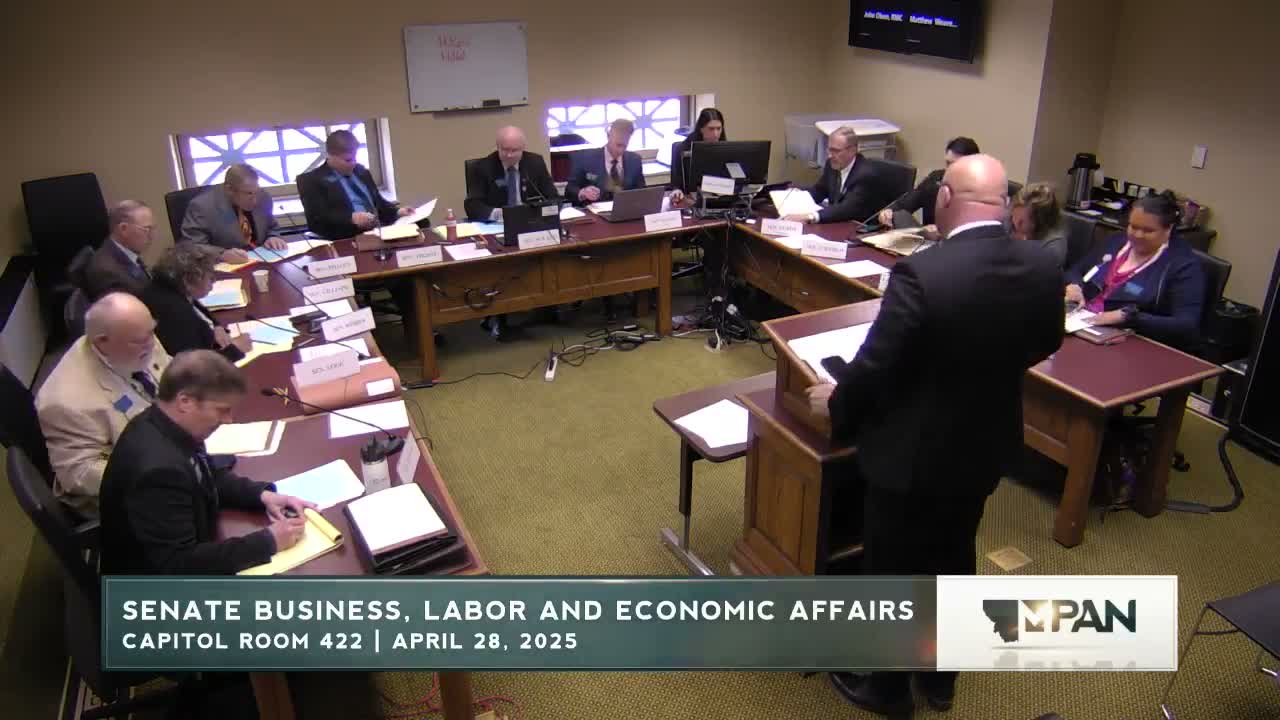
The Senate Business and Labor Committee voted to concur on House Joint Resolution 60, approving an interim study of kratom after proponents urged lawmakers to distinguish natural tea‑leaf kratom from more dangerous synthetic derivatives.
Representative Curtis Schomer opened hearings on House Joint Resolution 60, telling the Senate Business and Labor Committee the study is needed to "figure out what's good, what's bad" about kratom and asking members for a "do pass." Proponents — including Deborah Pitassi of the Montana Beer and Wine Distributors Association and Scott Bollinger of the American Kratom Association — told the committee that while natural kratom leaf has reported benefits, synthetic isolates raise safety concerns and warrant study.
Isaac Hammer, chief operating officer of Kava Roots, said natural kratom has a long history of use abroad and in the U.S. and that current problems stem from highly concentrated synthetic derivatives. "Those synthetic products are not good representation of what we serve at Kava Roots," Hammer said, urging legislators to "look at the science" and differentiate natural products from dangerous synthetics.
Committee members asked proponents about effects and uses. Representative Schomer and witnesses described natural kratom leaf as producing relaxation, mild pain relief and energy in some users, but witnesses and members repeatedly emphasized limits in current data and the need for careful study rather than immediate regulation.
After testimony and questioning, the committee moved the resolution forward. In executive action the committee recorded the motion to concur on HJ 60 and, with recorded opposition noted in the record, the chair announced the measure passes and will be carried to the floor.
The study resolution does not itself regulate kratom; rather, it directs an interim examination of available science, market practices and whether distinct regulatory approaches are needed for natural leaf products versus synthetic isolates. The committee record shows proponents asked the panel to consider frameworks similar to existing age‑gated regulatory systems if regulation becomes appropriate.
The committee concluded the hearing and moved HJ 60 to the Senate floor for further consideration.