Get Full Government Meeting Transcripts, Videos, & Alerts Forever!
Get email alerts on the Medical Assistant Program Map topic
No spam. Unsubscribe anytime.
Montana committee hears bill to add chiropractors, veterinarians to MAP to preserve licenses during treatment
Summary
House Bill 867 would allow chiropractors and veterinarians to enroll in the Montana Assistance Program (MAP), a monitored treatment pathway that can preserve a license while a practitioner receives care; the Department of Labor and Industry estimated roughly $29,000 in additional contract costs split between the two boards.
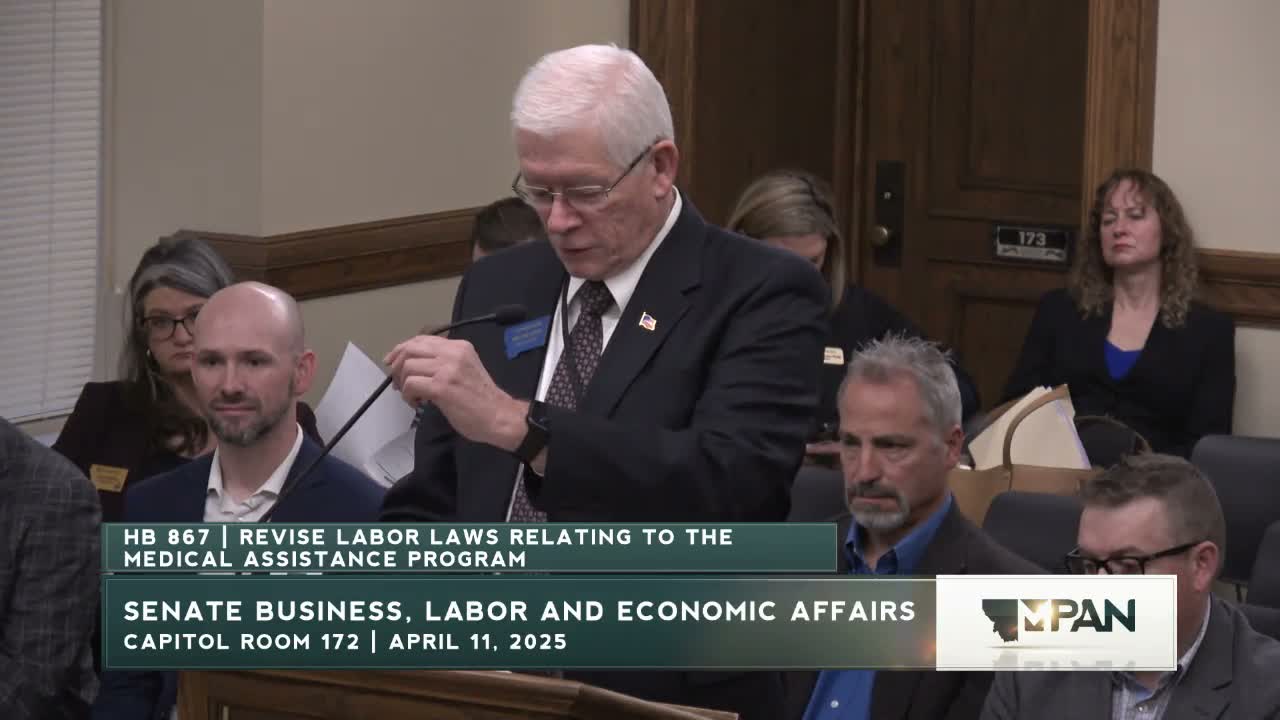
Representative Greg Oblander introduced House Bill 867 to the Senate Business and Labor Committee as a targeted change to the Montana Assistance Program (MAP) that would allow licensed chiropractors and veterinarians to participate when they face substance use or mental-health crises.
Sarah Swanson, commissioner of the Department of Labor and Industry, told the committee MAP is “for a practitioner when they are in crisis to preserve their license and their ability to work while ensuring that we’re also upholding our responsibility for public health and safety.” Swanson said the state contracts with a vendor, Maximus, to run MAP and that the fiscal estimate for adding the two license types is about $29,000; she said roughly $8,000 of that would be billed to the Board of Chiropractors and about $21,000 to the Board of Veterinarians, and that both boards have reserves large enough to cover the expense.
Multiple proponents with clinical experience described how self-referral and board-ordered enrollment work under the program. Kevin Bragg, bureau chief for professional licensing, said MAP allows both voluntary entry, when a licensee seeks help and is identified in the program by a number rather than a name, and a disciplinary track, where a board can order participation. Bragg also provided current program counts: he said there are about 70 active MAP participants across all included professions and a total licensee pool of roughly 40,179, with about 604 licensed chiropractors in the state.
Supporters said the change would help practitioners get treatment while maintaining patient access. Sarah Swanson and proponents emphasized that costs are borne by licensees who enter the program, and that program rules include close monitoring intended to protect the public.
Committee members asked about likely caseloads and complaint histories. Bragg said he expects only a small number of chiropractors or veterinarians would enroll annually — “a handful” — and provided complaint counts for the boards (six chiropractic complaints, 33 veterinary complaints in the prior year) but said revocation counts would have to be supplied later.
Representative Oblander closed by highlighting the self-referral option as an important patient- and practitioner-centered safeguard and asked for the committee’s support. The committee concluded the HB 867 hearing without a vote recorded in the hearing transcript.
The next procedural step if the committee advances the bill would be rulemaking by the Board of Chiropractors and the Department of Labor and Industry to establish the specific application, oversight and monitoring requirements described in the bill.