Get Full Government Meeting Transcripts, Videos, & Alerts Forever!
Get email alerts on the Employment Enforcement topic
No spam. Unsubscribe anytime.
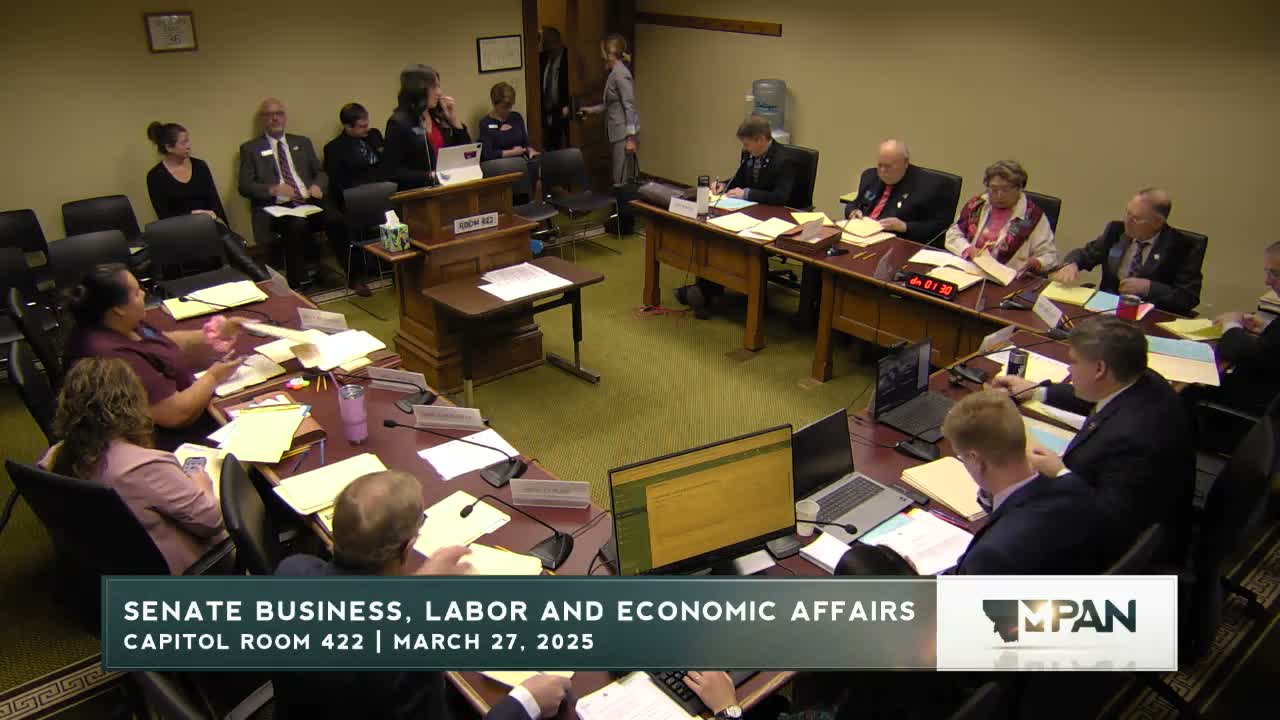
Panel debates enforcement bill allowing DLI to review I‑9 records, set penalties
Summary
Supporters said HB 226 gives the Department of Labor and Industry authority to inspect I‑9 or E‑Verify records and impose graduated penalties to curb illegal labor and labor trafficking; opponents raised concerns about differential liability between I‑9 and E‑Verify and the burden on small employers.
Representative Courtney Sprunger presented HB 226, the "legal employment and government accountability law," saying the bill "allows the Montana Department of Labor the ability to check for an employer's I‑9 or E‑Verify records for their employers as part of DLI's existing inspection process" to detect illegal employment and protect lawful businesses.
Proponents from the Montana Contractors Association, building trades and business groups backed the bill as a way to ensure fair competition. David Smith, executive director of the Montana Contractors Association, said members "support this bill" so long as it does not duplicate federal or existing state processes. Labor and industry stakeholders described the bill as a tool to catch bad actors, while preserving options such as E‑Verify for employers that choose it.
Don Cape of the Coalition for Safety and Justice testified in partial opposition, saying the bill's treatment of liability differs between using an I‑9 versus E‑Verify: "If you use an I‑9, you're still subject to liability, but if you use the E‑Verify system, you're not subject to liability. You're given a free pass," he said, asking why the bill would treat the two methods differently.
Quinlan O'Connor (DLI) explained enforcement and hearing procedures, including contested case processes under Title 2, Chapter 4, Part 6. Committee members pressed on the practical burdens for small businesses and the department's capacity; O'Connor said DLI expects to absorb the work using existing audit functions with an added FTE in the fiscal note and that penalties for third or subsequent violations could include $2,500 per individual employee and potential license revocation.
Committee discussion also addressed whether coordination with federal agencies (DOJ, ICE) was appropriate; the sponsor said she was open to coordination where needed but emphasized the bill's intent to use DLI's existing auditing mechanisms. The hearing closed without a vote; the committee requested written testimony from a participant with poor audio.