Get Full Government Meeting Transcripts, Videos, & Alerts Forever!
Get email alerts on the First Responder Mental Health topic
No spam. Unsubscribe anytime.
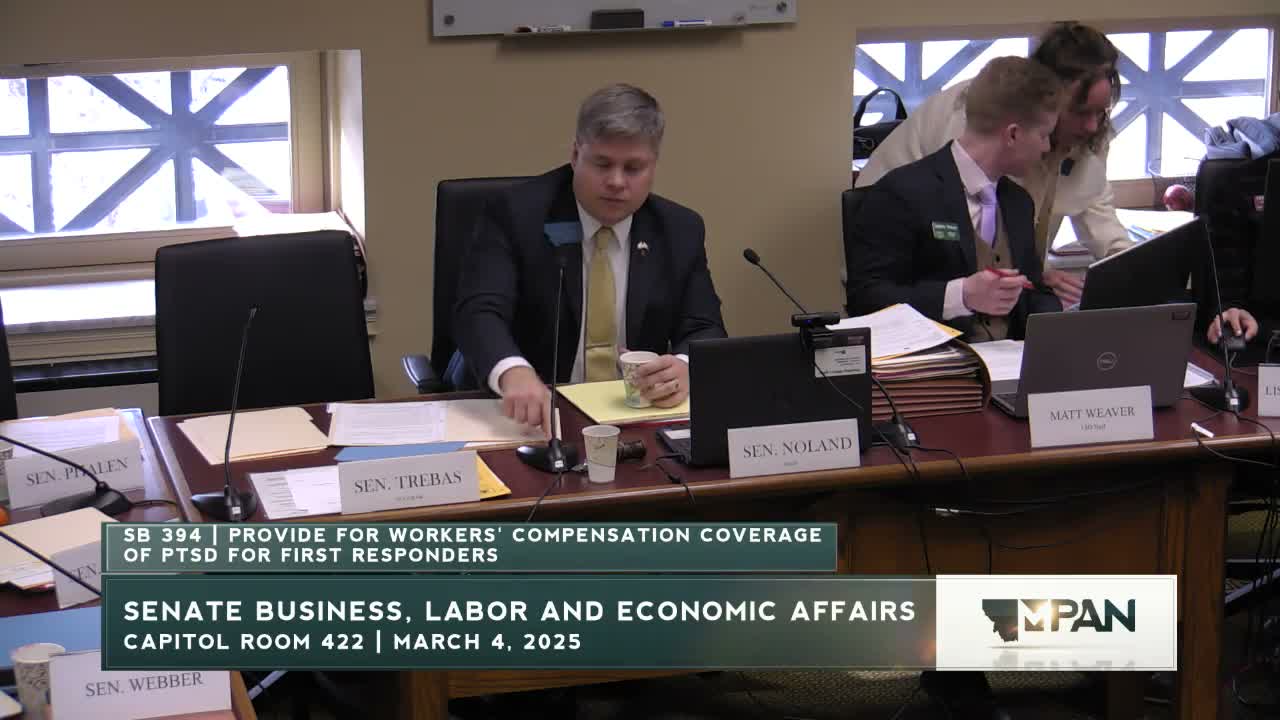
Committee hears PTSI workers—comp bill; proponents cite suicide, insurers highlight cost and legal issues
Summary
Senate Bill 394 would allow workers—comp to cover post-traumatic stress injuries (PTSI) for first responders. First-responder groups pressed for coverage, citing higher PTSD and suicide rates; insurers and self-insured entities warned of fiscal risk and potential equal-protection and program design issues.
Senator Cora Newman presented Senate Bill 394 to expand workers' compensation coverage to include post-traumatic stress injuries for defined "first responders". Newman described the epidemiology of repeated traumatic exposure among firefighters, law enforcement officers, EMTs and dispatchers and framed PTSI as an occupational injury requiring clinical treatment and time for recovery.
Proponents included the Montana State Firefighters Association, fire department chaplains, police associations and chiefs who provided personal and programmatic testimony about the clinical course of PTSI, successful return-to-duty after treatment and local gaps in access to behavioral health care. Joel Gaertig (MSFA) and others cited models in other states (Idaho, Texas, Georgia) and said early intervention reduces long-term disability.
Opponents — self-insured municipal pools, property casualty insurers and employer associations — said expanding first-party workers' compensation coverage to non-physical mental injuries would increase employer premiums and impose unpredictable lifetime benefit obligations. Peter Strauss (Montana Self-Insurance Association) and others suggested alternatives (Georgia—s state-backed program or targeted health-insurance reforms) and supplied anecdotal examples of large municipal claims in other states.
Informational witnesses (DLI legal counsel and Montana State Fund) summarized technical and constitutional issues in the current draft: an "unlawful delegation" concern around anchoring diagnosis to a moving edition of the DSM (fixable by statute), and potential equal-protection exposure from covering a specific occupational class; DLI counsel said those legal risks could be mitigated by drafting choices and severability mechanics. Actuarial contributors indicated NCCI modeling produced uncertain but non-negligible premium impacts, and the fiscal note reflected a number of assumptions.
Supporters asked the committee to prioritize the bill or consider amendments that clarify covered providers, diagnostic anchors and program scope; opponents urged further study of cost and design alternatives. The committee later voted SB394 out of committee during executive actions.