Get Full Government Meeting Transcripts, Videos, & Alerts Forever!
Get email alerts on the Right To Work topic
No spam. Unsubscribe anytime.
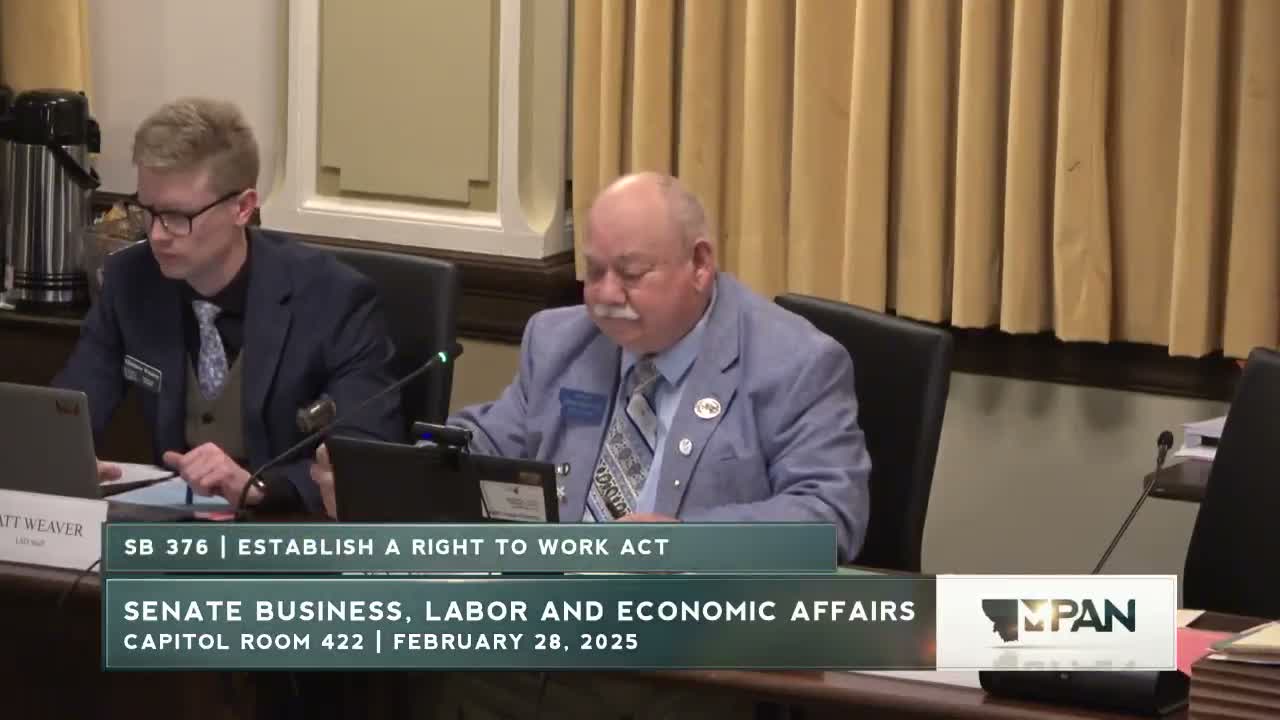
Senate committee hears hours of testimony on 'right-to-work' Senate Bill 376
Summary
Supporters argued Senate Bill 376 would protect workers' choice and spur job growth; labor unions, industry training programs and public-safety representatives warned it would weaken collective bargaining, jeopardize apprenticeship training and raise preemption and legal concerns.
Senate Bill 376, a proposal to prohibit agreements that require union membership or dues as a condition of employment, drew hours of testimony in the Senate Business, Labor and Economic Affairs Committee on Thursday.
Sponsor Senator Mark Noland opened the hearing by casting the measure as a freedom bill, saying the legislation would "ensure that no worker is compelled to support a labor union that he or she does not wish to join voluntarily." He cited state and regional income and employment statistics to argue right-to-work status helps attract business and raise household disposable income.
Proponents told the committee the bill would protect individual choice and improve Montana's economic competitiveness. Randy Pope of Montana Citizens for Right to Work said the bill "would protect every individual from being compelled to pay union dues or fees in order to work for a living," and John Kalb of the National Right to Work Committee repeated data-based claims about faster job growth in western right-to-work states.
Opponents included a long line of union leaders, rank-and-file members and several large employers and trade groups who urged the committee to reject the measure. Amanda Frickl of the Montana AFL-CIO said unions already operate on voluntary membership and warned SB 376 "creates barriers to workers who wish to join together to negotiate for fair wages and safe working conditions." She and other witnesses pointed to language in sections 8–9 that they said would impose criminal and civil penalties on labor activity, creating conflicts with federal law.
Several labor witnesses detailed how union-funded apprenticeship and training programs operate in Montana. Al Ekblad of Operating Engineers Local 400 told the committee the training network includes roughly 15 training centers with an investment the witnesses described as about $12,000,000 and training for roughly 900–1,000 apprentices at a time; opponents argued the bill would jeopardize those programs and raise safety and recruitment risks for critical trades such as electrical work, mining and construction.
Legal and procedural concerns were also emphasized. Testimony cited the National Labor Relations Act and federal preemption doctrines, with labor counsel warning that the bill would attempt to regulate subject matter long governed by federal law.
The committee did not take a vote during the hearing. The sponsor closed by asking members to consider the economic and individual-freedom arguments heard in proponents' testimony; opponents urged the committee to weigh practical impacts on training, wages and public safety before acting further.