Get Full Government Meeting Transcripts, Videos, & Alerts Forever!
Get email alerts on the Housing Fund topic
No spam. Unsubscribe anytime.
Senate committee advances $50 million proposal to capitalize Housing Montana Fund
Summary
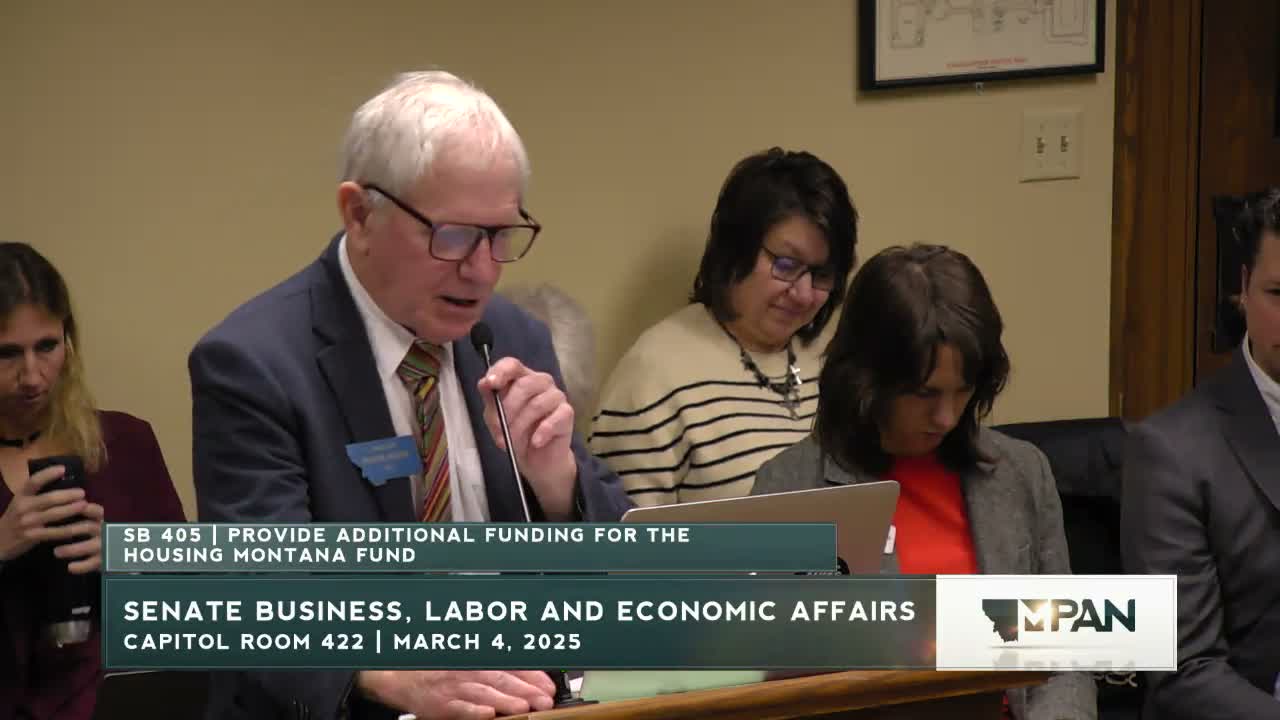
The Senate Business and Labor Committee advanced Senate Bill 405, which would direct a one-time $50 million general-fund appropriation to the Housing Montana Fund to provide flexible, revolving gap financing for affordable housing projects across the state.
Senator Dave Fern introduced Senate Bill 405 as a one-time $50 million appropriation from the state general fund to the Housing Montana Fund, a revolving loan vehicle created in 1999. Fern said the fund’s flexibility allows loans to both nonprofit and for-profit developers, offers sliding interest rates tied to average median income (AMI) tiers and can be combined with federal tax credits and private capital to fill final gaps in project financing.
Proponents — including housing advocates, developers and chambers of commerce — testified the appropriation would help communities leverage federal grants and bridge financing that many projects need to proceed. Aubrey Godbey of the Montana Budget & Policy Center highlighted that 46.6% of Montana renters are cost-burdened and said the state faces a large shortage of affordable rental units; Becky Brandborg, an affordable-housing developer, said Montana’s housing stock has not kept pace with population growth and cited a statewide deficit of roughly 10,000 housing units.
Cheryl Cohen, executive director of the Montana Board of Housing, told senators the fund would address "gap financing" needs, particularly when federal low-income housing tax credits (9% competitive and 4% bond-paired credits) do not cover full development costs. Cohen explained that the Board of Housing currently manages federal HOME and National Housing Trust Fund allocations that are heavily oversubscribed and that a flexible state source could enable projects that are otherwise stalled.
During questions, senators pressed staff and the sponsor about how SB405 would stack with earlier 2023 housing measures, whether the state’s coal-trust multifamily program and the Housing Montana Fund would compete, and how the fund would treat projects on tribal land. Cohen replied that both programs can operate on tribal land and noted statutory differences, including lien-position and property-tax expectations that make the Housing Montana Fund more flexible when private lenders will not subordinate.
Senator Fern closed by saying the bill grew from the governor—s housing task force and asked the committee to advance the measure to the floor. The committee later recorded a roll-call vote to pass SB405 out of committee.