Get Full Government Meeting Transcripts, Videos, & Alerts Forever!
Get email alerts on the Clean Indoor Air topic
No spam. Unsubscribe anytime.
Bill to create limited cigar-bar endorsements draws strong public-health opposition
Summary
Senator Wiley Galt’s proposal to allow narrowly defined cigar bars (age 21+, premium cigars, ventilation, liquor license) prompted extensive testimony from medical and public-health groups warning it would weaken Montana’s Clean Indoor Air Act and expose employees to secondhand smoke; sponsors say amendments are pending to narrow scope.
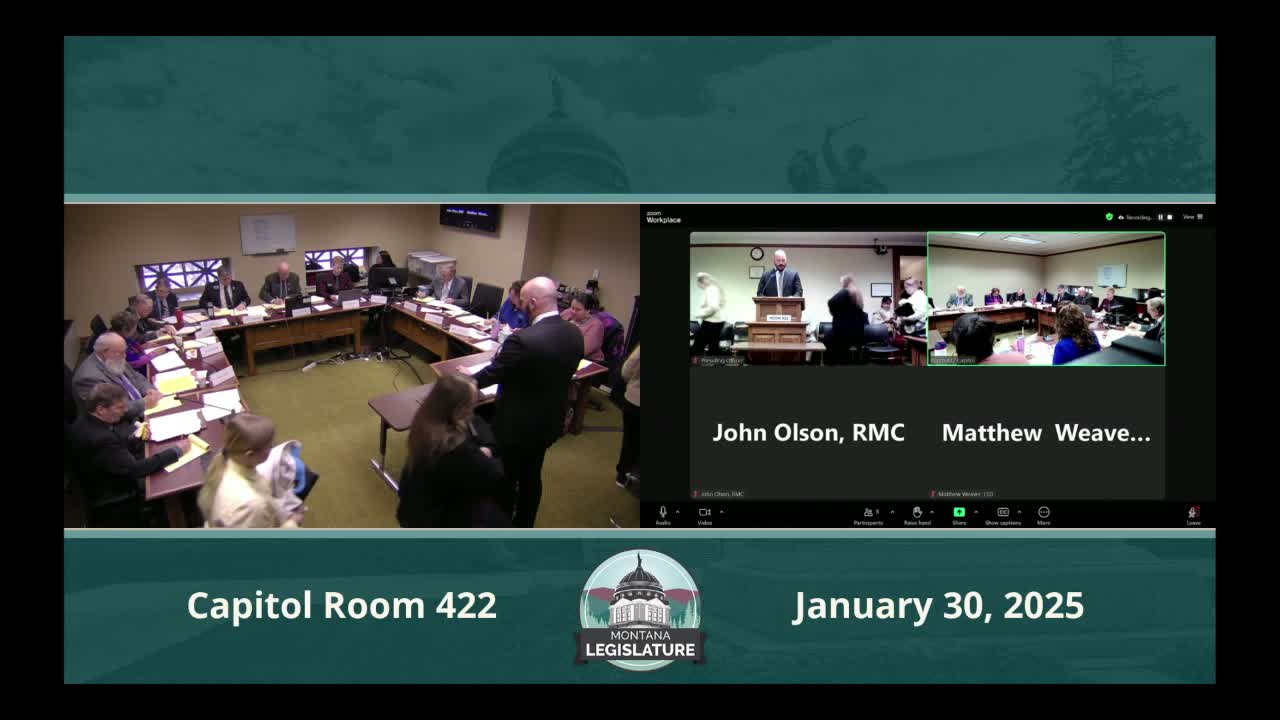
Senator Wiley Galt introduced Senate Bill 150 to the Senate Business and Labor Committee as a narrowly tailored measure allowing "cigar bar" endorsements for establishments with an all-beverages liquor license, a specific definition of premium cigars, and enhanced ventilation or a freestanding building.
"We tried to keep it as narrow as we could to keep it as small as possible," Galt said, describing requirements for a 21-and-over policy and a humidor and emphasizing the bill was modeled on language from another state.
The hearing drew substantial opposition from public-health organizations, clinicians and youth speakers. Dr. Richard Sargent, a retired family physician, urged the committee to reject the bill because ventilation cannot reliably eliminate carcinogenic secondhand smoke and doing so would undermine Montana’s Clean Indoor Air Act. "There is no way to safely ventilate a room of secondhand smoke," he testified, citing engineering standards and research on air exchanges.
Representatives of the American Heart Association, Confluence Public Health Alliance, the American Cancer Society, Americans for Nonsmokers’ Rights, the Montana Medical Association and others also opposed the bill, arguing it would create exemptions that weaken broad protections for workers and the public and could open the door to other carve-outs.
Multiple young people testified against the measure, saying the proposed carve-out would send a message that cigars are safer than cigarettes and risk increasing tobacco uptake among youth.
Industry and hospitality witnesses countered that the bill creates a narrow, regulated option tailored to premium hand-rolled cigars and that similar exceptions exist in other states. Jesse Luther (Hospitality and Development Association) said the draft requires an endorsement and ventilation; Will Israel (Montana Outfitters & Guides Association) and hospitality representatives argued it would support small businesses and tourism.
Informational witnesses included Nicole Aune of the Department of Public Health and Human Services (Montana Tobacco Use Prevention Program), who described the enforcement model for the Clean Indoor Air Act as complaint-driven and handled largely by local health departments, and Becky Schlau from the Department of Revenue Alcoholic Beverage Control, who said DOR enforcement would focus on licensing and suitability requirements.
Committee members pressed on specifics: who would enforce violations, how many endorsements the DOR might issue, whether the proposed ventilation would protect employees or nearby neighbors after exhausted air leaves the building, and when draft amendments would be available. Sponsor Galt said multiple amendments were in progress to tighten definitions, remove flavored-cigar language, adjust sales-threshold language and align DOR processes with the liquor system.
No formal committee vote was recorded during the hearing. The committee concluded the public testimony and the sponsor said he would circulate amendments for committee review.