Get Full Government Meeting Transcripts, Videos, & Alerts Forever!
Get email alerts on the Enterprise Budgets topic
No spam. Unsubscribe anytime.
Uxbridge reviews wastewater/water enterprise budgets; PFAS disposal, OPEB and indirect costs flagged as challenges
Summary
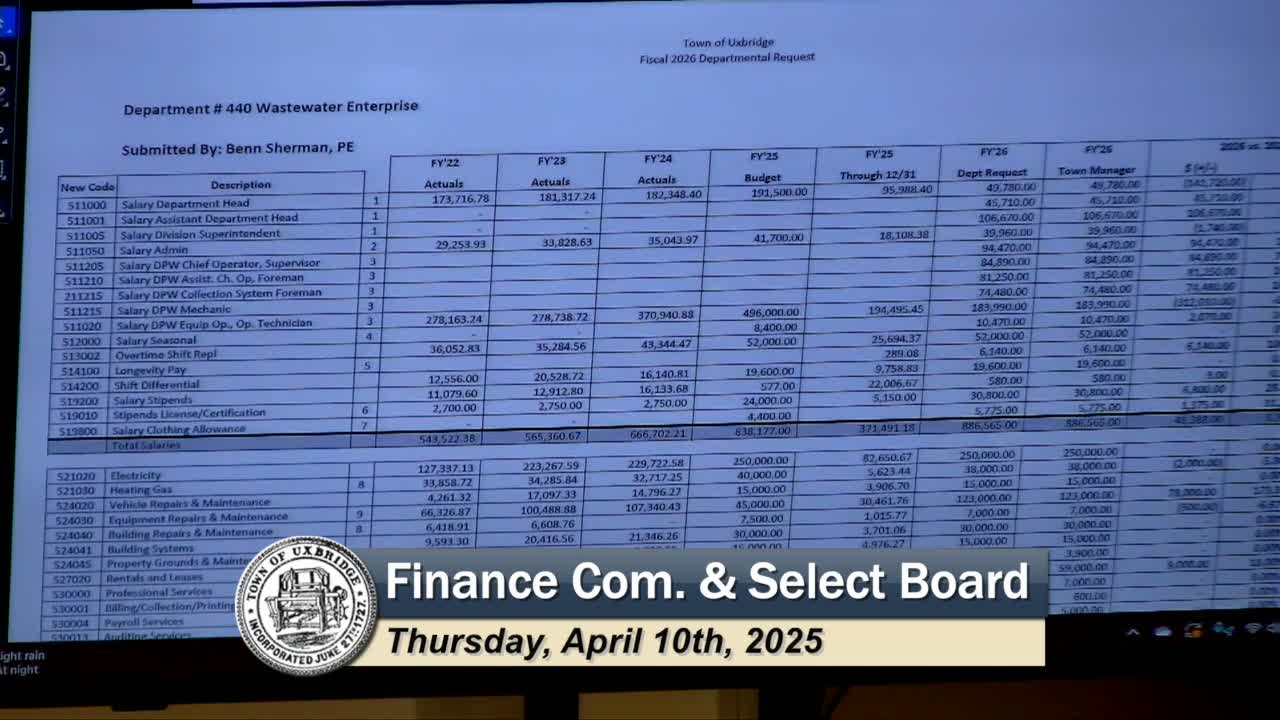
Finance staff presented FY26 enterprise budgets showing salary/benefit increases, new indirect allocations and uncertainty about PFAS‑related sludge disposal costs; committee asked staff for clearer rate impacts and requested documentation of indirect allocation methods.
The Uxbridge Finance Committee reviewed proposed FY26 enterprise budgets for wastewater, water and related DPW programs and heard staff warn that changing PFAS regulation and market constraints could raise long‑term disposal and operational costs.
Staff described budget drivers across enterprise funds: union contract adjustments and stipend/certification budgeting produced salary increases (wastewater salaries were described as increasing roughly $48,000, about 5.7%); professional services and reclassifications were used to show prior actuals more transparently; and new lines for retiree health and OPEB actuarial work were included to better align enterprise charges with actual costs.
On sludge disposal, staff noted the national and regional market is tightening: fewer vendors accept biosolids and federal/state standards for PFAS treatment and disposal are evolving, which complicates future cost projections. One staff member described the situation as concerning for larger facilities and said the industry is still adapting: "It's a scary... it keeps me up at night because it's changed in the time that I've been here," (paraphrased from the meeting).
The committee also reviewed capital and operating items: an ongoing inflow and infiltration (I&I) program, cloth filter replacement as a one‑time wastewater expense, and smaller capital items moved into operating budgets to smooth spending. Staff said they are implementing clearer indirect cost procedures and will provide spreadsheets and defendable calculations showing how central‑office allocations are apportioned to enterprise funds.
Members asked for clearer per‑customer rate impacts and schedule projections (staff projected construction completion in 2027 with debt service beginning in 2028 for the water project). The meeting also covered a townwide fleet maintenance initiative: the town recently hired an assistant mechanic to bring more vehicle repairs in‑house, purchase modest shop equipment (welding table, tire balancer, transmission jack) and to reduce outsourced labor costs for police and other departments; staff said early vendor invoice checks show substantial labor portions that could be saved by in‑house work.
Outcome: The committee requested detailed spreadsheets on indirect allocations, modelled rate impacts for the enterprise funds under several project packages (treatment plant base only; base+office; full scope) and OPEB/retiree cost schedules for inclusion in the continued hearing packet.