Get Full Government Meeting Transcripts, Videos, & Alerts Forever!
Get email alerts on the Septic Regulations topic
No spam. Unsubscribe anytime.
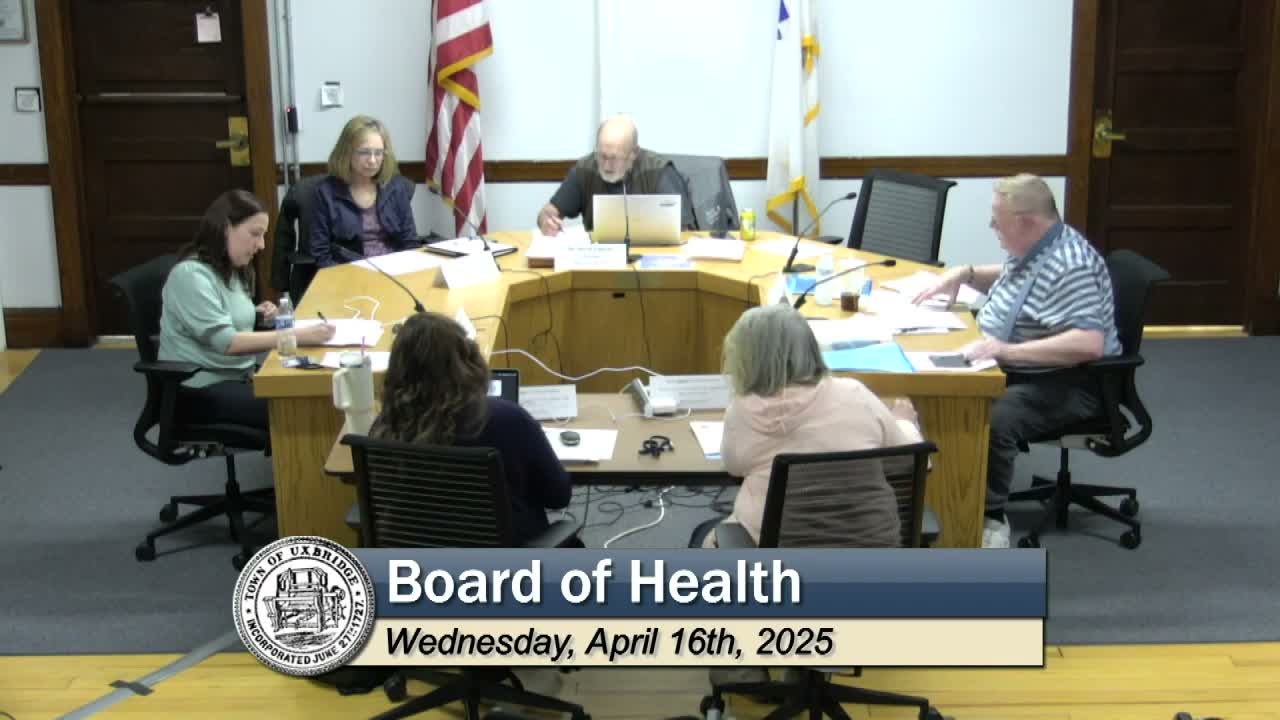
Uxbridge Board debates Article 11 septic changes and role of deed restrictions in permitting ADUs
Summary
Board reviewed proposed Article 11 edits to Title 5-based septic rules, sparking debate over deed restrictions to limit bedrooms for ADUs, enforcement practicality, and whether to delay a public hearing pending further guidance from the state.
The Uxbridge Board of Health spent a significant portion of its April meeting reviewing proposed edits to Article 11, the town's minimum requirements for subsurface septic systems, with members divided over how the rules should treat deed restrictions for accessory dwelling units (ADUs).
Board members discussed whether deed restrictions that limit the number of bedrooms on a parcel should be discouraged, narrowly permitted as exceptions, or simply "considered" rather than automatically allowed. Ray, a board member who helped draft earlier language, said he preferred warning and educating homeowners rather than preventing them from using deed restrictions if they choose: "We can warn them. We can educate them. But... people have the right to make that decision," he said.
Other members raised enforceability concerns. Several questioned how the board would verify a deed restriction remained effective over time if a future owner altered an interior layout without a building permit. Staff and members pointed out that occupancy and building permits generally tie into septic compliance: an owner cannot secure a certificate of occupancy without a functioning Title 5-compliant system.
Missy and other staff noted that Title 5 guidance published by the Commonwealth requires septic systems be sized to accommodate the number of bedrooms in the final house design and that deed restrictions historically have been reserved for specific, demonstrable situations (for example, properties requiring tight tanks near water bodies). The board discussed revising the Article 11 wording to make clear that soil-absorption systems must be designed for the final combined dwelling (primary house plus ADU) and to clarify definitions such as "final house design" and "facility."
Members agreed the changes require a public hearing under town rules and state notice requirements. Several members proposed postponing the hearing briefly to do a side-by-side comparison with Title 5 language and to watch for additional state Q&A guidance expected soon. The board directed staff to circulate a redline version and to prepare the public-notice materials, with the possibility of scheduling the hearing in June if state guidance does not arrive promptly.
The discussion ended without a formal vote on the substance of the Article 11 changes; the board asked staff to refine definitions and legal clarifications for the next meeting.