Get Full Government Meeting Transcripts, Videos, & Alerts Forever!
Get email alerts on the Tobacco Control topic
No spam. Unsubscribe anytime.
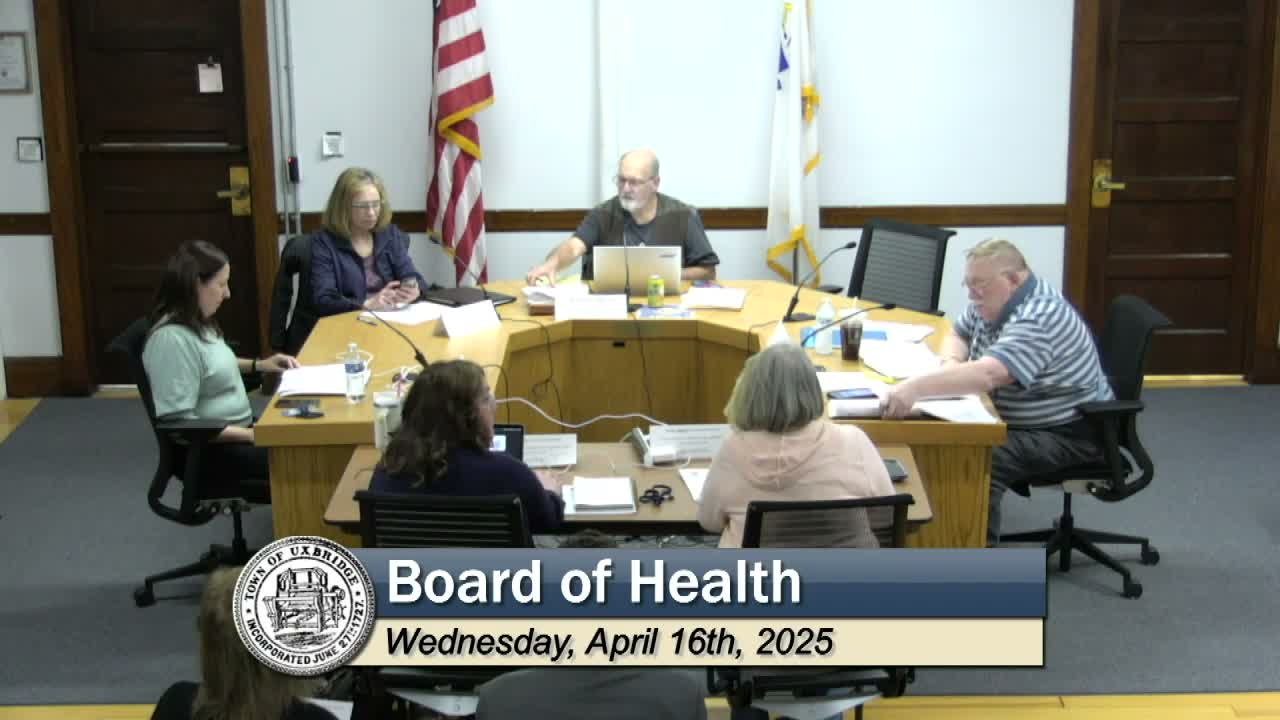
Uxbridge Board of Health debates scope of tobacco enforcement after withdrawal of warning is recorded in state database
Summary
Board members, tobacco-control agents and the Board's attorney discussed whether a prior vote to withdraw a warning effectively removes an inspection from the state record; staff said inspections and photos remain in the state database though the board's hearing outcome can be recorded.
The Uxbridge Board of Health spent its April meeting clarifying how local enforcement interacts with the state's tobacco-inspection system, after the board voted at a prior meeting not to issue a formal order in a coupon-advertising case.
Joan Hamlet, director of the Tobacco Control Alliance and the town's delegated tobacco agent, told the board her program provides education, youth-access checks, retail inspections and enforcement on behalf of towns that sign onto the alliance. "We are a free tobacco control agent... we provide tobacco inspection, education, and services for you," Hamlet said, describing a largely education-focused approach that reserves fines as a last resort.
Hamlet and other staff explained that a 2020 state law increased penalties and that local inspections are recorded in a state database with time-stamped photos and geo-coordinates. She said the database entry for a verbal warning or inspection cannot be erased, even when a board later finds "no violation," but that staff can record the board's hearing outcome in the entry.
Board members expressed differing views about whether the board had acted consistently with its role. "I have a problem upholding it," said Ray, who argued elected boards should be able to exercise discretion and avoid imposing severe penalties on small businesses for apparent upstream errors by distributors or manufacturers. Another member, Barry, questioned whether a local vote meaningfully altered consequences if the inspection and photo remained in the state record: "We made a decision, but, realistically, our decision almost is null and void because the minute the photo is taken ... it goes directly to the database."
Town legal counsel and program attorney Chris Banthin said boards retain the right to evaluate inspection procedures, hold hearings and make factual determinations about whether a sale occurred. He also said that for certain statutory violations (for example, a confirmed sale to a minor) the code requires a fine, but that other violations allow more local discretion.
Staff described practical steps they are taking to reduce inadvertent violations: distributing educational packets to retailers, providing sample 8-by-10 signage that clarifies the town does not honor discounts that are illegal in Massachusetts, and working with retailers on register procedures so discounts do not get applied at checkout. Hamlet offered to print and circulate the specific database entry that recorded the inspection and the board's hearing outcome.
Board members asked the tobacco-control program for a concise written summary of the database entries and sought guidance from counsel about legal implications. The board did not reverse its earlier motion at the meeting; members asked for legal feedback and to move forward with outreach and education to local retailers.
The Board of Health agreed to request written clarification from staff and counsel and to revisit enforcement wording if needed, while continuing to emphasize retailer education as its first line of response.